A-40 Mermaid
Soviet/Russian jet-powered amphibious flying boat, developed in the late 1980s for anti-submarine warfare and patrol duties. Key figures: top speed 800 km/h, range 4,100 km, service ceiling 9,700 m, max takeoff weight 86,000 kg, built 2.
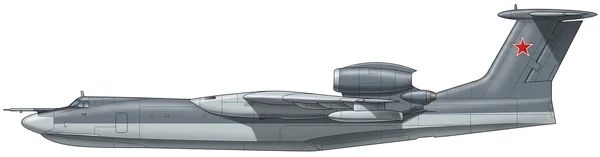
| Crew | 8 |
| Length | 43.8 m (143.8 ft) |
| Wingspan | 41.6 m (136.5 ft) |
| Height | 11 m (36.1 ft) |
| Wing area | 200 m² (2152.8 sqft) |
| Max. takeoff weight | 86,000 kg (189,597 lbs) |
| Powerplant | 2 × turbofans Soloviev D-30KPV 117 kN each |
| Maximum speed | 800 km/h (497 mph) |
| Operational range | 4,100 km (2,548 mi) |
| Service ceiling | 9,700 m (31,824 ft) |
| Climb rate | 30.0 m/s (98.4 ft/s) |
- Anti-Ship Kh-35
- Air-to-Surface Korshun
- Unguided Bomb depth charges
- Unguided Bomb mines
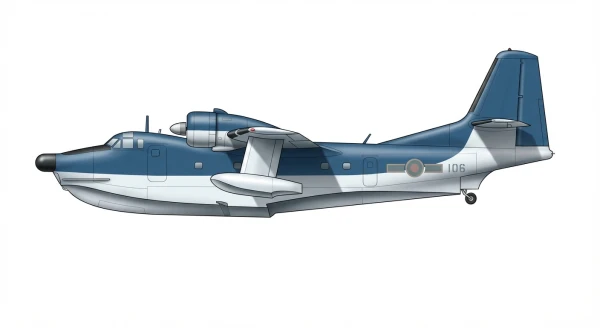
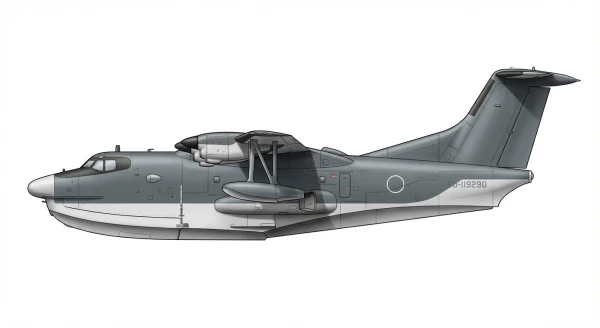
Description
The Beriev A-40 Albatros (NATO reporting name: Mermaid) is a Soviet/Russian jet-powered amphibious flying boat developed by the Beriev Aircraft Company for an anti-submarine warfare role. Intended to replace the Beriev Be-12 and Ilyushin Il-38, the project was suspended following the breakup of the Soviet Union after only one prototype was completed and a second reached 70% completion. Between 1989 and 1998, the aircraft set 140 world records.
Development
The A-40 made an unplanned maiden flight in 1986 when it inadvertently became airborne during high-speed taxi testing. By 1990, two distinct variants were planned: the A-42 search and rescue amphibian and the A-44 maritime patrol version, which were combined into a single project in 1993 before work halted. The initial A-40 prototype was restored to airworthiness in 2002, and the A-42 prototype was completed in 2006. In September 2019, the Russian Navy announced an order for three A-42 aircraft configured with Progress D-27 propfan engines, though the Ukrainian factory specified to build these engines was destroyed in May 2022.
Design
The A-40 is an all-metal flying boat featuring high-set swept wings with a marked anhedral angle and balance floats mounted beneath each wingtip. Primary propulsion is provided by two Soloviev D-30KPV turbofans mounted above the wing roots atop the landing gear nacelles, supplemented by two Rybinsk RD-36-35 turbojet engines acting as takeoff boosters. Avionics and system upgrades designed for the platform include a navigation complex for measuring sea waves, heat seekers, updated communications equipment, and a radar system integrated with a viewing sight.
Armament
The projected anti-submarine warfare configuration incorporates an internal bomb bay for sonobuoys, depth charges, and naval mines. The internal bay is also designed to hold either three Orlan torpedoes or six Korshun guided missiles, while underwing pylons provide capacity for Kh-35 anti-ship missiles.
Variants
-
A-40: Initial anti-submarine warfare amphibian with one completed prototype and a second built to 70% completion.
-
A-40P: Firefighting and maritime patrol design concept designed to scoop 25 tonnes of water or compete directly with the Tu-204P.
-
A-40PM: Projected 105-passenger civil transport study from 1994 that provided the baseline design for the Beriev Be-200.
-
A-42: Search and rescue variant created to replace the Be-12PS, later developed into a propfan-powered multi-role aircraft.
-
A-44: Dedicated maritime patrol version designed alongside the A-42 prior to the program merger in 1993.
Frequently Asked Questions
What type of aircraft is the A-40 Mermaid?
What is the maximum speed of the A-40 Mermaid?
What is the range of the A-40 Mermaid?
When did the A-40 Mermaid first fly?
How many A-40 Mermaid have been built?
What is the service ceiling of the A-40 Mermaid?
- AUG 62026 Created Page created: A-40 Mermaid