Mudry CAP 10
French two-seat aerobatic training aircraft, developed in the late 1960s and widely used for civilian and military flight training. Key figures: top speed 270 km/h, range 1,200 km, service ceiling 5,000 m, max takeoff weight 760 kg, built 300. In service with 2 air forces as of 2026 — France (6), Morocco (2).
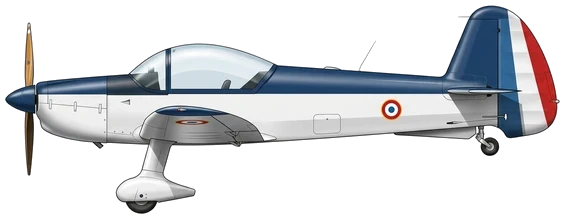
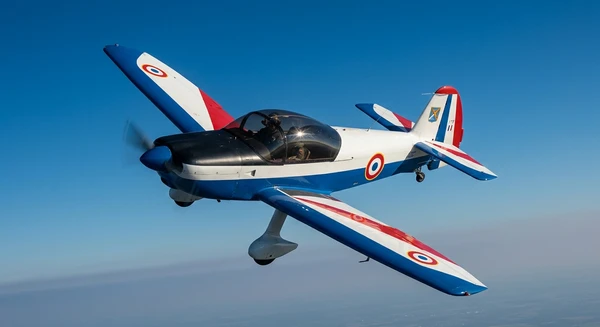
| Crew | 2 |
| Length | 7.2 m (23.5 ft) |
| Wingspan | 8.1 m (26.4 ft) |
| Height | 2.6 m (8.4 ft) |
| Wing area | 10.9 m² (116.8 sqft) |
| Empty weight | 540 kg (1,190 lbs) |
| Max. takeoff weight | 760 kg (1,676 lbs) |
| Powerplant | 1 × Lycoming AEIO-360-B2F 134 kW each |
| Maximum speed | 270 km/h (168 mph) |
| Operational range | 1,200 km (746 mi) |
| Service ceiling | 5,000 m (16,404 ft) |
| Climb rate | 6.0 m/s (19.7 ft/s) |


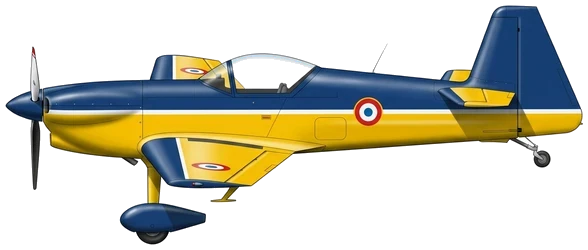
Description
The Mudry CAP 10 is a French two-seat aerobatic training aircraft developed from the Piel Super Emeraude. Originally designated as the CP100, the prototype first flew in August 1968. The designation subsequently changed to CAP 10, standing for "Constructions Aéronautiques Parisiennes." Manufactured initially by Mudry in Bernay, France, production was later managed by CAP Industries and Apex Aircraft. Following the bankruptcy of Apex in 2008, Dyn'Aviation acquired the rights to produce spare parts, which were subsequently taken over by CEAPR in 2012. Robin Aircraft began producing an updated version of the aircraft in 2021. More than 300 aircraft were built between 1970 and 2007.
Design
The CAP 10 is a low-wing cantilever monoplane of wooden construction, though later variants incorporate carbon composite materials. It features a NACA 23012 airfoil, a fixed-pitch two-bladed Hoffmann wooden propeller, and is powered by a 180 hp Lycoming AEIO-360 fuel-injected piston engine equipped with a lubrication system configured for inverted flight.
Operational History
In military service, the CAP 10 is utilized primarily for flight screening, grading, and aerobatic training. The French Navy acquired six CAP 10S aircraft in 1980 for flight initiation and student selection, which are operated by the EIP 50S unit. The Mexican Air Force purchased 20 aircraft in 1982, operating them until 1998. In Australia, BAE Training Systems operates three aircraft in Tamworth to conduct flight screening for the Royal Australian Air Force, Royal Australian Navy, and Australian Army. Other military operators include the French Air and Space Force, South Korea, and Morocco, where the aircraft equips the Equipe Voltige aerobatic display team.
Variants
- CAP 10: The initial production variant, which was fundamentally the third prototype.
- CAP 10B: A later production model featuring a ventral fin and an enlarged rudder.
- CAP 10C: An improved model incorporating a carbon-fibre wing spar for enhanced structural strength.
- CAP 10C NG: An updated version of the CAP 10C produced by Robin Aircraft since 2021.
- CAP 10S: A specialized version ordered by the French Navy for pilot selection and flight initiation.
Frequently Asked Questions
What type of aircraft is the Mudry CAP 10?
What is the maximum speed of the Mudry CAP 10?
What is the range of the Mudry CAP 10?
When did the Mudry CAP 10 first fly?
How many Mudry CAP 10 have been built?
Which countries operate the Mudry CAP 10?
What is the service ceiling of the Mudry CAP 10?
- JUL 272026 Updated Name updated
- JUL 12026 Created Page created: CAP 10