DHC-4 Caribou
Canadian twin-engine short takeoff and landing (STOL) tactical transport aircraft, developed in the late 1950s and widely operated for military cargo and rugged bush operations. Key figures: top speed 346 km/h, range 2,104 km, service ceiling 7,600 m, max takeoff weight 12,927 kg, built 307.
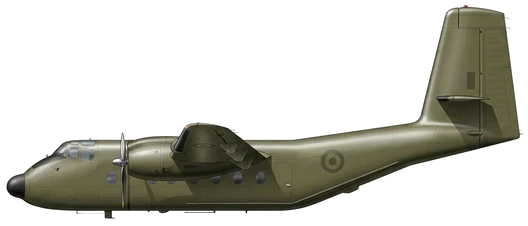
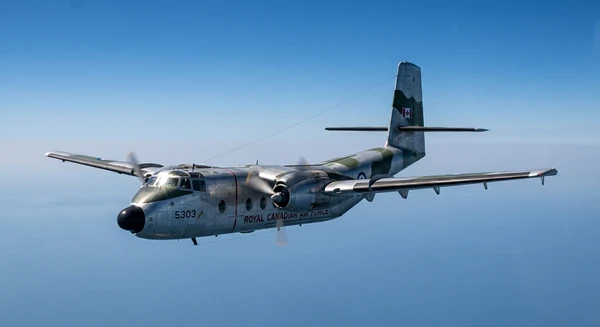
| Crew | 3 (2 pilots, loadmaster) |
| Length | 22.1 m (72.6 ft) |
| Wingspan | 29.1 m (95.6 ft) |
| Height | 9.7 m (31.8 ft) |
| Wing area | 84.7 m² (911.7 sqft) |
| Empty weight | 8,283 kg (18,261 lbs) |
| Max. takeoff weight | 12,927 kg (28,499 lbs) |
| Powerplant | 2 × Pratt & Whitney R-2000-7M2 Twin Wasp 1,080 kW each |
| Maximum speed | 346 km/h (215 mph) |
| Operational range | 2,104 km (1,307 mi) |
| Service ceiling | 7,600 m (24,934 ft) |
| Climb rate | 6.88 m/s (22.6 ft/s) |
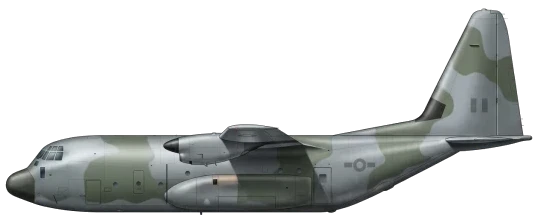
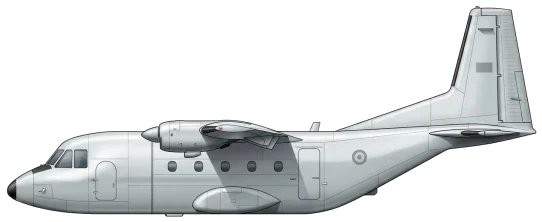
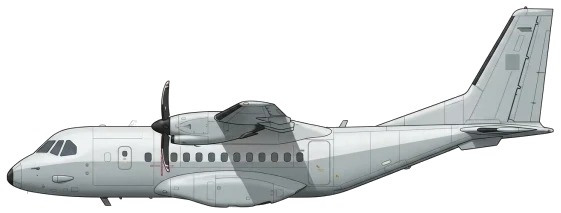
Description
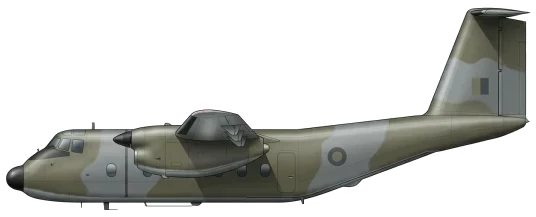
The de Havilland Canada DHC-4 Caribou is a twin-engine short takeoff and landing (STOL) tactical transport aircraft. Developed by de Havilland Canada as its third STOL design, the DHC-4 was designed as a rugged utility aircraft to supply battlefronts and evacuate casualties. The prototype demonstrator conducted its first flight on 30 July 1958. U.S. civil certification was awarded on 23 December 1960. The United States Army became the largest operator of the type, ordering five YAC-1 evaluation aircraft and subsequent production models, eventually purchasing 159 aircraft.
Design
The DHC-4 is constructed for operation on runways as short as 1,200 feet (365 meters). It features a rear loading ramp suitable for cargo loading and parachute dropping. The aircraft has a wingspan of 95 feet 7.5 inches (29.147 meters) and a length of 72 feet 7 inches (22.12 meters). Power is provided by two Pratt & Whitney R-2000-7M2 Twin Wasp 14-cylinder air-cooled radial piston engines, each producing 1,450 hp and driving three-bladed Hamilton Standard fully-feathering, constant-speed, reversible-pitch propellers. Standard avionics include blind flying instrumentation. The DHC-4 carries up to 32 troops, 26 paratroops, 22 stretchers, or two light vehicles, with a maximum payload capacity of 8,740 lb (3,964 kg).
Operational History
During the Vietnam War, United States and Australian military services deployed the Caribou, utilizing its STOL capabilities to operate from airstrips unusable by larger C-123 and C-130 transports. Following the Johnson-McConnell agreement of 1966, the U.S. Army transferred its Caribou fleet to the United States Air Force on 1 January 1967. The USAF phased out the type in the 1980s, transferring them to Air Force Reserve and Air National Guard units. The final U.S. military Caribou served with the U.S. Army's Golden Knights parachute team until 1985. The Royal Australian Air Force retired its final aircraft in November 2009. Other export customers included Canada, India, Malaysia, Spain, Kenya, and Ghana. Civil operators, including Air America and Ansett-MAL, operated the type in rugged regions.
Variants
- CC-108: Royal Canadian Air Force designation for the DHC-4 Caribou.
- CV-2B: United States Army designation for the second production run of 103 aircraft featuring reinforced internal ribbing.
- C-7A/B: Designations applied to the 144 Caribou transferred from the U.S. Army to the United States Air Force in 1967.
- DHC-4A Caribou: Version similar to the baseline DHC-4 but featuring an increased takeoff weight.
- DHC-4T Turbo Caribou: Conversion powered by PWC PT6A-67T turboprop engines, designed and certified by Pen Turbo Aviation.
Frequently Asked Questions
What type of aircraft is the DHC-4 Caribou?
What is the maximum speed of the DHC-4 Caribou?
What is the range of the DHC-4 Caribou?
When did the DHC-4 Caribou first fly?
How many DHC-4 Caribou have been built?
Which countries operate the DHC-4 Caribou?
What is the service ceiling of the DHC-4 Caribou?
- AUG 12026 Updated Manufacturer updated
- JUL 232026 Updated Sources and cross-references refreshed
- JUN 302026 Created Page created: DHC-4 Caribou