Westland Wasp
British turbine-powered, shipboard anti-submarine helicopter, developed in the 1960s, used primarily for maritime operations. Key figures: top speed 193 km/h, range 487 km, service ceiling 3,700 m, max takeoff weight 2,495 kg, built 133.
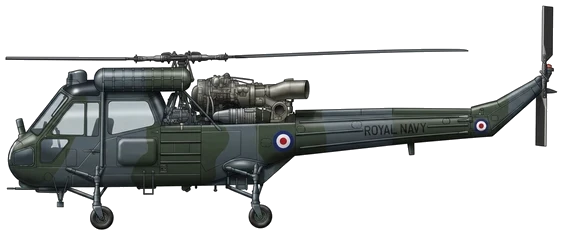
| Crew | 2 (pilot, aircrewman) |
| Length | 12.3 m (40.3 ft) |
| Wingspan | 9.8 m (32.3 ft) |
| Height | 2.7 m (8.9 ft) |
| Wing area | 75.9 m² (816.9 sqft) |
| Empty weight | 1,566 kg (3,452 lbs) |
| Max. takeoff weight | 2,495 kg (5,501 lbs) |
| Powerplant | 1 × Rolls-Royce Nimbus 103 530 kW each |
| Maximum speed | 193 km/h (120 mph) |
| Operational range | 487 km (303 mi) |
| Service ceiling | 3,700 m (12,139 ft) |
| Climb rate | 7.3 m/s (24.0 ft/s) |
- Unguided Bomb Mk 11 depth charge
- Nuclear WE.177 Nuclear Depth Bomb
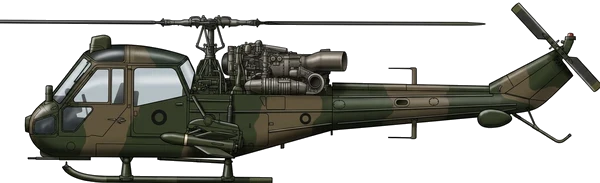
Description
The Westland Wasp was a British shipboard anti-submarine helicopter developed by Westland Helicopters from the Saunders-Roe P.531 programme and based on the piston-engined Saunders-Roe Skeeter. It was designed to meet a Royal Navy requirement for a Manned Torpedo-Carrying Helicopter (MATCH). The first prototype Saro P.531 flew on 20 July 1958, and two pre-production aircraft flew on 28 October 1962. A total of 133 aircraft were produced, including 98 for the Royal Navy.
Design
The Wasp was powered by a Rolls-Royce Nimbus 103 turboshaft engine de-rated to 710 shp. Lacking onboard sonar, the helicopter relied on external targeting data to deliver weapons. To operate from pitching flightdecks, it featured a four-wheeled castering undercarriage, negative rotor pitch for deck adhesion, and foldable main rotor blades and tail boom. Additional features included a starboard winch, an under-fuselage cargo release unit, floor fuel tanks, emergency floats, and a cockpit-roof aimer's sight. The cabin accommodated a pilot, an aircrewman, and up to three passengers or a single stretcher.
Armament
The aircraft carried two Mk 44 torpedoes, one Mk 46 torpedo, two Mk 11 depth charges, or a WE.177 nuclear depth bomb. For surface targets, it was armed with four Nord SS.11 or two AS.12 wire-guided missiles, an L7 GPMG, flares, and smoke or flame floats.
Operational History
The Royal Navy introduced the Wasp in 1964 and retired the type in 1988. On 25 April 1982, three Wasps launched from HMS Plymouth and HMS Endurance attacked the Argentinian submarine ARA Santa Fe with AS.12 missiles in South Georgia, disabling the vessel. Export operators included the Netherlands, which flew 12 AH-12As from 1966 to 1981; New Zealand, which operated 19 aircraft from 1966 to 1998; and South Africa, which received ten aircraft in 1963 and six of an ordered eight from 1973, retiring them in 1990. Brazil operated the type from destroyers and frigates, Malaysia operated Wasps from 1988 to 1998, and Indonesia operated refurbished ex-Dutch aircraft until 1998.
Variants
Frequently Asked Questions
What type of aircraft is the Westland Wasp?
What is the maximum speed of the Westland Wasp?
What is the range of the Westland Wasp?
When did the Westland Wasp first fly?
How many Westland Wasp have been built?
Which countries operate the Westland Wasp?
What is the service ceiling of the Westland Wasp?
- JUL 272026 Updated Name updated
- JUL 232026 Updated Sources and cross-references refreshed
- JUL 12026 Created Page created: Wasp