DHC-8 Dash 8
Canadian turboprop-powered regional airliner, widely adopted globally for short-haul commuter flights throughout the late 20th century. Key figures: top speed 451 km/h, range 1,600 km, service ceiling 9,144 m, max takeoff weight 15,649 kg, unit price $27M, built 1,258. In service with 5 air forces as of 2026 — Canada (4), United States (4), Kenya (3) and 2 others.
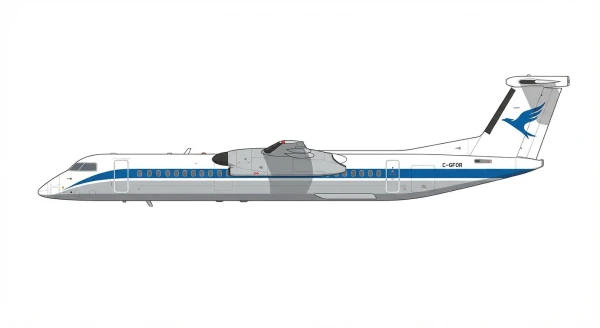
| Length | 22 m (72.2 ft) |
| Wingspan | 26 m (85.3 ft) |
| Height | 7.5 m (24.6 ft) |
| Wing area | 54.4 m² (585.6 sqft) |
| Empty weight | 14,787 kg (32,600 lbs) |
| Max. takeoff weight | 15,649 kg (34,500 lbs) |
| Powerplant | 2 × turboprops Pratt & Whitney Canada PW-120A 1,342 kW each |
| Maximum speed | 451 km/h (280 mph) |
| Operational range | 1,600 km (994 mi) |
| Service ceiling | 9,144 m (30,000 ft) |


Description
In the 1970s, de Havilland Canada's focus on STOL capabilities with the four-engine Dash 7 did not achieve widespread market acceptance primarily due to associated operational costs. By 1980, DHC redirected its development efforts towards reducing these costs. This involved adapting the Dash 7 design and reducing the engine count to two. Pratt & Whitney Canada developed the PW100 series engines, specifically tailored for this new aircraft, providing significantly increased power compared to the PT6. Initially designated as the PT7A-2R, this engine was later redesignated the PW120. The Dash 8 was unveiled on April 19, 1983. Leading up to the unveiling, over 3,800 hours of testing had been completed on five PW100 series test engines over a two-year period. The Dash 8's maiden flight occurred on June 20, 1983, and the PW120 engine received certification on December 16, 1983. Commercial operations commenced in 1984 with NorOntair, followed by Piedmont Airlines as the first US customer in the same year.
Design
The Dash 8 incorporates several distinctive design features. A prominent T-tail design helps to position it above the prop wash during takeoff. The wing exhibits a very high aspect ratio. Elongated engine nacelles are also designed to accommodate the rearward-folding main landing gear. These design elements contribute to the aircraft's overall performance and operational characteristics. Compared to the Dash 7, the Dash 8 design offers improved cruise performance, lower operating expenses, and substantially reduced maintenance costs, largely attributable to its twin-engine configuration.
Operational History
Since its introduction in 1984, the De Havilland Canada DHC-8 has been employed across a wide array of roles globally. It has been widely adopted by regional airlines for operation on short- to medium-haul routes connecting smaller communities to larger air transportation hubs. The aircraft's operational strengths include fuel efficiency, high reliability, and the capacity to operate from shorter runways than those required by most regional jets. Its operational characteristics also include a higher cabin noise level compared to jet aircraft and a slower cruise speed; however, the Q400 series implemented a noise mitigation system to bring cabin noise closer to jet standards. Beyond commercial passenger transport, military and government agencies utilize various Dash 8 models for specialized roles such as range control during live-fire exercises (e.g., the United States Air Force E-9A Widget), maritime surveillance, pollution control, navigation training, and general utility transport. As of 2024, the Dash 8 remains in extensive service worldwide, with new orders reflecting continued demand for the platform.
Variants
Main Variants:
-
Series 100: The initial production variant, accommodating 37-39 passengers and powered by Pratt & Whitney Canada PW120 engines, entered service in 1984.
-
Series 200: Utilizing the same airframe as the Series 100, this variant was equipped with more powerful Pratt & Whitney Canada PW123 engines to enhance performance.
-
Series 300: Featuring an airframe stretched by 3.43 meters relative to the Series 100/200, this variant carries 50–56 passengers and is powered by Pratt & Whitney Canada PW123 engines.
-
Series 400: This series features an airframe stretched 6.83 meters beyond the Series 300, incorporating a larger wingspan and a reinforced T-tail, accommodating 68–90 passengers and powered by Pratt & Whitney Canada PW150A engines.
-
Q400: An extended and refined version accommodating 70–78 passengers, introduced in 2000, distinguished by its Active Noise and Vibration Suppression (ANVS) system designed to reduce cabin noise levels.
Frequently Asked Questions
What type of aircraft is the DHC-8 Dash 8?
What is the maximum speed of the DHC-8 Dash 8?
What is the range of the DHC-8 Dash 8?
When did the DHC-8 Dash 8 first fly?
How many DHC-8 Dash 8 have been built?
Which countries operate the DHC-8 Dash 8?
How much does a DHC-8 Dash 8 cost?
What is the service ceiling of the DHC-8 Dash 8?
- APR 72026 Updated Picture credits updated in a site-wide editorial pass
- JAN 202026 Updated Range added