Fokker 50
Dutch turboprop airliner, production from 1980s-2010s, globally adopted for regional flights and maritime patrol duties. Key figures: top speed 526 km/h, range 1,700 km, service ceiling 7,620 m, max takeoff weight 20,820 kg, unit price $6M, built 213. In service with 3 air forces as of 2026 — Singapore (9), Peru (5), Taiwan (3).
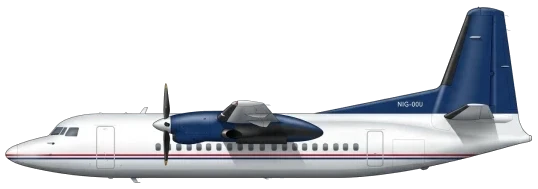
| Length | 25.3 m (82.8 ft) |
| Wingspan | 29 m (95.1 ft) |
| Height | 8.3 m (27.3 ft) |
| Wing area | 70 m² (753.5 sqft) |
| Empty weight | 12,250 kg (27,007 lbs) |
| Max. takeoff weight | 20,820 kg (45,900 lbs) |
| Powerplant | 2 × turboprops Pratt & Whitney Canada PW125B 1,864 kW each |
| Maximum speed | 526 km/h (327 mph) |
| Operational range | 1,700 km (1,056 mi) |
| Service ceiling | 7,620 m (25,000 ft) |


Description
By the early 1980s, Dutch aircraft manufacturer Fokker recognized declining sales of its Fokker F27 Friendship. In November 1983, it initiated two development projects: the Fokker 100 to succeed the F28, and the Fokker 50 as a successor to the F27. The Fokker 50 combined refinements and improvements to the F27, reducing fuel consumption by 30% through modifications such as the adoption of Pratt & Whitney Canada PW127B turboprop engines. Fokker partnered with SABCA (Belgium), Dassault Aviation (France), Messerschmitt-Bölkow-Blohm (Germany), and Fuji Heavy Industries (Japan) to manufacture aircraft portions. Two prototypes, derived from F27 airframes, were produced, with the first maiden flight on 28 December 1985. Certification by the Dutch aviation authority RLD was completed in 1987, and the first production aircraft was delivered to German airline DLT Luftverkehrsgesellschaft (DLT).
Design
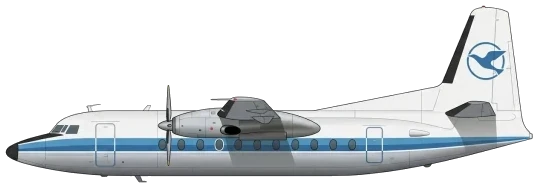
The Fokker 50 is a twin turboprop-powered airliner based on the earlier Fokker F27 Friendship, specifically the stretched F27-500 model. Structurally similar to its predecessor, the Fokker 50 incorporates advancements such as composite materials, hot-bonded structures, and anti-corrosion treatments. Key design changes include wing endplates acting as winglets, a larger number of smaller windows in the fuselage, and a new two-wheel nose gear configuration for stable operations in crosswind conditions. The adoption of more fuel-efficient Pratt & Whitney Canada PW124 turboprop engines, each capable of generating 1,864 kW (2,500 hp), driving six-bladed Dowty Rotol propellers, represents a notable change from the F27. The Fokker 50 features a glass cockpit incorporating an electronic flight instrument system and an automatic flight control system certified for Cat II approaches. The flying controls include a single lever for controlling both engine power and actuating the variable-pitch propellers.
Operational History
The Fokker 50 was primarily designed for civil passenger or cargo transport and was not equipped with internal weapons bays or hardpoints for external stores. In the freighter role, the Fokker 60 variant could accommodate a maximum payload of 5,500 kg (12,100 lb) of cargo, accessed via a large cargo door on the right side of the aircraft, immediately behind the cockpit. The Fokker 50 saw service with a variety of civil and military operators across the globe. The Fokker 60, a stretched freighter version, was exclusively operated by the Royal Netherlands Air Force (RNLAF), which used it for transporting equipment and soldiers, as well as for paradrop operations. Two Fokker 60s were later converted into maritime patrol aircraft. These aircraft were subsequently sold to the Peruvian Naval Aviation. The Republic of Singapore Air Force operated nine Fokker 50s.
Variants
Main Variants:
-
F27 Mark 050 (Fokker 50): Basic model based on the F27 Mark 500, featuring updated systems, cockpit instrumentation, and Pratt & Whitney Canada PW125B or PW127B turboprop engines.
-
F27 Mark 0502 (Fokker 50): Similar to the 050, this variant includes a reconfigured interior layout and changes to the aft emergency exits.
-
F27 Mark 0604 (Fokker 60): Stretched version of the 0502, with an increased fuselage length and the addition of a large cargo door on the forward right side of the fuselage.
Frequently Asked Questions
What type of aircraft is the Fokker 50?
What is the maximum speed of the Fokker 50?
What is the range of the Fokker 50?
When did the Fokker 50 first fly?
How many Fokker 50 have been built?
Which countries operate the Fokker 50?
How much does a Fokker 50 cost?
What is the service ceiling of the Fokker 50?
- JUL 272026 Updated Name updated
- JUL 232026 Updated Sources and cross-references refreshed
- APR 72026 Updated Sources and cross-references refreshed
- JAN 122026 Updated Range updated in a site-wide editorial pass