E-1 Tracer
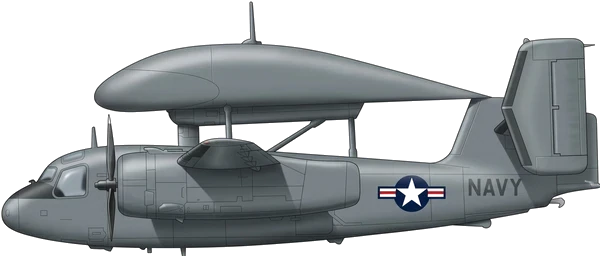
American carrier-based airborne early warning aircraft derived from the Grumman Trader, introduced in 1960 and retired in 1977, carrying an AN/APS-82 radar in a dorsal radome. Key figures: top speed 383 km/h, range 1,666 km, service ceiling 4,816 m, max takeoff weight 12,066 kg, built 88.
| Crew | 4 (2 pilots, 2 radar/intercept controllers) |
| Length | 13.8 m (45.3 ft) |
| Wingspan | 22.1 m (72.3 ft) |
| Height | 5.1 m (16.8 ft) |
| Wing area | 47 m² (505.9 sqft) |
| Empty weight | 9,361 kg (20,637 lbs) |
| Max. takeoff weight | 12,066 kg (26,601 lbs) |
| Powerplant | 2 × piston engines Wright R-1820-82A Cyclone 1,137 kW each |
| Maximum speed | 383 km/h (238 mph) |
| Operational range | 1,666 km (1,035 mi) |
| Endurance | 7 hours |
| Service ceiling | 4,816 m (15,801 ft) |
| Climb rate | 5.7 m/s (18.7 ft/s) |
Description
The Grumman E-1 Tracer, designated WF until 1962, is an American carrier-based airborne early warning (AEW) aircraft built by Grumman for the United States Navy. It was the Navy's first purpose-built AEW aircraft, developed from the Grumman Trader carrier transport, and entered service in 1960. It is known for the airfoil-shaped radome mounted above its fuselage and served until 1977, when the Grumman E-2 Hawkeye had replaced it.
Development
After the Second World War, the AD-3W Skyraider and TBM-3W Avenger, both modified attack aircraft, filled the Navy's AEW role. In 1951 the Navy asked Grumman and Vought for a TBM-3W replacement based on their anti-submarine designs, the XS2F Tracker and XS2U. Grumman's Design 95, designated XWF-1, combined the XS2F fuselage and wings with an AN/APS-20 radar on a pylon over the forward fuselage. Two prototypes were ordered, but the project was cancelled in late 1952.
In 1955 Grumman began studying how to fit Hazeltine's new radar, later the AN/APS-82, to a carrier-based aircraft and concluded that a Tracker-based design was the best option. When the Bureau of Aeronautics issued an AEW requirement later that year, Grumman proposed a Tracker development. The WF designation produced the nickname "Willy Fudd," and the aircraft's descent from the S2F "Stoof" led to its other nickname, "Stoof with a Roof." The aerodynamic prototype first flew on 17 December 1956, and the first production WF-2 flew just over fourteen months later. Grumman built 88 WF-2s, which were redesignated E-1B in 1962.
Design
The radome prevented the upward wing fold used on the S-2 and C-1. Grumman instead used an updated version of its patented "Sto-Wing" system from the F4F-4 Wildcat, which folds the wings aft along the fuselage sides. The twin vertical tails give yaw control without a single large fin and leave some rudder authority if one rudder is damaged. The tails sit at the edges of the propeller wash, which increases rudder effectiveness, and the opposing torques of the two propellers cancel the yawing moment from the wash. The aircraft sits nose-up on deck, which raises the angle of attack and increases wing lift during catapult launches.
Power comes from two Wright R-1820-82A Cyclone nine-cylinder radial engines, each rated at 1,525 hp for take-off, driving three-bladed constant-speed reversible propellers. The crew comprised two pilots and two radar/intercept controllers. Maximum speed was 238 mph (383 km/h) at 4,000 ft, range 1,035 mi (1,666 km), endurance 6 hours 50 minutes, and service ceiling 15,800 ft (4,800 m).
The Hazeltine AN/APS-82 radar used a 17 × 5 ft (5.2 × 1.5 m) parabolic dish antenna inside the radome. Its airborne moving target indicator (AMTI) compared successive pulse returns to separate aircraft from sea clutter. The radar also provided ground stabilization and target height determination.
Operational History
The E-1B first deployed with VAW-11 aboard USS Constellation (CV-64). In the early years of the Vietnam War, Tracers vectored combat air patrol fighters, controlled Alpha strikes over North Vietnam, and warned strike aircraft of MiG activity at radii of 250–300 miles. Tracer-equipped VAW squadrons made 56 deployments in support of operations over Southeast Asia. VAW-12 and VAW-121 also flew the type.
By May 1973 only four VAW-121 aircraft at NAS Norfolk, Virginia, remained in service. They made a final cruise aboard USS Franklin D. Roosevelt, were retired in mid-summer 1977, and were ferried to Davis-Monthan for storage. Five E-1Bs are preserved in US museums, including the National Naval Aviation Museum at Pensacola and the Intrepid Sea, Air & Space Museum. A further 11 are stored near Davis-Monthan AFB, and one of these (BuNo 148922) was sold to a private collector in 2011 for restoration to flight.
Variants
- XWF-1: Proposed 1951 AEW derivative of the S2F-1 with AN/APS-20 radar; cancelled in 1952 and not built.
- G-117: Company designation for the WF-2, applied to TF-1 BuNo 136792, which was converted into an aerodynamic prototype without electronics and later rebuilt as a Trader transport retaining the twin tail.
- WF-2: Production AEW version of the TF-1 Trader with AN/APS-82 radar; 88 built.
- E-1B: Designation applied to the WF-2 in 1962.
Frequently Asked Questions
What type of aircraft is the E-1 Tracer?
What is the maximum speed of the E-1 Tracer?
What is the range of the E-1 Tracer?
When did the E-1 Tracer first fly?
How many E-1 Tracer have been built?
Which countries operate the E-1 Tracer?
What is the service ceiling of the E-1 Tracer?
- OCT 12026 Created Page created: E-1 Tracer