Alizé
French single-turboprop carrier-based anti-submarine aircraft, in Aéronavale service from 1959 to 2000 and flown by the Indian Navy from INS Vikrant in the 1965 and 1971 wars. Key figures: top speed 518 km/h, range 2,500 km, service ceiling 8,000 m, max takeoff weight 8,200 kg, built 89.
| Crew | 3 (pilot, radar operator, navigator) |
| Length | 13.9 m (45.5 ft) |
| Wingspan | 15.6 m (51.2 ft) |
| Height | 5 m (16.4 ft) |
| Wing area | 36 m² (387.5 sqft) |
| Empty weight | 5,700 kg (12,566 lbs) |
| Max. takeoff weight | 8,200 kg (18,078 lbs) |
| Powerplant | 1 × turboprop Rolls-Royce Dart RDa.7 Mk 21 1,565 kW each |
| Maximum speed | 518 km/h (322 mph) |
| Operational range | 2,500 km (1,553 mi) |
| Endurance | 5 hours |
| Service ceiling | 8,000 m (26,247 ft) |
| Climb rate | 7.0 m/s (23.0 ft/s) |
- Anti-Ship AS.12
- Homing torpedo
- Depth charges
- Rocket Pod 68 mm
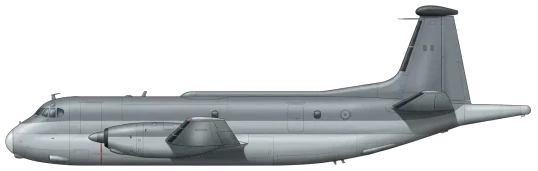
Description
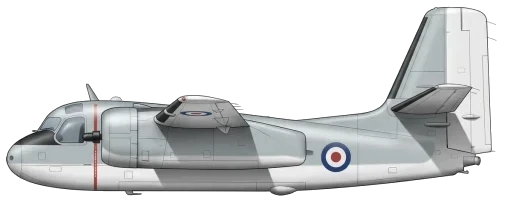
The Bréguet Br.1050 Alizé ("Tradewind") is a French carrier-based anti-submarine warfare aircraft built by Bréguet. It entered Aéronavale service in March 1959 and was also operated by the Indian Navy. The Alizé flew from the carriers Arromanches, Clémenceau, Foch and INS Vikrant, saw combat in the Indo-Pakistani wars of 1965 and 1971, and remained in French service until 2000.
Development
The Alizé was developed in the 1950s. It was based loosely on the second prototype Bréguet Vultur attack aircraft, which had been modified into the Br.965 Épaulard anti-submarine aircraft. The prototype first flew on 6 October 1956 and was exhibited at the Paris Air Show at Le Bourget in May 1957. A total of 89 aircraft were built between 1957 and 1962, including two preproduction prototypes, although some sources give five. The Aéronavale acquired 75 production aircraft and the Indian Navy 12. Other figures of 14 and 17 for India may reflect the transfer of used Aéronavale aircraft.
Design
The Alizé is a low-wing monoplane of conventional configuration. It is powered by one Rolls-Royce RDa.7 Dart Mk 21 turboprop rated at 1,565 kW (2,099 hp), which drives a four-bladed, constant-speed, fully feathering, reversible propeller. The three crew members are a pilot in the front left seat, a navigator in the front right, and a sensor operator seated sideways behind them. A CSF radar uses a retractable antenna dome in the belly. The main units of the tricycle landing gear have dual wheels and retract forwards into wing nacelles, whose forward sections house sonobuoys. A yoke-type arresting hook is fitted. Maximum speed is 518 km/h at 3,050 m, range is 2,500 km, and endurance is 5 hr 10 min.
Armament
An internal weapons bay holds a homing torpedo or depth charges. Underwing pylons carry bombs, depth charges, rockets or missiles. Typical underwing stores were 68 mm rocket pods or AS.12 wire-guided anti-ship missiles.
Operational History
The Indian Navy received its first Alizé on 7 January 1961 and operated the type with INAS 310 from shore bases and INS Vikrant. During the 1961 annexation of Goa, Alizés flew maritime patrol and photo reconnaissance. In the 1965 war they flew maritime patrol and ELINT missions off Mumbai and Cochin, located radar sites over Punjab for the IAF, and shadowed the Pakistani force conducting Operation Dwaraka. During the 1971 war the type flew 300 sorties, and one was shot down by a PAF F-104 Starfighter. It was the only night-capable aircraft aboard Vikrant and was credited with sinking three gunboats. In 1987 the Alizé was relegated to shore basing when Vikrant was converted for Sea Harrier operations. That year it flew against LTTE targets during Operation Pawan. The type also disabled the merchant ship Progress Light during Operation Cactus. India retired the Alizé in 1991 and replaced it with ASW helicopters.
In France the Alizé served with Flottilles 4F, 6F and 9F and several training and support escadrilles. By the 1990s it could no longer hunt modern nuclear submarines and was reassigned to surface patrol, with 24 aircraft still in use in 1997. Alizés flew from Foch during the 1999 NATO campaign over Kosovo. The last aircraft was withdrawn in 2000 when Foch was retired.
Variants
- Br.1050 Alizé prototypes: Two preproduction aircraft preceded production, with the first flight taking place on 6 October 1956.
- Br.1050 Alizé: This production model equipped the Aéronavale and the Indian Navy from 1959.
- Br.1050M: In the early 1980s, 28 aircraft were upgraded with the Thomson-CSF Iguane radar, OMEGA navigation and the ARAR 12 ESM system. Of these, 24 later received a decoy system, datalink, a computerised data processing system and the Chlio FLIR.
Frequently Asked Questions
What type of aircraft is the Alizé?
What is the maximum speed of the Alizé?
What is the range of the Alizé?
When did the Alizé first fly?
How many Alizé have been built?
Which countries operate the Alizé?
What is the service ceiling of the Alizé?
- SEP 302026 Created Page created: Alizé