S-3 Viking
American anti-submarine aircraft, operational during the Cold War, recognized for its service in Gulf War naval missions. Key figures: top speed 815 km/h, range 5,121 km, service ceiling 12,466 m, max takeoff weight 23,831 kg, unit price $27M, built 188.
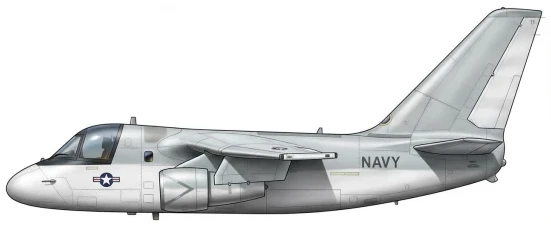
| Crew | 4 |
| Length | 16.3 m (53.4 ft) |
| Wingspan | 21.0 m (68.8 ft) |
| Height | 7.0 m (22.9 ft) |
| Wing area | 56 m² (602.8 sqft) |
| Empty weight | 12,057 kg (26,581 lbs) |
| Max. takeoff weight | 23,831 kg (52,538 lbs) |
| Powerplant | 2 × turbofans General Electric TF34-GE-2 4,207 kgf each |
| Ejection seat | Escapac E-1 |
| Maximum speed | 815 km/h (506 mph) |
| Operational range | 5,121 km (3,182 mi) |
| Endurance | 7 hours |
| Service ceiling | 12,466 m (40,899 ft) |
| Climb rate | 26.0 m/s (85.3 ft/s) |
Description
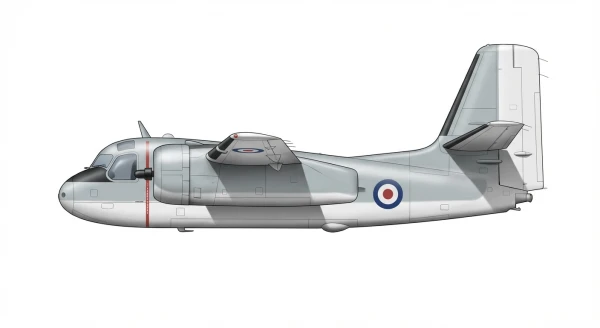
The Lockheed S-3 Viking is a carrier-based, twin-turbofan, subsonic anti-submarine warfare aircraft built by the Lockheed Corporation for the United States Navy. It entered operational service on 20 February 1974 with VS-41 at NAS North Island and flew with a crew of four in its original configuration. Nicknamed the "War Hoover" for its engine noise, it later shifted from ASW to surface warfare, aerial refuelling and reconnaissance, and was withdrawn from front-line carrier service in January 2009.
Development
The Navy formulated the VSX requirement in the mid-1960s to replace the piston-engined Grumman S-2 Tracker. In August 1968 a Lockheed-led team and a rival Convair/Grumman team were asked to develop their proposals further. Lacking carrier aircraft experience, Lockheed brought in Ling-Temco-Vought, which designed the folding wings and tail, engine nacelles and landing gear, some derived from the A-7 Corsair II and F-8 Crusader; Sperry Univac Federal Systems developed the onboard computers. Lockheed won on 4 August 1969 with an order for eight YS-3A prototypes, and the first flew on 21 January 1972 with test pilot John Christiansen. Production ran from 1974 to 1978, totalling 186 S-3As; most survivors were later converted to S-3B standard and 16 to ES-3A configuration.
Design
The S-3 is a cantilever shoulder-wing monoplane with 15° leading-edge sweep and an almost straight trailing edge, fitted with leading-edge and Fowler flaps and spoilers on both wing surfaces. Two General Electric TF34 high-bypass turbofans are mounted in underwing nacelles. Controls are hydraulically boosted and irreversible, with an Emergency Flight Control System for dual hydraulic failure. An auxiliary power unit permits unassisted starts. All four crew sit on Douglas Escapac zero-zero ejection seats with a group-eject mode. Sensor data was integrated through a single General Purpose Digital Computer feeding Multi-Purpose Displays, giving a four-man crew capability comparable to the twelve-man P-3. Equipment included AN/APS-116 sea search radar (AN/APS-137 ISAR on the S-3B), OR-89 FLIR, AN/ASQ-81 MAD on a retractable tail boom, AN/ALR-47 ESM in wingtip pods and up to 60 sonobuoys. The MAD boom and submarine detection electronics were removed in the late 1990s.
Armament
Up to 4,900 lb (2,200 kg) is carried on four internal bomb bay stations and two underwing hardpoints. Stores include Mark 82, 83 and 84 bombs, CBU-100 cluster bombs, Mark 46 and Mark 50 torpedoes, mines, depth charges and B57 nuclear depth bombs, plus AGM-65E/F Maverick, AGM-84D Harpoon and AGM-84H/K SLAM-ER missiles. The underwing stations also accept rocket pods, 300 US gal tanks or buddy refuelling stores.
Operational History
The first operational cruise came in 1975 with VS-21 aboard USS John F. Kennedy. Early service suffered from mission computer failures during catapult launches and a shortage of spares. S-3Bs flew attack, tanker and ELINT missions in the 1991 Gulf War, including a SLAM strike on an Iraqi Silkworm site from USS Theodore Roosevelt. The type served in the Yugoslav wars, Operation Enduring Freedom and Operation Iraqi Freedom, where a VS-38 aircraft fired the first combat laser-guided Maverick in March 2003. VS-22, the last squadron, was disestablished on 29 January 2009. VX-30 flew range clearance S-3Bs at Point Mugu until January 2016, and NASA retired its last example on 13 July 2021.
Variants
- S-3A: First production version, 187 built.
- S-3B: Upgraded avionics with AN/APS-137 ISAR, JTIDS and Harpoon capability; 119 converted, first flight 13 September 1984.
- ES-3A Shadow: Sixteen aircraft converted for carrier-based ELINT, replacing the EA-3B and serving from 1993 to 1999.
- US-3A: Six aircraft converted for carrier onboard delivery, carrying six passengers or 4,680 lb of cargo, retired in 1998.
- KS-3A: Proposed dedicated tanker with 4,382 US gal fuel capacity, one converted from a YS-3A.
Frequently Asked Questions
What type of aircraft is the S-3 Viking?
What is the maximum speed of the S-3 Viking?
What is the range of the S-3 Viking?
When did the S-3 Viking first fly?
How many S-3 Viking have been built?
How much does a S-3 Viking cost?
What is the service ceiling of the S-3 Viking?
- AUG 302026 Updated Description updated
- AUG 52026 Updated Powerplant updated in a site-wide editorial pass
- JUL 232026 Updated Sources and cross-references refreshed
- APR 72026 Updated Sources and cross-references refreshed
- FEB 72026 Updated Endurance added