S-2 Tracker
American carrier-based anti-submarine aircraft, deployed during the Cold War, notably used in the Vietnam and Korean Wars. Key figures: top speed 450 km/h, range 2,172 km, service ceiling 6,706 m, max takeoff weight 11,860 kg, built 1,284.
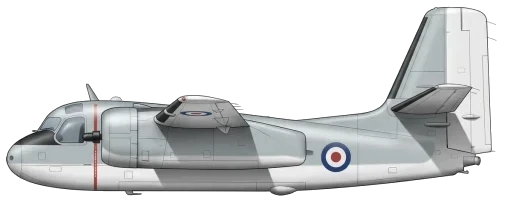
| Length | 13.3 m (43.6 ft) |
| Wingspan | 22.2 m (72.7 ft) |
| Height | 5.4 m (17.6 ft) |
| Wing area | 45 m² (484.4 sqft) |
| Empty weight | 8,308 kg (18,316 lbs) |
| Max. takeoff weight | 11,860 kg (26,147 lbs) |
| Powerplant | 2 × radial engine Wright R-1820-82WA 1,137 kW each |
| Maximum speed | 450 km/h (280 mph) |
| Operational range | 2,172 km (1,350 mi) |
| Endurance | 9 hours |
| Service ceiling | 6,706 m (22,001 ft) |
Recent Events — S-2 Tracker
1 event →
Description
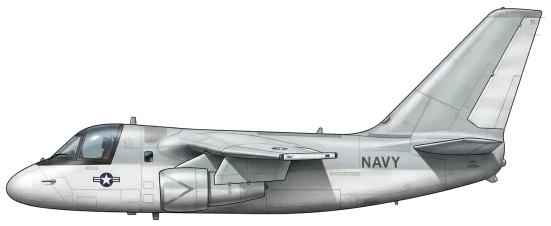
The Grumman S-2 Tracker (designated S2F before the 1962 tri-service standardization) was a carrier-based anti-submarine warfare aircraft built by Grumman for the United States Navy. It was the first purpose-built single-airframe ASW aircraft to enter US Navy service, combining the detection and attack functions previously split between paired AF-2W and AF-2S Guardians. Introduced in 1952, it served with the US Navy until 1976 and with foreign operators into the 21st century, the last Argentine examples being retired in 2025. The type was nicknamed "Stoof".
Development
The Tracker replaced the Grumman AF Guardian hunter-killer pairs, saving carrier deck space. Grumman's model G-89 was a high-wing monoplane with twin Wright R-1820 nine-cylinder radials, a yoke-type arrestor hook, folding wings and a crew of four. Two XS2F-1 prototypes and 15 S2F-1 production aircraft were ordered together on 30 June 1950. First flight took place on 4 December 1952, and production aircraft entered service with VS-26 in February 1954. Grumman built 1,185 Trackers; de Havilland Canada produced a further 99 under licence as the CS2F, the first Canadian-built example flying on 31 May 1956.
Design
The Tracker was propeller-driven with twin radial engines, a high folding wing and tricycle undercarriage. The S-2F was powered by two Wright R-1820-82WA engines of 1,525 hp each, giving a maximum speed of 243 kn, a range of 1,173 nmi and nine hours' endurance. Sensors included a ventrally mounted retractable radome for AN/APS-38 radar and an AN/ASQ-8 magnetic anomaly detector on an extendable tail boom. Early aircraft carried a dorsal ESM pod and a smoke particle "sniffer" for detecting snorkelling diesel-electric submarines; later aircraft deleted the sniffer and moved the ESM antennae to wingtip extensions. A 70-million-candlepower searchlight was fitted to the starboard wing. The engine nacelles housed JEZEBEL sonobuoys, 16 in early marks and 32 in the S-2E/G. Early Trackers carried 60 explosive charges for JULIE semi-active sonar with AN/AQA-3 and AQA-4 sets; the S-2G conversion introduced active sonobuoys and AN/AQA-7.
Armament
An internal torpedo bay accommodated two lightweight aerial torpedoes or one nuclear depth charge. Six underwing hardpoints carried rocket pods, conventional depth charges or up to four additional torpedoes, with total payload of 4,800 lb across the bay and wing stations. Torpedo types included the Mk 41, Mk 43, Mk 34, Mk 44 and Mk 46; depth charges comprised the Mk 54, along with naval mines.
Operational History
The Lockheed S-3 Viking superseded the Tracker in US service; VS-37, the last operational USN squadron, was disestablished in 1976 and the final Navy S-2 withdrawn on 29 August 1976. TS-2A trainers served with VT-27, VT-28 and VT-31 at NAS Corpus Christi. Export operators included Argentina, Australia, Brazil, Canada, Italy, Japan, the Netherlands, Peru, South Korea, Taiwan, Thailand, Turkey, Uruguay and Venezuela. Argentine S-2Es flew from ARA Veinticinco de Mayo during the 1982 Falklands War, detecting the British task force on 1 May 1982 and later conducting ASW sorties against submarine contacts. The Royal Australian Navy operated S-2E/G aircraft with 816 and 851 Squadrons from NAS Nowra between 1967 and 1984, losing much of its fleet to a deliberately lit hangar fire on 4 December 1976. Many airframes were converted for aerial firefighting by Conair and CAL FIRE.
Variants
- S2F-1 (S-2A): Initial production variant with two 1,525 hp R-1820-82WA engines, 740 built.
- S2F-2 (S-2C): Asymmetrical port-side bomb bay extension and enlarged tail surfaces, 77 built.
- S2F-3 (S-2D): Enlarged forward fuselage and tail, added fuel and nacelle bays for 32 sonobuoys, 100 built.
- S2F-3S (S-2E): S-2D with Julie/Jezebel equipment, 252 built.
- S-2G: S-2E conversions with AN/AQA-7 DIFAR processor and AN/ARR-75 sonobuoy receiver.
Frequently Asked Questions
What type of aircraft is the S-2 Tracker?
What is the maximum speed of the S-2 Tracker?
What is the range of the S-2 Tracker?
When did the S-2 Tracker first fly?
How many S-2 Tracker have been built?
Which countries operate the S-2 Tracker?
What is the service ceiling of the S-2 Tracker?
- AUG 302026 Updated Description updated
- JUL 232026 Updated Sources and cross-references refreshed
- APR 72026 Updated Picture credits updated in a site-wide editorial pass
- FEB 72026 Updated S-2 Tracker: top speed added; S-2 Tracker: endurance added
- JAN 122026 Updated Range updated in a site-wide editorial pass