E-8 Joint STARS
American command and control aircraft, instrumental during Persian Gulf War, primarily deployed for surveillance and ground-target tracking missions. Key figures: top speed 853 km/h, range 6,821 km, service ceiling 12,802 m, max takeoff weight 152,407 kg, unit price $250M, built 17.
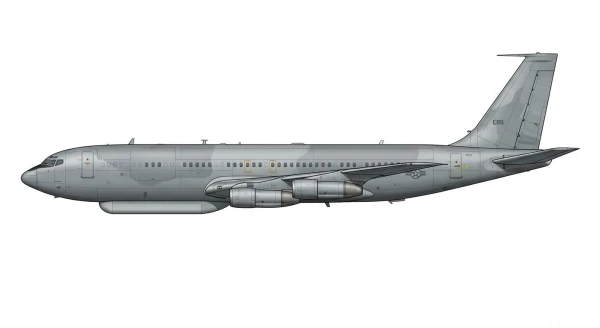
| Crew | 24–40 |
| Length | 46.6 m (152.9 ft) |
| Wingspan | 44.4 m (145.7 ft) |
| Height | 13.0 m (42.5 ft) |
| Wing area | 283.4 m² (3050.0 sqft) |
| Empty weight | 77,564 kg (170,999 lbs) |
| Max. takeoff weight | 152,407 kg (336,000 lbs) |
| Powerplant | 4 × turbofans Pratt & Whitney TF33-102C 8,709 kgf each |
| Maximum speed | 853 km/h (530 mph) |
| Operational range | 6,821 km (4,238 mi) |
| Endurance | 9 hours |
| Service ceiling | 12,802 m (42,001 ft) |
Description
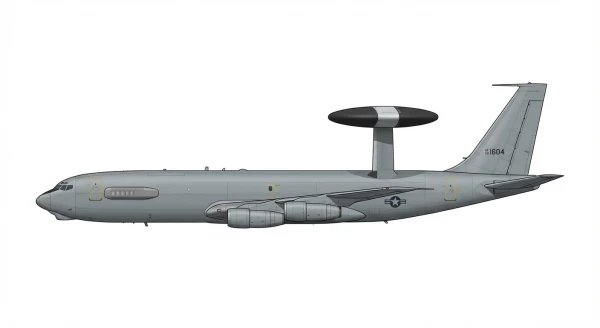
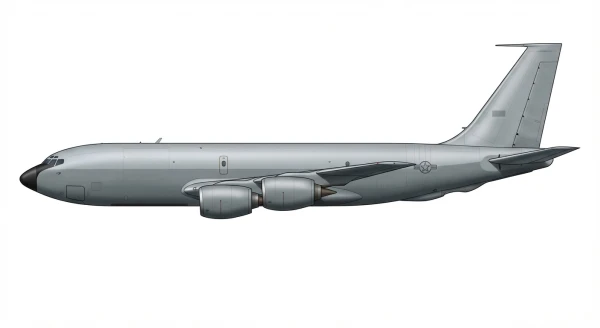
The Northrop Grumman E-8 Joint Surveillance Target Attack Radar System (Joint STARS) was an airborne ground surveillance, battle management, and command and control aircraft operated by the United States Air Force. Converted from commercial Boeing 707-300 airliners, the aircraft tracked ground vehicles and low-flying aircraft, gathered imagery, and transmitted tactical pictures to ground and air theater commanders. The E-8 saw its first combat deployment during testing in 1991, achieved initial operational capability in December 1997, and remained in active duty and Air National Guard service until its retirement in November 2023.
Development
Joint STARS evolved from separate 1982 U.S. Army and Air Force programs aimed at detecting and attacking enemy armor beyond the forward edge of battle, with the USAF taking the lead. Concept and sensor integration was evaluated using the Tacit Blue experimental aircraft. Grumman Aerospace Corporation received the prime contract in September 1985 for two E-8A developmental systems. Northrop Grumman was awarded a contract in 2005 to fit Pratt & Whitney JT8D-219 engines, and a test aircraft flew with the new powerplants in December 2008 before the USAF halted re-engining funding in 2009.
Design
The E-8C airframe is modified from the Boeing 707-300 airliner and powered by four Pratt & Whitney TF33-PW-102 low-bypass turbofan engines. The primary sensor is an AN/APY-7 active electronically scanned array side-looking radar housed in a 40-foot (12 m) ventral canoe radome. The radar operates in wide area surveillance, ground moving target indicator (GMTI), fixed target indicator, and synthetic aperture radar (SAR) modes, offering a 120-degree field of view to track up to 600 targets simultaneously at ranges over 152 miles (250 km). The cabin contains 18 operator workstations and relays imagery and target coordinates via a secure Surveillance and Control Data Link (SCDL) or UHF satellite communications. The E-8C has an unrefueled flight endurance of 9 hours, which can be extended using in-flight refueling.
Operational History
Two developmental E-8A aircraft flew 49 combat sorties during Operation Desert Storm in 1991 prior to official entry into service. Production E-8C aircraft subsequently deployed for NATO missions during Operation Joint Endeavor in 1995 and Operation Allied Force in 1999. Between 2001 and January 2011, the fleet accumulated over 63,000 flight hours across 5,200 combat missions supporting operations in Iraq and Afghanistan. The aircraft maintained an 18-year continuous operational presence in the USCENTCOM area of responsibility until October 2019, flying 10,938 sorties. In late 2021 and early 2022, E-8C aircraft flew reconnaissance missions over Eastern Europe prior to the Russian invasion of Ukraine, and the fleet conducted its final operational flight on September 21, 2023.
Variants
- E-8A: Original platform configuration used for initial system development and combat evaluation.
- TE-8A: Single aircraft with mission equipment removed, designated for flight crew training.
- YE-8B: Single U.S. Navy Boeing E-6 transferred to the USAF as a test platform before second-hand Boeing 707s were selected for conversion.
- E-8C: Standard production Joint STARS platform converted from pre-owned commercial Boeing 707-300 airframes.
Frequently Asked Questions
What type of aircraft is the E-8 Joint STARS?
What is the maximum speed of the E-8 Joint STARS?
What is the range of the E-8 Joint STARS?
When did the E-8 Joint STARS first fly?
How many E-8 Joint STARS have been built?
How much does a E-8 Joint STARS cost?
What is the service ceiling of the E-8 Joint STARS?
- AUG 62026 Updated Description updated
- AUG 52026 Updated Powerplant updated in a site-wide editorial pass
- AUG 12026 Updated Manufacturer updated
- JUL 232026 Updated Sources and cross-references refreshed
- APR 72026 Updated Sources and cross-references refreshed
- FEB 72026 Updated E-8 Joint STARS: range added; E-8 Joint STARS: endurance added