E-7 Wedgetail
American twin-engine airborne early warning and control aircraft, developed in the early 21st century, deployed for tactical battle management and surveillance. Key figures: top speed 853 km/h, range 6,500 km, service ceiling 12,500 m, max takeoff weight 77,600 kg, unit price $400M, built 15. In service with 4 air forces as of 2026 — Australia (6), South Korea (4), Turkey (4) and 1 other.
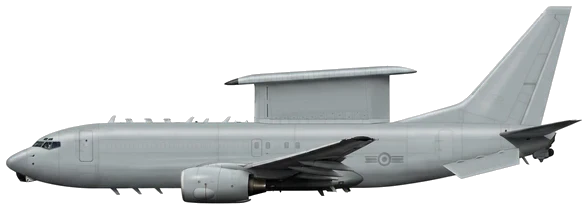
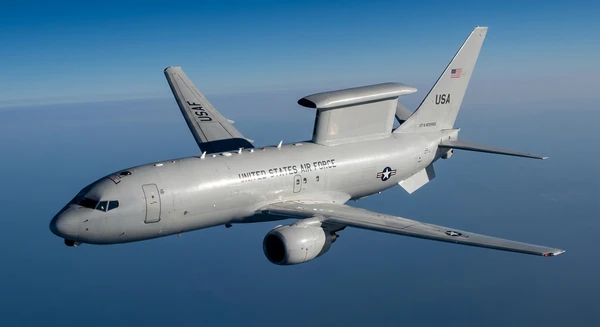
| Crew | 21 (2 flight crew, 19 mission crew) |
| Length | 33.6 m (110.2 ft) |
| Wingspan | 35.8 m (117.5 ft) |
| Height | 12.5 m (41.0 ft) |
| Wing area | 91 m² (979.5 sqft) |
| Empty weight | 46,606 kg (102,749 lbs) |
| Max. takeoff weight | 77,600 kg (171,079 lbs) |
| Powerplant | 2 × CFM International CFM56-7B27A 121 kN each |
| Maximum speed | 853 km/h (530 mph) |
| Operational range | 6,500 km (4,039 mi) |
| Endurance | 17 hours |
| Service ceiling | 12,500 m (41,011 ft) |
-
 Australia
6
Australia
6
-
 South Korea
4
South Korea
4
-
 Turkey
4
Turkey
4
-
 United Kingdom
1 +2
United Kingdom
1 +2
-
 United States
0 +26
United States
0 +26
Recent Events — E-7 Wedgetail
3 events →
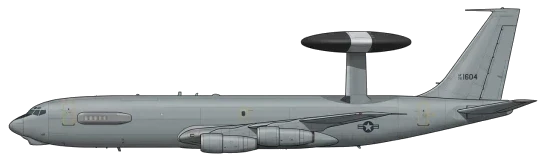
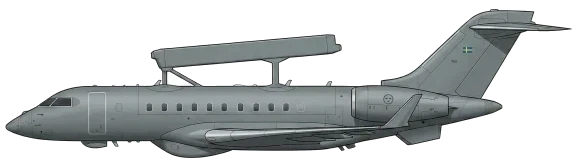
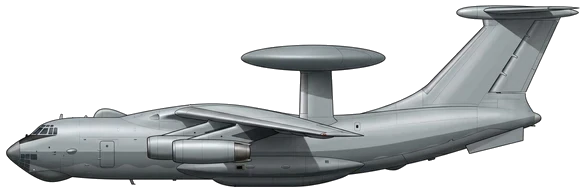
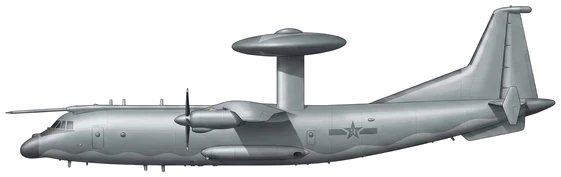
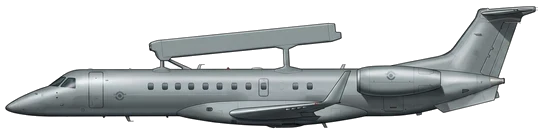
Description
The Boeing E-7 Wedgetail is a twin-engine airborne early warning and control (AEW&C) aircraft based on the Boeing 737 Next Generation design, roughly similar to the 737-700ER. Originally developed for the Royal Australian Air Force (RAAF) under Project AIR 5077, Boeing was awarded the initial supply contract in 1999. The first test flight of the Turkish variant occurred in September 2007. Deliveries to the RAAF began in November 2009, with the sixth and final aircraft accepted in June 2012. Production and modification subcontractors have included Boeing Australia, BAE Systems Australia, Turkish Aerospace Industries, HAVELSAN, Korea Aerospace Industries, and STS Aviation Group.
Design
The E-7 uses a fixed Northrop Grumman Multi-role Electronically Scanned Array (MESA) radar mounted in a dorsal "top hat" fin designed for minimal aerodynamic effect. The radar operates in simultaneous air and sea search, fighter control, and area search modes, with a maximum look-up range exceeding 600 km. It achieves 360-degree coverage via two broadside electronic manifold arrays covering 120 degrees to both port and starboard, and front and aft end-fire arrays covering 60 degrees. The antenna also serves as an ELINT array with a range over 850 km at an altitude of 9,000 meters. Ventral fins counterbalance the radar structure, and countermeasures are located on the nose, wingtips, and tail. The cabin contains eight to ten operator consoles. Propulsion is provided by two CFM International CFM56-7B27A turbofans.
Operational History
The RAAF operates six E-7As with No. 2 Squadron out of RAAF Base Williamtown. The fleet achieved Initial Operational Capability in 2012 and conducted its first operational sortie in 2014 during the search for Malaysia Airlines Flight 370. The aircraft supported coalition operations in Iraq starting in October 2014, including a 17-hour, 6-minute command and control mission. RAAF Wedgetails deployed to Europe in October 2023 and August 2025 to monitor supply flows to Ukraine, and to the United Arab Emirates in March 2026 for operations related to the Iran war. The Turkish Air Force operates four E-7T aircraft, delivered between 2014 and 2015. The Republic of Korea Air Force operates four Peace Eye aircraft, delivered between 2011 and 2012. The United Kingdom ordered three Wedgetail AEW Mk1 aircraft, receiving its first airframe in October 2024. The United States Air Force cancelled a planned 26-aircraft procurement in June 2025, but continues development of two prototype aircraft under contracts awarded in 2025 and 2026.
Variants
- E-7A Wedgetail: The designation for the six aircraft operated by the Royal Australian Air Force.
- E-7T Peace Eagle: The designation for the four Turkish Air Force aircraft, modified and assembled in partnership with Turkish Aerospace Industries.
- Peace Eye: The designation for the four aircraft operated by the Republic of Korea Air Force.
- Wedgetail AEW Mk1: The designation for the Royal Air Force variant, with three aircraft ordered for conversion by STS Aviation Group.
Frequently Asked Questions
What type of aircraft is the E-7 Wedgetail?
What is the maximum speed of the E-7 Wedgetail?
What is the range of the E-7 Wedgetail?
When did the E-7 Wedgetail first fly?
How many E-7 Wedgetail have been built?
Which countries operate the E-7 Wedgetail?
How much does a E-7 Wedgetail cost?
What is the service ceiling of the E-7 Wedgetail?
- JUN 302026 Created Page created: E-7 Wedgetail; then first flight added