Il-114
Soviet and Russian twin-engine turboprop regional airliner, introduced in the late 20th century for short-haul civilian passenger and specialized transport operations. Key figures: top speed 500 km/h, range 2,000 km, built 22.
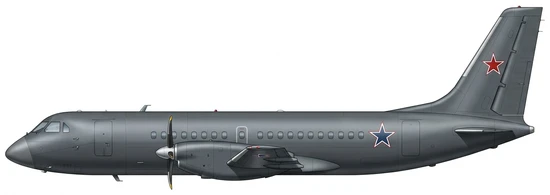
| Crew | 2 |
| Length | 26.9 m (88.2 ft) |
| Powerplant | 2 × turboprops Klimov TV7-117ST-01 2,300 kW each |
| Maximum speed | 500 km/h (311 mph) |
| Operational range | 2,000 km (1,243 mi) |
| Endurance | 14 hours |
- Anti-Ship Kh-35
Description
The Ilyushin Il-114 is a twin-engine, short-haul regional turboprop airliner developed by the Ilyushin Design Bureau in Russia. Designed to replace the Antonov An-24, the aircraft entered commercial service with Uzbekistan Airways following airworthiness certification in April 1997. It is known for its extended development history spanning the dissolution of the Soviet Union and its subsequent program restart as the modernized Il-114-300.
Development
The Soviet Ministry of Aviation Industry launched the Il-114 program in June 1986. The prototype first flew on 29 March 1990 at Zhukovsky Airfield, but work was delayed by engine issues and the dissolution of the Soviet Union. Serial production began in 1992 at the Tashkent Aircraft Production Association in Uzbekistan, but output was halted at 20 aircraft after a 1993 prototype crash caused Russia to withdraw government funding. In 2014, United Aircraft Corporation initiated a program restart under the Il-114-300 designation using domestic components to replace aging regional fleets. Newly built prototypes underwent testing at Tretyakovo, and type certification was granted by the Russian Federal Air Transport Agency on 5 June 2026.
Design
The Il-114 is a low-wing cantilever monoplane constructed primarily of metal, using composite materials for the wing box, fairings, and control surfaces. It features retractable tricycle landing gear, double-slotted trailing edge flaps, and a two-crew flight deck with mechanical primary flight controls. Early production aircraft were powered by Klimov TV7-117S or Pratt & Whitney Canada PW127H turboprops, whereas the Il-114-300 uses upgraded TV7-117ST-01 engines driving Aerosila AV-112-114 six-blade propellers. Avionics include the digital TsPNK-114M2 suite with five liquid-crystal displays, allowing ICAO Category II operations. Passenger capacity ranges from 52 to 68 seats arranged in a 2–2 layout.
Armament
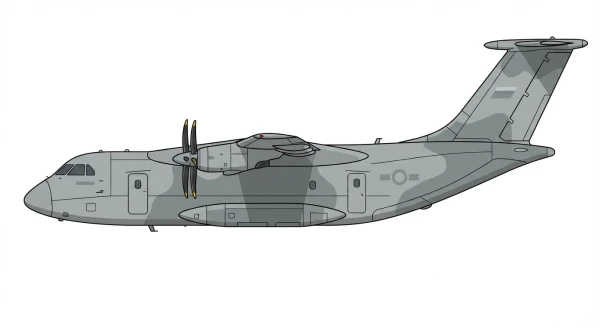
An experimental maritime patrol demonstrator based on the Il-114 platform incorporates two under-fuselage pylons for Kh-35 anti-ship missiles or sensor pods. This configuration can also accommodate a right-side fuselage pod mounting a GSh-2-23 twin-barrel 23 mm cannon.
Operational History
Uzbekistan Airways operated six Il-114 aircraft on domestic routes and international flights to Ashgabad and Bishkek until May 2018. Russian carrier Vyborg Airlines operated two aircraft until suspending operations in July 2010. In June 2026, an agreement was signed to lease the first three serial-production Il-114-300 aircraft to the 2nd Arkhangelsk United Aviation Division.
Variants
-
Il-114: Initial production variant powered by Klimov TV7-117S turboprops carrying up to 64 passengers.
-
Il-114-100: Production variant equipped with Pratt & Whitney Canada PW127H engines for commercial export.
-
Il-114-300: Modernized import-substituted variant featuring TV7-117ST-01 engines, updated digital avionics, and redesigned interior fittings.
-
Il-114T: Dedicated cargo transport variant equipped with freight handling systems, first flown in September 1996.
-
Il-114MP: Proposed maritime patrol and strike variant configured for anti-shipping and surveillance roles.
Frequently Asked Questions
What type of aircraft is the Il-114?
What is the maximum speed of the Il-114?
What is the range of the Il-114?
When did the Il-114 first fly?
How many Il-114 have been built?
Which countries operate the Il-114?
- AUG 62026 Created Page created: Il-114