J-21 Jastreb
Yugoslav single-seat, single-engined, light attack aircraft, developed in the mid-1960s and used for ground-attack and reconnaissance missions. Key figures: top speed 820 km/h, range 1,520 km, service ceiling 12,000 m, max takeoff weight 5,100 kg. In service with 1 air force as of 2026 — Libya (1).
| Crew | 1 |
| Length | 10.9 m (35.7 ft) |
| Wingspan | 10.6 m (34.6 ft) |
| Height | 3.6 m (11.9 ft) |
| Wing area | 19.4 m² (209.1 sqft) |
| Max. takeoff weight | 5,100 kg (11,244 lbs) |
| Powerplant | 1 × BMB Viper Mk 531 13 kN each |
| Maximum speed | 820 km/h (510 mph) |
| Operational range | 1,520 km (944 mi) |
| Service ceiling | 12,000 m (39,370 ft) |
| Climb rate | 21.0 m/s (68.9 ft/s) |

- Unguided Bomb 250 kg general-purpose bomb
- Cluster Bomb 150 kg cluster bomb
- Cluster Bomb 120 kg cluster fragmentation bomb
- Rocket Pod rocket pod with 12x 55 mm rockets
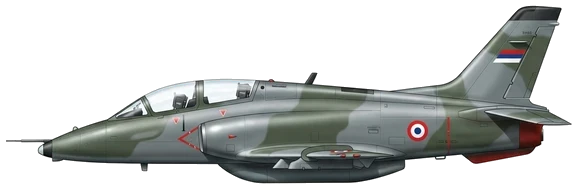
Description
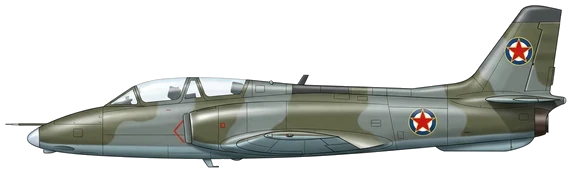
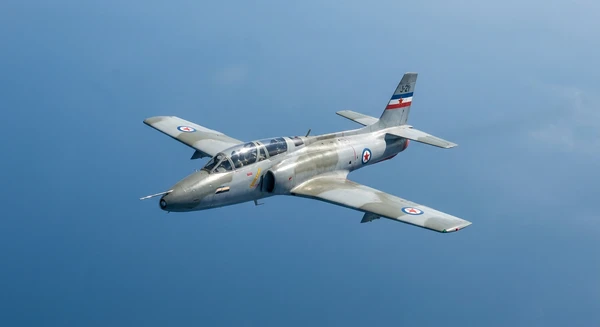
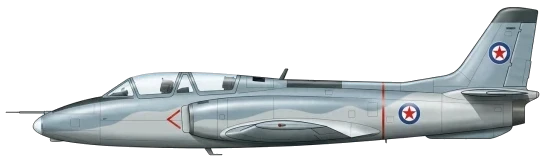
The Soko J-21 Jastreb ("hawk", sometimes designated J-1 Jastreb) is a Yugoslav single-seat, single-engine light attack aircraft, designed by the Aeronautical Technical Institute (ATI) and the Military Technical Institute (VTI) in Belgrade, and produced by SOKO in Mostar. Derived from the G-2 Galeb advanced trainer, it entered service with the JRV (Yugoslav Air Force) on 31 December 1968 and remains known for its losses to American F-16s over Bosnia and Herzegovina.
Development
The J-21 was developed to replace the Republic F-84 Thunderjet, the most widespread fighter-bomber in the Yugoslav Air Force until 1967. Developed on the basis of the G-2 Galeb as a single-seat ground-attack version, it made its first flight on 19 July 1965. Tactical reconnaissance versions and a two-seat flight and weapons trainer followed.
Design
The airframe is a conventional stressed-skin structure in aluminium alloy, strengthened compared with that of the Galeb in order to increase the payload. The relatively thick wing section limits performance but houses the fuel tanks and the main landing gear, which retracts inwards and provides a wide track; the trailing-arm legs and low-pressure tyres allow operation from rough airstrips. Power comes from a 13.32 kN BMB (Rolls-Royce/Bristol Siddeley) Viper Mk 531 turbojet, supplemented by two 4.45 kN JATO rockets. The unpressurised cockpit receives a licence-built Folland Type 1-B ejection seat, under a canopy hinged to starboard, with manual flight controls, conventional instrumentation and a K-14A or K-14C gunsight. Maximum take-off weight reaches 5,100 kg, maximum speed 820 km/h and range 1,520 km with wingtip tanks.
Armament
Fixed armament consists of three 12.7 mm Browning AN/M3 machine guns installed in the nose. Eight hardpoints allow an external load of 800 kg: two inboard 250 kg pylons for bombs, rocket pods or additional tanks, and six outboard 50 kg pylons for 127 mm VRZ-157 rockets. Configurations include two 250 kg bombs, two 150 kg cluster bombs or 120 kg fragmentation bombs, two 150 l napalm tanks and pods of twelve 55 mm rockets.
Operational History
During the First Congo War, Yugoslavia delivered three J-21s and one G-2 to Mobutu's government, based at Gbadolite and flown mainly by Serbian mercenaries. The pilot Ratko Turčinović was killed there during a very low pass when he struck a lamp post, the wreckage falling on a column of soldiers on parade; the Yugoslav personnel were expelled shortly afterwards and the aircraft abandoned on site. Over Bosnia and Herzegovina, six J-21s flown by Croatian and Bosnian Serb pilots were intercepted by USAF F-16s during Operation Deny Flight: the USAF claimed four aircraft shot down, while the Serbs declared five lost. On 15 November, during the Battle of the Dalmatian Channels, three J-21s overflew Brač and Šolta at low altitude and two were shot down by anti-aircraft artillery. Besides Yugoslavia and the Republika Srpska (12 aircraft), the type was operated by Libya, Zaire and Zambia.
Variants
- J-21 Jastreb: single-seat ground-attack and reconnaissance version.
- J-21E Jastreb: export version of the J-21.
- RJ-21 Jastreb: single-seat tactical reconnaissance version.
- RJ-21E Jastreb: export version of the RJ-21.
- NJ-21: two-seat advanced trainer, weapons trainer and light attack aircraft.
Frequently Asked Questions
What type of aircraft is the J-21 Jastreb?
What is the maximum speed of the J-21 Jastreb?
What is the range of the J-21 Jastreb?
When did the J-21 Jastreb first fly?
Which countries operate the J-21 Jastreb?
What is the service ceiling of the J-21 Jastreb?
- AUG 302026 Updated Description updated
- AUG 12026 Updated Manufacturer updated
- JUN 302026 Created Page created: J-21 Jastreb