JA 37 Viggen
Swedish fighter jet, key component of Cold War air defense, not deployed beyond national borders despite being built for NATO use. Key figures: top speed 2,231 km/h, range 1,820 km, service ceiling 18,000 m, max takeoff weight 20,000 kg, unit price $5M, built 329.
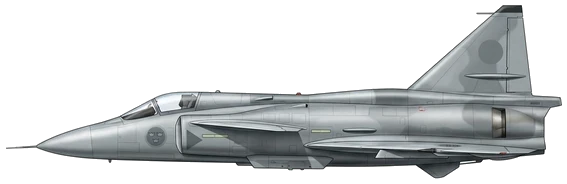
| Crew | 1 |
| Length | 16.4 m (53.8 ft) |
| Wingspan | 10.6 m (34.8 ft) |
| Height | 5.9 m (19.4 ft) |
| Wing area | 46 m² (495.1 sqft) |
| Empty weight | 9,500 kg (20,944 lbs) |
| Max. takeoff weight | 20,000 kg (44,092 lbs) |
| Powerplant | 1 × turbofan Volvo RM8B 12,746 kgf each |
| Ejection seat | SAAB FPL |
| Maximum speed | 2231 km/h (Mach 2.1) |
| Operational range | 1,820 km (1,131 mi) |
| Service ceiling | 18,000 m (59,055 ft) |
| Climb rate | 203.0 m/s (666.0 ft/s) |
- Air-to-Surface AGM-65 Maverick
- Air-to-Air Medium-Range AIM-120 AMRAAM
- Air-to-Air Short-Range Raytheon AIM-9 Sidewinder
- Air-to-Air Medium-Range Skyflash
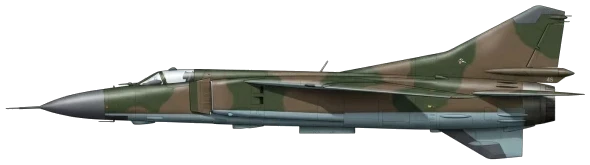
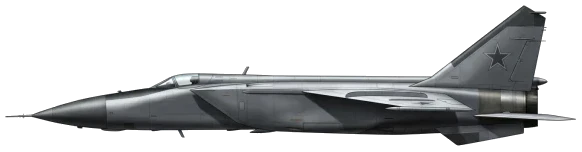
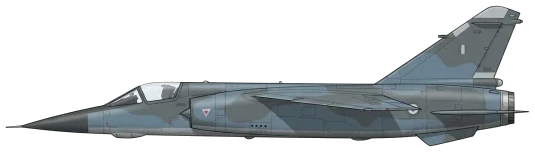
Description
The JA 37 Viggen was a single-seat, single-engine all-weather interceptor produced by Saab of Sweden, operated solely by the Swedish Air Force. It was the fighter-interceptor variant of the Saab 37 Viggen family, first flying in 1974 and entering operational service in 1979, and it retained a secondary ground-attack capability. It served as Sweden's primary air defence platform until it was replaced by the Saab JAS 39 Gripen, with the last front-line Viggens retired on 25 November 2005.
Development
Saab continued work on a dedicated all-weather interceptor version while earlier attack and reconnaissance variants were entering production. A 1970 review of Sweden's air defences concluded the projected JA 37 was suited to the role, and the Swedish government authorised development in 1972. Five prototypes were built — four converted AJ 37 airframes plus one pre-production JA 37 — to test control systems, engine, avionics and armament respectively; the first flew on 27 September 1974, and an initial order for 30 aircraft followed later that year. The first production JA 37 flew in November 1977, with operational trials running from January to December 1979. Serial numbers ran 37301–449. Viggen production ended in 1990 after 329 aircraft of all types; total Viggen output fell well short of the 800 envisaged in the 1964 budget proposal.
Design
The JA 37 used the double-delta wing with high-set canard foreplanes common to the family, with the fuselage stretched by 10 cm as a wedge between the canard and main wing to accommodate the Volvo RM8B turbofan. The RM8B added a third low-pressure compressor stage over the RM8A, giving 72.1 kN dry and 125.0 kN with afterburner; a thrust reverser permitted operations from 500 m airstrips. Externally the variant was distinguished by a taller tailfin and an underfuselage gunpack. Avionics centred on the Singer-Kearfott SKC-2037 processor, licence-built by Saab as the CD 107, and an Ericsson PS 46/A X-band pulse-doppler radar with look-down/shoot-down capability reported in excess of 50 km, continuous-wave illumination and track-while-scan on two targets. A Saab/Honeywell automatic digital flight control system, a Garrett AiResearch central air data computer derived from the F-14 unit, and three AP-12 CRT multifunction displays were fitted. The "fighter link" datalink entered service in 1985, allowing one aircraft to illuminate a target for the Skyflash missiles of three others.
Armament
Nine hardpoints could carry up to 7,000 kg. Primary armament was up to two RB 71 Skyflash semi-active radar homing missiles on the inner wing pylons, typically combined with four RB 24J Sidewinders; the JA 37D added the RB 99 (AIM-120 AMRAAM). A conformal underfuselage pod housed an Oerlikon KCA 30 mm cannon with 126 rounds, selectable at 22 or 11 rounds per second, firing the GAU-8 cartridge and effective to 2,000 m. Rocket pods, RB 04 and RBS 15 anti-ship missiles and the U95 ECM pod could also be carried.
Variants
- JA 37: Baseline all-weather interceptor with RM8B engine and PS 46/A radar, delivered from 1979 and partially decommissioned in 1998.
- JA 37C: Avionics and software upgrade of earlier JA 37s with added countermeasures.
- JA 37D: 1993–1998 upgrade of 35 airframes with new avionics, software and RB 99 integration.
- JA 37DI: Twenty JA 37Ds modified for international duties, with English-labelled instruments and feet/knots units.
Frequently Asked Questions
What type of aircraft is the JA 37 Viggen?
What is the maximum speed of the JA 37 Viggen?
What is the range of the JA 37 Viggen?
When did the JA 37 Viggen first fly?
How many JA 37 Viggen have been built?
Which countries operate the JA 37 Viggen?
How much does a JA 37 Viggen cost?
What is the service ceiling of the JA 37 Viggen?
- AUG 302026 Updated Description updated
- AUG 52026 Updated Powerplant and thrust updated
- APR 72026 Updated Sources and cross-references refreshed
- JAN 122026 Updated Range updated in a site-wide editorial pass