JA 37 Viggen vs JAS 39 Gripen
JA 37 Viggen vs JAS 39 Gripen at a glance — top speed 2,231 vs 2,100 km/h, range 1,820 vs 4,000 km, max takeoff weight 20,000 vs 14,000 kg, built 329 vs 300 units.
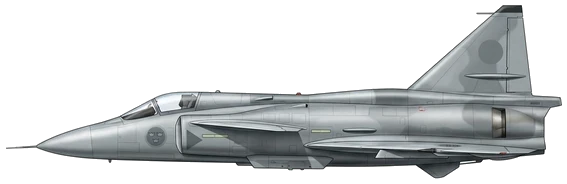
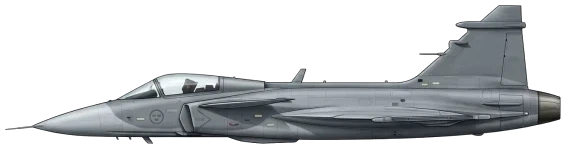
| JA 37 Viggen | JAS 39 Gripen | |
|---|---|---|
| Origin country | 🇸🇪 Sweden | 🇸🇪 Sweden |
| Category | Combat Aircraft | Combat Aircraft |
| Manufacturer | Saab | Saab |
| First flight | 8 February 1967 | 9 December 1988 |
| Year introduced | 1971 | 1996 |
| Number produced | 329 units | 300 units |
| Average unit price | $5 million | $30 million |
| Wing area | 46.0 m² | 30.0 m² |
| Wingspan | 10.6 m | 8.4 m |
| Height | 5.9 m | 4.5 m |
| Length | 16.4 m | 14.9 m |
| Maximum speed | 2231 km/h | 2100 km/h |
| Operational range | 1,820 km | 4,000 km |
| Service ceiling | 18,000 m | 15,240 m |
| Max. takeoff weight | 20,000 kg | 14,000 kg |
| Empty weight | 9,500 kg | 6,800 kg |
| Total thrust | 1 x 12,746 kgf | 1 x 8,209 kgf |
Detailed Comparison
The SAAB JA 37 Viggen and its successor, the JAS 39 Gripen, represent a direct lineage in Swedish combat aircraft design, yet they are products of vastly different strategic and technological eras. The Viggen was a powerful, specialized platform engineered for the specific Cold War threat of a large-scale invasion, prioritizing raw power and STOL performance from dispersed road bases. The Gripen, by contrast, is a lighter, truly multirole aircraft designed for flexibility, lower operational costs, and superior information processing in a more varied modern battlespace.
Development and Design
The Viggen's design was revolutionary for the 1960s, combining a large double-delta wing with a canard foreplane. This configuration was a direct answer to Sweden's unique requirement for aircraft that could operate from 500-meter road strips while still achieving Mach 2 performance. Its development was marked by key innovations like the world's first airborne computer using integrated circuits, the CK 37, and a ruggedized airframe built for no-flare landings. In contrast, the Gripen's development in the 1980s focused on creating a single, cost-effective platform to replace the entire Viggen and Draken fleets. While retaining the delta-canard layout, the Gripen is aerodynamically more refined and reliant on a sophisticated digital fly-by-wire system for its exceptional agility. Its design philosophy emphasizes modularity and ease of maintenance, aiming for high sortie rates with minimal ground crew.
Specifications and Performances
A comparison of specifications reveals a shift from brute force to balanced efficiency. The Viggen is substantially larger and heavier, with a maximum takeoff weight of 20,000 kg compared to the Gripen's 14,000 kg. This mass was powered by the immensely powerful Volvo RM8B engine, which gave the Viggen its high top speed (2,231 km/h) and formidable thrust for short takeoffs. The Gripen's lighter airframe and more modern, efficient Volvo RM12 turbofan result in a slightly lower top speed but a superior thrust-to-weight ratio and a significantly better climb rate (254 m/s vs. 203 m/s). The most significant performance gap is in avionics and weapons. While the Viggen's pulse-Doppler radar was capable for its time, the Gripen's sensor fusion, data links, and ability to employ modern BVR missiles like the Meteor provide vastly superior situational awareness and combat effectiveness.
Deployment and usage
The Viggen was the backbone of the Swedish Air Force during the Cold War, but its operational concept was highly specialized. It was deployed in distinct variants for attack (AJ 37), interception (JA 37), and reconnaissance (SF/SH 37), all integrated into a national air defense network. Its design was so tailored to Swedish needs—and reliant on US technology like its engine—that it achieved no export sales. The Gripen, conversely, was designed from the outset for both national defense and the export market. Its true multirole capability from a single airframe simplifies logistics and training. It has been successfully exported to several nations and has seen operational use in international contexts, including NATO's Baltic Air Policing and reconnaissance missions over Libya, proving its interoperability.
Conclusion
The Viggen was a formidable technological solution to a very specific and severe problem: national survival in a high-intensity Cold War conflict. It was a powerful, rugged, and innovative aircraft that pushed the boundaries of its era. The Gripen represents a logical evolution, adapting to a new strategic and economic reality. It trades the Viggen's raw power and specialization for superior agility, information dominance through advanced avionics, and operational flexibility. The transition from the Viggen to the Gripen illustrates the broader shift in air power doctrine, moving from platforms defined by sheer performance metrics to smarter, more adaptable, and economically sustainable systems.


