Aero L-159 ALCA
Summary
| Category | Military Training Aircraft |
| Origin country | 🇨🇿 Czechia |
| Manufacturer | Aero |
| First flight | 2 August 1997 |
| Year introduced | 2000 |
| Number produced | 72 units |
| Average unit price | $9 million |
Technical specifications
| Version: L-159A | |
|---|---|
| Crew | 1 pilot |
| Operational range | 1,570 km (976 mi) |
| Maximum speed | 936 km/h (582 mph) |
| Wing area | 18.8 m² (202.4 sqft) |
| Wingspan | 9.5 m (31.3 ft) |
| Height | 4.9 m (16.0 ft) |
| Length | 12.7 m (41.7 ft) |
| Service ceiling | 13,200 m (43,307 ft) |
| Empty weight | 4,350 kg (9,590 lbs) |
| Max. takeoff weight | 8,000 kg (17,637 lbs) |
| Climb rate | 62.0 m/s (203.4 ft/s) |
| Powerplant | 1 x turbojet Honeywell F124-GA-100 delivering 2871 kgf each |


Armament
Missiles payload:
- Air-to-Surface AGM-65 Maverick
- Anti-Radiation AGM-88 HARM
- Air-to-Air Short-Range MBDA AIM-132 ASRAAM
- Air-to-Air Short-Range MBDA IRIS-T
- Air-to-Air Short-Range Raytheon AIM-9 Sidewinder
Description
Development of the L-159 started in 1993 to replace Soviet-era fighter aircraft with a modern Czech-built equivalent, based on the L-59 Super Albatros. The development was supported by the Czech government, which ordered 72 L-159A aircraft to equip the Czech Air Force. In 1998, the Boeing Company became a strategic partner in the project and Aero Vodochody. The maiden flight of the L-159 occurred on 4 August 1997, and the first production aircraft was delivered to the Czech Air Force on 10 April 2000. The technical development of the L-159 conducted between 1994 and 1997 primarily involved building a single L-159 two-seat prototype based on the L-59 airframe and utilizing western engine, avionics, and weapon systems, with Rockwell Collins (eventually Boeing) as the avionics integrator. On 31 March 2017, after a 13-year stoppage in L-159 production, Aero Vodochody resumed manufacturing, delivering a new-build L-159 to the Iraqi Air Force.
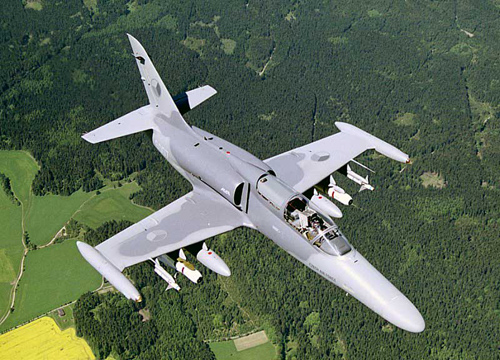
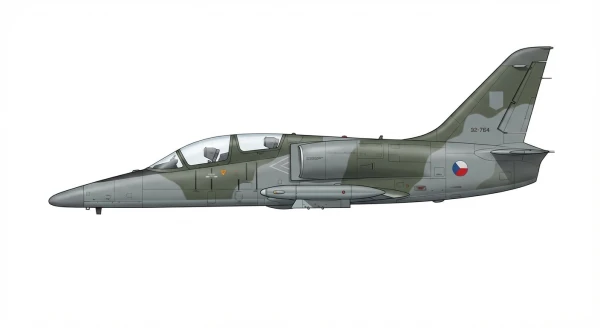
The L-159 design evolved from the L-39/59 series, retaining a similar aerodynamic configuration but with enhancements. The airframe was strengthened, and the cockpit received composite and ceramic ballistic armor. The nose was enlarged to house a radar, while the number of underwing pylons increased to six, along with a hardpoint under the fuselage. It is powered by a Honeywell/ITEC F124-GA-100 turbofan engine and carries almost 2,000 liters of fuel internally, with provisions for external drop tanks. The cockpit features a VS-2B ejection seat, and the avionics suite, based on the MIL-STD-1553 databus, includes a Selex Navigation and Attack Suite, INS, GPS, a head-up display, and multi-function displays. For self-protection, it is equipped with a radar warning receiver and a chaff and flare dispenser. The L-159A and T2 variants have the FIAR Grifo L multi-mode Doppler radar. It has a total of seven hardpoints and can carry external loads up to 2,340 kg.
The aircraft has seven hardpoints (one under the fuselage and six under the wings) enabling the carriage of external loads of up to 2,340 kg. The L-159 can be outfitted with a range of weaponry, from unguided bombs and rocket pods to air-to-ground and air-to-air guided missiles, alongside equipment for aerial reconnaissance or electronic warfare. Gun options include up to three ZVI PL-20 Plamen 2x20 mm gun pods. Rockets can be deployed using LAU-5002 pods (each with 6 x CRV7 70 mm rockets) or LAU-5003 pods (each with 19 x CRV7 70 mm rockets). For air-to-air engagements, the L-159 can carry AIM-9L/M Sidewinder missiles and is fitted for, but not with, AIM-120 AMRAAM missiles. Air-to-ground capabilities include AGM-65 Maverick missiles, as well as various laser-guided and unguided bombs such as the CBU-87 Combined Effects Munition, Mark 82 and 83 general-purpose bombs, GBU-12 Paveway II, and GBU-16 Paveway II. The aircraft can carry up to two 500 L drop tanks on inner hardpoints for ferry flights, or up to four 350 L drop tanks on inner and middle hardpoints for tactical missions.
The Czech Air Force is the primary operator of the L-159, though its initial order of 72 aircraft was later reduced to 24, which were upgraded, while the remaining airframes were placed into long-term storage. These aircraft have formed the backbone of the Czech Air Force's light attack and training capabilities. The L-159 has also seen active combat use by the Iraqi Air Force against ISIS insurgents, participating in attacks in Fallujah and near Mosul; these aircraft were placed into temporary storage and later brought back into service, with reported strikes against insurgents in ISIL hideouts. Draken International, a civilian American company, acquired 21 ex-Czech Air Force L-159s and employs them as aggressor aircraft for pilot training. Lewis Fighter Fleet LLC also operates three L-159As.
Main Variants:
-
L-159A: A single-seat light multi-role combat aircraft designed for air-to-air, air-to-ground, and reconnaissance missions, equipped with a multi-mode Doppler Grifo-L radar for all-weather, day and night operations and the ability to carry a wide range of NATO standard stores.
-
L-159E: The export designation for the L-159A variant, primarily operated by Draken International for aggressor training.
-
F/A-259: A combat-capable variant, developed in collaboration with Israel Aerospace Industries, powered by a Honeywell F124-GA-100 engine and pitched for light attack and armed reconnaissance roles.
-
L-159T1: A two-seat trainer derivative utilized by the Czech and Iraqi Air Forces, converted from stored L-159A airframes, featuring one multi-function display (MFD) in each cockpit without a radar.
-
L-159T2: A two-seat trainer with full combat capabilities converted from stored L-159A airframes, featuring newly manufactured components and a Grifo-L radar, with independent instruments interchangeable with the L-159A and using the same software configuration.