L-159 ALCA
Czech light combat aircraft, used since the late 20th century, active in NATO led partnership for peace program. Key figures: top speed 936 km/h, range 1,570 km, service ceiling 13,200 m, max takeoff weight 8,000 kg, unit price $9M, built 72. In service with 2 air forces as of 2026 — Czechia (24), Iraq (14).
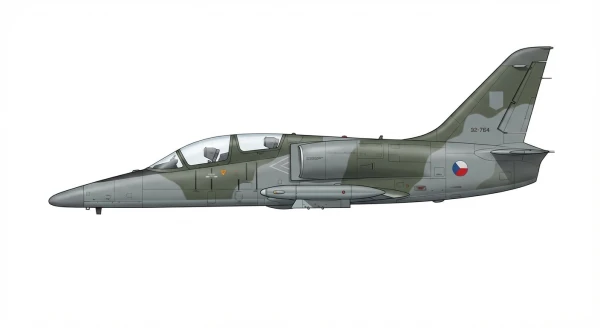
| Crew | 1 |
| Length | 12.7 m (41.7 ft) |
| Wingspan | 9.5 m (31.3 ft) |
| Height | 4.9 m (16.0 ft) |
| Wing area | 18.8 m² (202.4 sqft) |
| Empty weight | 4,350 kg (9,590 lbs) |
| Max. takeoff weight | 8,000 kg (17,637 lbs) |
| Powerplant | 1 × turbofan Honeywell F124-GA-100 2,871 kgf each |
| Ejection seat | VS-2B |
| Maximum speed | 936 km/h (582 mph) |
| Operational range | 1,570 km (976 mi) |
| Service ceiling | 13,200 m (43,307 ft) |
| Climb rate | 62.0 m/s (203.4 ft/s) |


- Air-to-Surface AGM-65 Maverick
- Anti-Radiation AGM-88 HARM
- Air-to-Air Short-Range MBDA AIM-132 ASRAAM
- Air-to-Air Short-Range MBDA IRIS-T
- Air-to-Air Short-Range Raytheon AIM-9 Sidewinder
Description
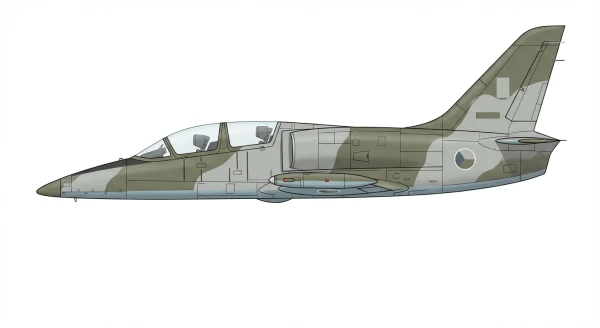
The Aero L-159 ALCA (Advanced Light Combat Aircraft) is a subsonic light combat aircraft and advanced trainer built by Aero Vodochody of the Czech Republic. Derived from the L-59 Super Albatros and, through it, the L-39 Albatros, it exists in single-seat (L-159A) and two-seat (L-159B/T) forms. It first flew in 1997 and entered Czech Air Force service in 2000. It has seen combat with the Iraqi Air Force against ISIL and is operated commercially as an aggressor aircraft by Draken International.
Development
After the 1989 Velvet Revolution and the dissolution of the Soviet Union, Aero Vodochody continued developing the L-39 line into the L-39MS/L-59, sold to Egypt and Tunisia. In 1993 a group of Czech military experts began work on a domestic replacement for Soviet-era types; the supersonic Aero L-X was rejected on cost grounds (up to US$2 billion) in favour of the subsonic L-159, intended to replace MiG-23BN and Su-22 fighter-bombers and Su-25 attack aircraft. Technical development ran from 1994 to 1997 around a single two-seat prototype on an L-59 airframe, with Rockwell Collins as avionics integrator. The Czech government ordered 72 L-159A aircraft for roughly 50 billion CZK, the contract signed on 4 July 1997. Boeing joined as strategic partner in May 1998, withdrawing in 2004 when Aero Vodochody was privatised; Penta Investments bought the company in October 2006. The two-seat prototype (5831) flew on 2 August 1997, the L-159A prototype (5832) on 18 August 1998, and the L-159B prototype (6073) on 1 June 2002. First delivery to the Czech Air Force took place on 10 April 2000. In 2003 the Czech fleet was cut from 72 to 24 aircraft. Production restarted on 31 March 2017 with a new-build aircraft for Iraq, incorporating a wet wing and increased endurance.
Design
The L-159 retains the L-39/59 aerodynamic configuration with a strengthened airframe, composite and ceramic ballistic armour in the cockpit, and an enlarged nose housing the radar. Underwing pylons were increased from four to six, with a fuselage hardpoint replacing the GSh-23L cannon. Power comes from a single non-afterburning Honeywell/ITEC F124-GA-100 turbofan of 28 kN. Almost 2,000 litres of fuel are carried in eight internal tanks, six fuselage and two wingtip. The cockpit uses a VS-2B zero-zero ejection seat. Avionics are built on a MIL-STD-1553 databus and include a Selex navigation and attack suite, ring laser gyro INS, GPS, an FV-3000 HUD and two MFDs. Self-protection comprises a Sky Guardian 200 RWR and Vinten Vicon 78 Series 455 dispensers. The L-159A and T2 carry the FIAR Grifo-L multi-mode Doppler radar.
Armament
Seven hardpoints — six underwing and one under-fuselage — carry up to 2,340 kg. Guns are provided by up to three ZVI PL-20 Plamen twin 20 mm pods. Stores include LAU-5002 and LAU-5003 CRV7 70 mm rocket pods, AIM-9L/M Sidewinder, AGM-65 Maverick, Mark 82 and Mark 83 bombs, CBU-87, GBU-12 and GBU-16 Paveway II; the type is fitted for but not with AIM-120 AMRAAM. AN/AAQ-28(V) LITENING targeting pods can be carried, and an Iraqi aircraft was photographed in March 2023 with a Turkish Aselpod. Two 500 L or four 350 L drop tanks may be fitted.
Operational History
The Czech Air Force operated 16 L-159A and 5 L-159T1 by 2016, ordering an upgrade of 16 airframes on 1 June 2016. Iraq agreed to buy 28 aircraft in October 2012, signing in early 2015 for 12 L-159As and two L-159T1s; delivery began 5 November 2015. Iraqi aircraft struck ISIL positions at Fallujah in May 2016 and, with No. 115 Squadron, south of Mosul in October–November 2016. Placed in storage around 2017–18, they returned to service by February 2022 after strikes in the Hamrin Mountains in late 2021. In 2009 EADS-CASA traded four C-295 for three L-159As, two L-159T1s and €130 million; the T1s were later returned and the L-159As resold to Lewis Fighter Fleet LLC. Draken International acquired 21 ex-Czech aircraft from 2014, the first handed over on 30 September 2015, under contracts with the USAF and RAF. Hungary leased one L-159B from 2008 to 2010, and Ireland evaluated the type without ordering.
Variants
- L-159A: Single-seat multi-role version with Grifo-L radar, in service with the Czech and Iraqi air forces.
- L-159E: Export designation for aircraft operated by Draken International.
- L-159B Albatros II: Two-seat lead-in fighter trainer; the sole prototype was rebuilt as the L-159T2X demonstrator.
- L-159T1/T1+: Two-seat trainers converted from stored L-159A airframes, the T1+ adding an upgraded mission system and Grifo-L radar.
- F/A-259: Combat variant developed with Israel Aerospace Industries, unveiled at Farnborough on 16 July 2018 for the USAF Light Attack/Armed Reconnaissance programme.
Frequently Asked Questions
What type of aircraft is the L-159 ALCA?
What is the maximum speed of the L-159 ALCA?
What is the range of the L-159 ALCA?
When did the L-159 ALCA first fly?
How many L-159 ALCA have been built?
Which countries operate the L-159 ALCA?
How much does a L-159 ALCA cost?
What is the service ceiling of the L-159 ALCA?
- AUG 302026 Updated Description updated
- AUG 52026 Updated Powerplant updated in a site-wide editorial pass
- JUL 232026 Updated Sources and cross-references refreshed
- APR 72026 Updated Sources and cross-references refreshed
- APR 52026 Updated Ejection seat added
- JAN 122026 Updated Range updated in a site-wide editorial pass