L-159 ALCA vs L-39 Albatros
L-159 ALCA vs L-39 Albatros at a glance — top speed 936 vs 750 km/h, range 1,570 vs 1,100 km, max takeoff weight 8,000 vs 4,700 kg, built 72 vs 2,900 units.
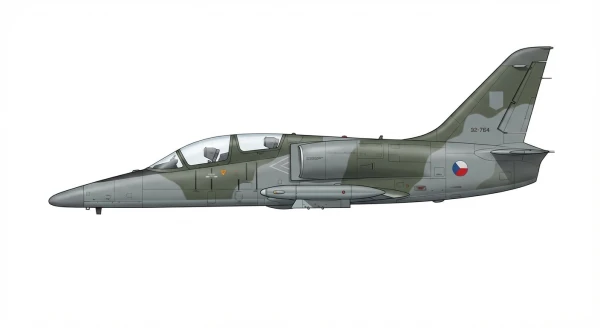
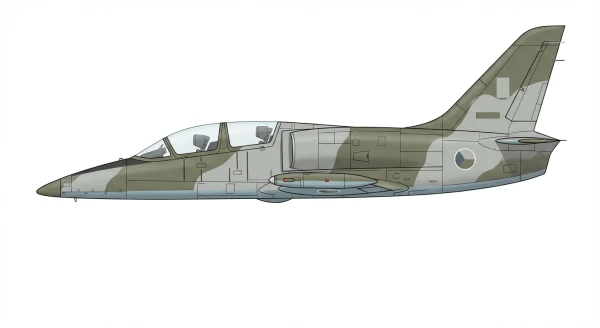
| L-159 ALCA | L-39 Albatros | |
|---|---|---|
| Origin country | 🇨🇿 Czechia | 🇨🇿 Czechia |
| Category | Military Training Aircraft | Military Training Aircraft |
| Manufacturer | Aero | Aero |
| First flight | 2 August 1997 | 4 November 1968 |
| Year introduced | 2000 | 1972 |
| Number produced | 72 units | 2900 units |
| Average unit price | $9 million | $1 million |
| Wing area | 18.8 m² | 18.8 m² |
| Wingspan | 9.5 m | 9.5 m |
| Height | 4.9 m | 4.8 m |
| Length | 12.7 m | 12.1 m |
| Maximum speed | 936 km/h | 750 km/h |
| Operational range | 1,570 km | 1,100 km |
| Service ceiling | 13,200 m | 11,500 m |
| Max. takeoff weight | 8,000 kg | 4,700 kg |
| Empty weight | 4,350 kg | 3,459 kg |
| Total thrust | 1 x 2,871 kgf | 1 x 1,720 kgf |
Detailed Comparison
The transition from the Aero L-39 Albatros to the L-159 ALCA reflects the Czech aviation industry's pivot from Warsaw Pact standardization to NATO interoperability. While the L-39 achieved global hegemony as the Eastern Bloc’s primary trainer with nearly 3,000 units produced, the L-159 attempted to carve a niche as a dedicated light combat aircraft (LCA) utilizing Western avionics and weaponry, resulting in a far more capable but commercially challenged platform.
Development and Design
The L-39 was engineered in the 1960s for simplicity and ruggedness, prioritizing operation from unprepared airstrips and ease of maintenance for conscript mechanics. Its design relies on the straightforward Ivchenko AI-25TL engine and basic electromechanical avionics suitable for ab-initio through advanced training.
Conversely, the L-159, developed in the late 1990s with Boeing as a strategic partner, represents a doctrinal shift. It integrates a MIL-STD-1553 databus, Honeywell F124 engine, and composite armor. Unlike the L-39, which was a trainer adapted for light attack, the L-159A was designed primarily as a single-seat combat aircraft. The inclusion of the Grifo-L multi-mode radar fundamentally changes the airframe's utility, enabling all-weather operations and air-to-air engagements that the L-39 cannot support.
Specifications and Performance
The performance gap between the two is substantial, dictated largely by the powerplant. The L-159’s Honeywell F124 generates 2,871 kgf of thrust, nearly 67% more than the L-39’s 1,720 kgf. This results in a climb rate of 62.0 m/s for the L-159 compared to an anemic 22.0 m/s for the L-39. In a combat scenario, this energy management capability is often the difference between survivability and destruction by ground fire.
Payload capacity reinforces this disparity. The L-159 carries 2,340 kg of external stores across seven hardpoints, more than double the L-39’s typical 1,000 kg load. Furthermore, the L-159’s avionics support precision-guided munitions like the AGM-65 Maverick and GBU-12/16, whereas the L-39 is generally restricted to unguided rockets and iron bombs.
Deployment and Usage
The L-39 remains the "Kalashnikov of jet trainers," seeing widespread combat in Syria, Libya, and Ukraine. However, its usage in these conflicts has been characterized by high attrition rates due to its lack of radar warning receivers (RWR) and countermeasures, forcing pilots into low-altitude, high-risk profiles to deliver unguided munitions.
The L-159 has seen more specialized combat application. The Iraqi Air Force effectively employed the type against ISIS in Fallujah and Mosul, utilizing its targeting pod and guided munition capabilities to strike insurgent positions with reduced collateral damage. Additionally, the L-159 has found a second life in the private aggressor market; Draken International utilizes the platform's radar and performance to simulate fourth-generation threats, a role the L-39 cannot fulfill.
Conclusion
The L-159 ALCA is unequivocally the superior combat platform, offering genuine light attack and lead-in fighter training (LIFT) capabilities comparable to the BAE Hawk 200. It is a pocket fighter capable of BVR engagement and precision strikes. The L-39 Albatros, costing a fraction of the price ($1M vs $9M), retains the edge only in cost-efficiency for basic pilot training and attrition warfare where quantity supersedes technological capability. The L-159 failed to match the L-39's export success not due to capability, but because it entered a market flooded with surplus F-16s that offered higher performance for similar procurement costs.