Aermacchi M-345
Italian training jet, deployed in the 21st-century, used extensively for military pilot training purposes. Key figures: top speed 740 km/h, range 1,410 km, service ceiling 12,190 m, max takeoff weight 4,100 kg, built 4. In service with 1 air force as of 2026 — Italy (9).
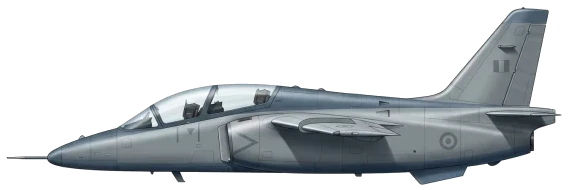
| Length | 9.9 m (32.3 ft) |
| Wingspan | 8.5 m (27.8 ft) |
| Height | 3.7 m (12.3 ft) |
| Wing area | 12.6 m² (135.6 sqft) |
| Empty weight | 2,300 kg (5,071 lbs) |
| Max. takeoff weight | 4,100 kg (9,039 lbs) |
| Powerplant | 1 × turbofan Pratt & Whitney Canada JT15D-5C 1,447 kgf each |
| Ejection seat | Martin-Baker Mk 16 |
| Maximum speed | 740 km/h (460 mph) |
| Operational range | 1,410 km (876 mi) |
| Service ceiling | 12,190 m (39,993 ft) |
| Climb rate | 25.0 m/s (82.0 ft/s) |

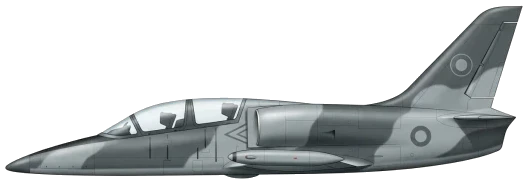
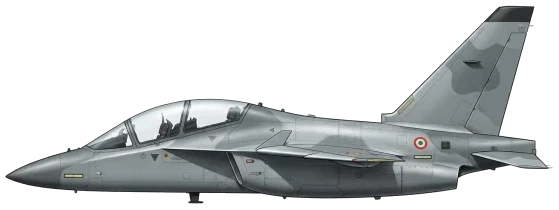
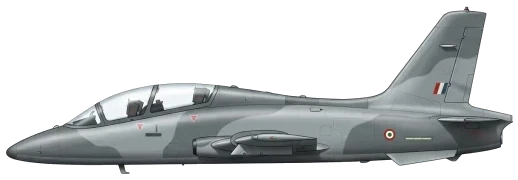
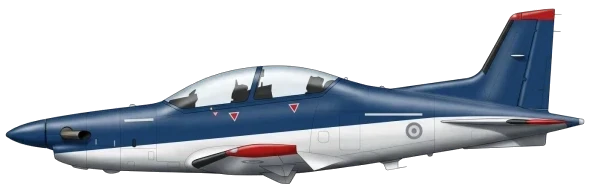
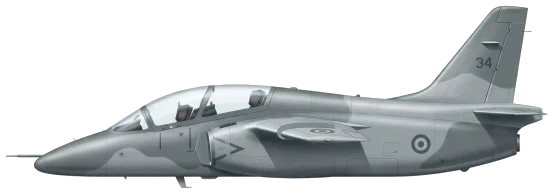
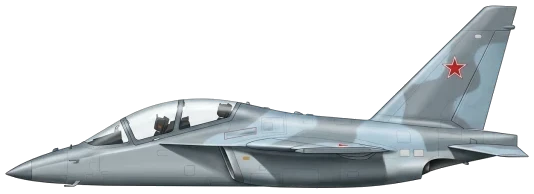
Description
The Aermacchi M-345 is a single-engine, two-seat jet trainer designed and produced by Leonardo S.p.A. of Italy. Developed from the Aermacchi M-311, itself a derivative of the SIAI-Marchetti S.211, it covers basic and advanced training as well as tactical training, complementing the twin-engine M-346 Master. The type first flew on 29 December 2016 and entered Italian Air Force service in December 2020 as the T-345A, replacing the MB-339A.
Development
Aermacchi acquired SIAI-Marchetti in 1997, obtaining rights to the S.211. In 2004 the company announced an improved version designated M-311, fitted with a new cockpit, structural changes including greater use of composites, and a Pratt & Whitney Canada JT15D-5C turbofan. These changes gave a 15,000-flight-hour fatigue life and longer overhaul intervals; Aermacchi claimed direct operating costs only 5% above turboprop competitors despite roughly 30% higher fuel burn. The first prototype flew on 1 June 2005, joined by a second aircraft converted from a 1990s technology demonstrator; a prototype was displayed at the Royal International Air Tattoo in July 2006. In mid-2006 the company forecast demand for up to 350 aircraft by 2030, and on 28 May 2008 Boeing and Alenia signed an agreement covering marketing and product support for the M-311 and M-346.
In 2012 Alenia Aermacchi redesignated the revised aircraft M-345 HET (High Efficiency Trainer). The Williams International FJ44-4M was selected in October 2014 over Honeywell and Pratt & Whitney bids, and was installed on the flight-test aircraft in place of the JT15D. A memorandum of understanding with ENAER of Chile followed in March 2015 for possible joint manufacture in South America, and the type was offered to the French DGA on 1 June 2015 as an Alpha Jet replacement. On 20 September 2018 Alenia Aermacchi signed a memorandum with South Africa's Paramount Group to study a combat variant. The first production-standard aircraft flew from Venegono Superiore in December 2018.
Design
The M-345 is a shoulder-wing monoplane with retractable tricycle landing gear, powered by one Williams FJ44-4M-34 of 15.40 kN. Maximum speed is 740 km/h, range 1,410 km, service ceiling 12,190 m, with g limits of +7.0/−3.5 and a maximum take-off weight of 4,500 kg. Crew sit in tandem on Martin-Baker Mk.IT16D zero-zero ejection seats with HOTAS controls; cockpit internal dimensions match those of the BAE Systems Hawk, and displays are NVG-compatible. An OBOGS replaces oxygen bottles. Avionics comprise three 5 x 7 in colour multifunction displays, a wide-angle HUD with a rear-cockpit repeater, dual mission computers, embedded GPS/INS and radar altimeter, two V/UHF radios, IFF transponder, TAS and TCAS, with optional digital moving map, stores management system and the Embedded Tactical Training System also used on the M-346. Ailerons are hydraulically boosted with manual reversion; elevator and rudder are mechanically actuated by pushrods. A HUMS supports two-level maintenance.
Armament
Four underwing hardpoints carry more than 1,000 kg of stores for a secondary close air support role. Loads include gun pods, bombs and rockets, with provision for infrared-guided air-to-air missiles.
Operational History
Italy ordered five aircraft in January 2017 and a further 13 in June 2019, for a total of 18 against a stated requirement of up to 45 to replace 137 MB-339s. Initial military certification was achieved in May 2020, with the first two aircraft accepted in December 2020 and inducted in January 2021 for the second and third phases of pilot training. The 61° Stormo at Lecce-Galatina Air Base operates the M-345 alongside MB-339A/CD and M-346 aircraft, including international student training. A planned re-equipment of the Frecce Tricolori was reversed in 2024 in favour of the M-346, the M-345 being judged unsuitable for large-formation aerobatics. The T-345A was formally introduced in June 2025 alongside the MB-339A phase-out.
Variants
- M-311: Modernized S.211 derivative powered by a Pratt & Whitney Canada JT15D-5C, two prototypes built.
- M-345: 2012 redesignation of the M-311, re-engined with the Williams International FJ44-4M.
- T-345A: Italian Air Force designation for the M-345.
Frequently Asked Questions
What type of aircraft is the Aermacchi M-345?
What is the maximum speed of the Aermacchi M-345?
What is the range of the Aermacchi M-345?
When did the Aermacchi M-345 first fly?
How many Aermacchi M-345 have been built?
Which countries operate the Aermacchi M-345?
What is the service ceiling of the Aermacchi M-345?
- AUG 302026 Updated Description updated
- JUL 272026 Updated Name updated
- APR 192026 Updated Service entry year added
- APR 72026 Updated Sources and cross-references refreshed
- APR 52026 Updated Ejection seat added
- JAN 122026 Updated Range updated in a site-wide editorial pass