Aermacchi S-211
Italian jet trainer, utilized from the 1980s, widely deployed for military roles like ground attack and reconnaissance. Key figures: top speed 667 km/h, range 1,668 km, service ceiling 12,200 m, max takeoff weight 2,750 kg, built 60. In service with 1 air force as of 2026 — Philippines (3).
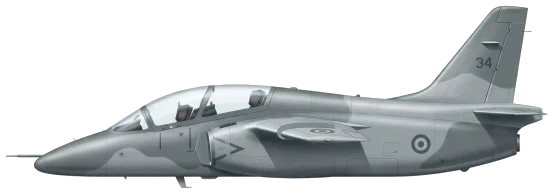
| Length | 9.3 m (30.5 ft) |
| Wingspan | 8.4 m (27.7 ft) |
| Height | 3.8 m (12.5 ft) |
| Wing area | 12.6 m² (135.6 sqft) |
| Empty weight | 1,850 kg (4,079 lbs) |
| Max. takeoff weight | 2,750 kg (6,063 lbs) |
| Powerplant | 1 × turbofan Pratt & Whitney Canada JT15D-4C 1,131 kgf each |
| Ejection seat | Martin-Baker Mk 10 |
| Maximum speed | 667 km/h (414 mph) |
| Operational range | 1,668 km (1,036 mi) |
| Service ceiling | 12,200 m (40,026 ft) |
| Climb rate | 21.0 m/s (68.9 ft/s) |

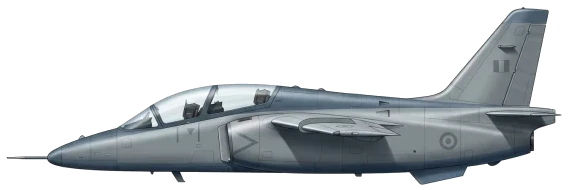
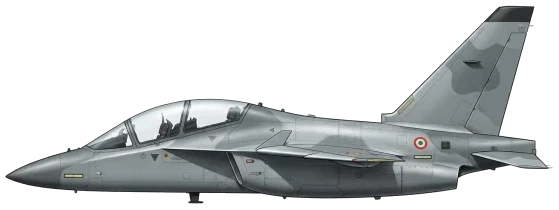
Description
The SIAI-Marchetti S.211, later marketed as the Aermacchi S-211, is a two-seat turbofan-powered basic trainer and light attack aircraft developed in Italy. Designed as a private venture from 1976, it first flew in April 1981 and entered service with the Republic of Singapore Air Force following a 1983 order. Around 60 aircraft were built, serving with the air forces of Singapore, the Philippines and Haiti.
Development
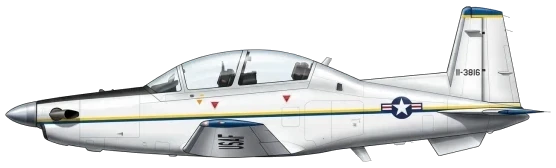
SIAI-Marchetti began work on the S-211 in 1976 as a private venture intended for existing customers of its piston-engined SF.260 trainer. The programme was announced at Paris in 1977, and customer interest justified two prototypes, the first flying on 10 April 1981. The Singapore Air Force ordered ten aircraft in 1983, the type's first order. The S-211A, an updated variant developed with Grumman and later Northrop Grumman using two converted ex-Haitian airframes, was an unsuccessful entrant in the USAF Joint Primary Aircraft Training System competition won by the Raytheon/Pilatus T-6 Texan II. Aermacchi acquired SIAI-Marchetti in 1997, consolidating production at Venegono Inferiore. In 2004 Aermacchi announced a modernised derivative, initially the S-311/M-311 and later the M-345, which entered service in 2020.
Design
The S-211 is a shoulder-wing monoplane with retractable tricycle landing gear and tandem seating, the rear cockpit raised above the front and fully duplicated. Power comes from a single Pratt & Whitney Canada JT15D-4C turbofan rated at 11.12 kN (2,500 lbf), giving a maximum speed of 414 knots at 25,000 ft and a climb rate of about 5,100 ft/min. The airframe makes use of Kevlar, Nomex and carbon fibre with structural bonding; primary flight controls are manual push-pull rods, while the airbrake, landing gear and boosted ailerons are hydraulically actuated at 200 bar. Electrical supply is 28V DC from an engine-driven generator with two inverters for AC and a nickel-cadmium battery for starting. Internal fuel totals 955 L in an integral wing tank and a fuselage bladder cell, with two 323 L drop tanks available on the inner wing pylons. Avionics fits were customisable, typically comprising VHF/UHF radios, AHRS, HSI, ADF, VOR-ILS, TACAN and IFF; glass cockpits were offered as an option.
Armament
Four underwing hardpoints carry up to 660 kg of stores, with some aircraft fitted with an additional fuselage centreline station. Typical loads include unguided bombs, rocket pods such as the SNEB 68 mm, gun pods, and reconnaissance sensor or camera pods. Philippine AS-211s carry a belly gun pod built by Aerotech Industries Philippines, housing an M3 .50 calibre machine gun with an automatic charger and roughly 240 rounds.
Operational History
The Republic of Singapore Air Force operated 32 aircraft, 24 assembled locally by Singapore Aircraft Industries and two acquired second-hand from Haiti as attrition replacements. Flying with 130 and 131 Squadrons, training was conducted at RAAF Base Pearce, Western Australia; seven airframes were written off in accidents and the type was replaced by the Pilatus PC-21 from late 2008. Twenty-one surplus airframes were sold to IAP Group Australia in 2009. Haiti received four aircraft in June 1985 and retired them in April 1990. The Philippine Air Force took 18 aircraft ordered in 1988 and delivered in 1989, followed by six more in 1992, with 15 assembled by the Philippine Aerospace Development Corporation. Redesignated AS-211 and nicknamed "Warriors", they assumed air defence duties after the F-5s retired in 2005 and received the Norsight optical sight, AN/ARC-34 radios and low-visibility grey camouflage under Projects Falcon, Falcon Uniform and Falcon Hear. Attack duties passed to the FA-50PH from 2015–2017, and three remained active in 2024.
Variants
- S-211: Original production version, roughly 60 built, operated by Haiti, the Philippines and Singapore.
- S-211A: JPATS contender developed with Grumman input, two prototypes converted from ex-Haitian airframes.
- AS-211: Philippine Air Force trainers with secondary combat capability, upgraded from 2005 with F-5 sighting and radio equipment and an Aerotech .50 calibre belly gun pod.
- M-311: Modernised and uprated version announced by Aermacchi in 2004, two prototypes built.
Frequently Asked Questions
What type of aircraft is the Aermacchi S-211?
What is the maximum speed of the Aermacchi S-211?
What is the range of the Aermacchi S-211?
When did the Aermacchi S-211 first fly?
How many Aermacchi S-211 have been built?
Which countries operate the Aermacchi S-211?
What is the service ceiling of the Aermacchi S-211?
- AUG 302026 Updated Description updated
- JUL 272026 Updated Name updated
- APR 72026 Updated Picture credits updated in a site-wide editorial pass
- JAN 122026 Updated Range updated in a site-wide editorial pass