Aermacchi M-345 vs M-346 Master
Aermacchi M-345 vs M-346 Master at a glance — top speed 740 vs 1,092 km/h, range 1,410 vs 1,925 km, max takeoff weight 4,100 vs 9,500 kg, built 4 vs 92 units.
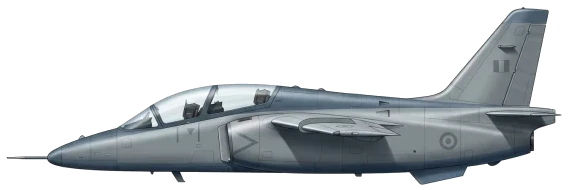
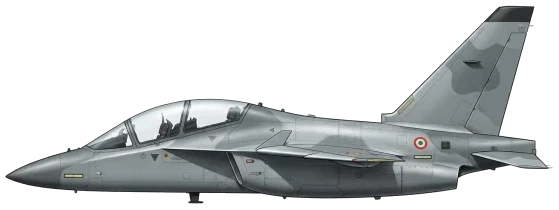
| Aermacchi M-345 | M-346 Master | |
|---|---|---|
| Origin country | 🇮🇹 Italy | 🇮🇹 Italy |
| Category | Military Training Aircraft | Military Training Aircraft |
| Manufacturer | Aermacchi | Aermacchi |
| First flight | 29 December 2016 | 15 July 2004 |
| Year introduced | 2020 | 2015 |
| Number produced | 4 units | 92 units |
| Average unit price | -- | $40 million |
| Wing area | 12.6 m² | 23.5 m² |
| Wingspan | 8.5 m | 9.7 m |
| Height | 3.7 m | 4.8 m |
| Length | 9.9 m | 11.5 m |
| Maximum speed | 740 km/h | 1092 km/h |
| Operational range | 1,410 km | 1,925 km |
| Service ceiling | 12,190 m | 13,716 m |
| Max. takeoff weight | 4,100 kg | 9,500 kg |
| Empty weight | 2,300 kg | 4,610 kg |
| Total thrust | 1 x 1,447 kgf | 2 x 2,835 kgf |
Detailed Comparison
Leonardo’s training aircraft portfolio splits into two distinct tiers: the M-346 Master targets the high-end Lead-In Fighter Training (LIFT) requirement, while the M-345 HET serves as a basic-to-advanced platform intended to replace the legacy MB-339. While they share a manufacturer and avionics DNA, they occupy opposite ends of the jet trainer spectrum—one is a transonic surrogate for fifth-generation fighters, the other a cost-conscious evolution of a Cold War-era airframe designed to keep per-hour operating costs near turboprop levels.
Development and Design
The M-346 Master creates a lineage break from traditional Italian designs, originating from a dissolved 1990s partnership with Yakovlev (resulting in the Russian Yak-130). It features a quadruplex digital fly-by-wire (FBW) control system and high angle-of-attack (AoA) capability (>30 degrees), specifically engineered to mimic the unstable aerodynamics of fighters like the Eurofighter Typhoon or F-35.
In contrast, the M-345 is a direct evolution of the SIAI-Marchetti S.211 from the 1980s. Aermacchi re-engined the airframe with a commercial Williams FJ44 and updated the avionics, but the fundamental aerodynamics remain conventional. It lacks the fly-by-wire sophistication of the Master, relying on structural reinforcement and systems updates to bridge the gap between primary training and LIFT.
Specifications and Performance
Performance metrics reveal the stark operational divide. The twin-engine M-346 achieves 1,092 km/h and a climb rate of 127 m/s, providing the excess thrust required to teach energy management tactics. The single-engine M-345 serves a different envelope, with a max speed of 740 km/h and a modest climb rate of 25 m/s.
The M-346's payload capacity of 3,000 kg across seven hardpoints dwarfs the M-345's 1,000 kg on four stations. Consequently, the M-346 can replicate complex combat loads and dynamic maneuvering, whereas the M-345 is limited to basic weapons employment and navigation training.
Deployment and Usage
The M-346 has secured a foothold in the global LIFT market, adopted by Israel, Singapore, Poland, and Qatar. Its Embedded Tactical Training System (ETTS) allows it to emulate radar and electronic warfare scenarios without carrying the actual sensors, a critical feature for training pilots for network-centric warfare. However, its high acquisition cost ($40 million) contributed to its failure in the U.S. Air Force T-X competition (as the T-100).
The M-345 has seen limited adoption, primarily by the Italian Air Force (AMI) to replace the MB-339, including for the Frecce Tricolori. It functions as a "download" aircraft, handling syllabus items that are too expensive to fly on the M-346 but require jet characteristics.
Conclusion
The M-346 Master is the superior combat trainer, essential for air forces transitioning to fifth-generation platforms where high-AoA handling and sensor emulation are mandatory. It is a genuine light combat aircraft capable of secondary policing roles.
The M-345 occupies a precarious niche. While it offers jet handling at lower costs, it faces fierce competition from high-performance turboprops like the Pilatus PC-21 and Embraer Super Tucano, which offer similar avionics and operating costs with better endurance. The M-346 wins on capability; the M-345 relies entirely on the operator's preference for a pure-jet syllabus over turboprops.


