Alpha Jet
French-German trainer jet, known for North Atlantic Treaty Organization (NATO) pilot training, used particularly from late 1970s onward. Key figures: top speed 1,000 km/h, range 2,940 km, service ceiling 14,630 m, max takeoff weight 7,500 kg, unit price $8M, built 480. In service with 8 air forces as of 2026 — Egypt (40), France (25), Morocco (22) and 5 others.
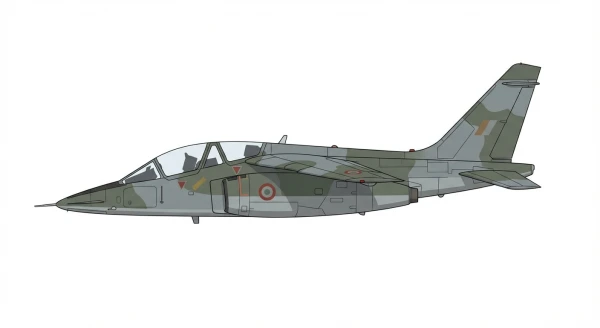
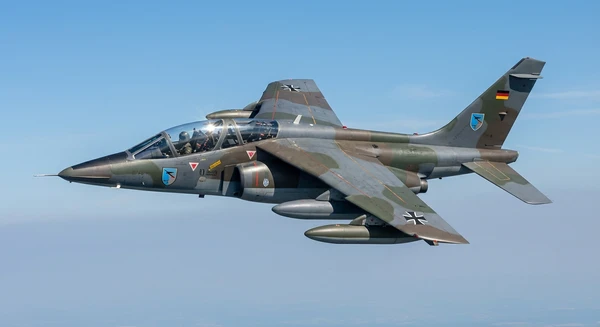
| Crew | 2 |
| Length | 13.2 m (43.4 ft) |
| Wingspan | 9.1 m (29.9 ft) |
| Height | 4.2 m (13.7 ft) |
| Wing area | 17.5 m² (188.4 sqft) |
| Empty weight | 3,515 kg (7,749 lbs) |
| Max. takeoff weight | 7,500 kg (16,535 lbs) |
| Powerplant | 2 × turbofans SNECMA-Turbomeca Larzac 04-C5 2,700 kgf each |
| Ejection seat | UPC Stencel S-III-S3IA63 |
| Maximum speed | 1000 km/h (Mach 1.0) |
| Operational range | 2,940 km (1,827 mi) |
| Service ceiling | 14,630 m (47,999 ft) |
| Climb rate | 57.0 m/s (187.0 ft/s) |


- Air-to-Surface AGM-65 Maverick
- Air-to-Air Short-Range R550 Magic
- Air-to-Air Short-Range Raytheon AIM-9 Sidewinder
- Cluster BL755
- Low-Drag Thomson-CSF BAT-120
Recent Events — Alpha Jet
3 events →
Description
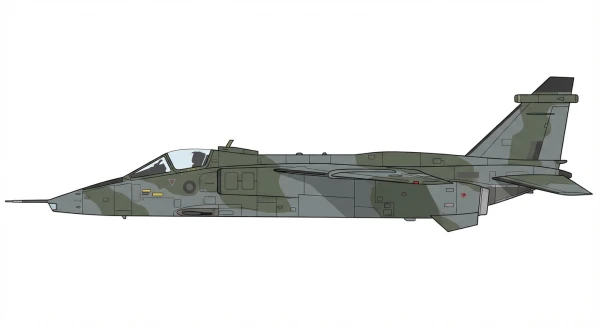
In the early 1960s, several European air forces recognized a need for a new generation of jet trainers to replace aircraft like the Lockheed T-33 and Fouga Magister. Initial collaboration between Britain and France to produce a supersonic jet for both training and light attack roles led to the SEPECAT Jaguar, which evolved into a nuclear-capable strike fighter, not suited for basic training. Consequently, France initiated discussions with West Germany in 1967 for a collaborative effort. By 1968, a joint specification for a subsonic trainer aircraft was produced, and in July 1969, a joint development and production agreement was signed, committing both nations to purchase 200 aircraft, to be assembled domestically. Competing proposals from Dassault, Breguet, and Dornier ("TA501"), VFW-Fokker ("VFT-291"), and SNIAS/MBB ("E.650 Eurotrainer") were evaluated, with the TA501 declared the winner on July 23, 1970. Dassault was designated the lead company, and construction of four prototypes commenced, two by Dassault in France, and two by Dornier in Germany. The first French prototype flew in October 1973, followed by the first German prototype in January 1974.
Design
The Alpha Jet is a light twin-engine jet, whose simple airframe belies its high performance. Its design, developed with the assistance of CAD, adheres to the area rule, while both the leading edges and air intakes are fixed. The aircraft makes use of fully powered controls incorporating dual-hydraulic systems, with a load-factor limited dynamic feel system arrangement linked to conventional flight control surfaces. For enhanced crew comfort during training flights, the cockpit is pressurized. Attention was given to rapid turnaround times, aiming for just ten minutes with minimal ground equipment, achieved through features like single-point pressure refueling, ladder-less cockpit access, and a liquid oxygen system capable of ten hours of endurance. The Alpha Jet is equipped with five hardpoints, four on the wings and one at the centerline on the lower fuselage, capable of carrying nearly 5,000 lb of munitions and equipment.
Armament
When configured for armed missions, a gun pod containing either a 30 mm DEFA cannon (as installed on French aircraft) or a 27 mm Mauser BK-27 cannon (as installed on German aircraft) is typically mounted on the centerline hard point. For air-to-air defense, it can carry two AIM-9 Sidewinder or Matra Magic II missiles. Furthermore, the Alpha Jet can be equipped with two Matra rocket pods, each housing eighteen SNEB 68 mm rockets, or two CRV7 rocket pods, each with nineteen 70 mm rockets. For ground attack, it is cleared to carry a variety of bombs, including cluster bombs like the Hunting BL755. The aircraft also has provisions for carrying two 310 L drop tanks to extend its range.
Operational History
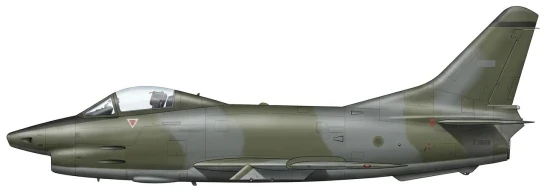
The French Air Force adopted the Alpha Jet primarily as a trainer, with the first production aircraft for French service flying in November 1977 and entering line service in May 1979 as the Alpha Jet E. It replaced the Canadair T-33 and Fouga Magister in jet training roles and the Dassault Mystère IVA in weapons training. In contrast, the Luftwaffe primarily used the Alpha Jet in the light strike role, replacing the Fiat G91R/3 fleet, and also employed it in electronic countermeasures and aerial reconnaissance roles, with a reconnaissance pod for the latter. During the 1991 Gulf War, 18 German Alpha Jets were deployed to Turkey as part of a NATO operation. The Nigerian Air Force deployed four Alpha Jets in 1990 to support ECOMOG forces in Liberia, significantly enhancing their firepower and later employing them extensively against the NPLF. The Royal Moroccan Air Force used its Alpha Jets in strike missions against the Polisario Front during the Western Sahara War, losing one aircraft in December 1985.
Variants
Main Variants:
-
Alpha Jet A: The attack version, originally used by Germany, was optimized for close air support and tactical strike missions.
-
Alpha Jet E: The trainer version, initially operated by France and Belgium, was designed for advanced pilot training.
-
Alpha Jet 2: This was a development of the Alpha Jet E that was further optimized for ground attack, featuring improved avionics.
-
Alpha Jet MS1: This close support-capable version was assembled in Egypt, serving in both training and light attack roles.
-
Alpha Jet MS2: An improved Egyptian version with new avionics, an uprated engine, compatibility with Magic Air-to-Air missiles, and a Lancier glass cockpit.
Frequently Asked Questions
What type of aircraft is the Alpha Jet?
What is the maximum speed of the Alpha Jet?
What is the range of the Alpha Jet?
When did the Alpha Jet first fly?
How many Alpha Jet have been built?
Which countries operate the Alpha Jet?
How much does a Alpha Jet cost?
What is the service ceiling of the Alpha Jet?
- AUG 122026 Updated Range corrected to the ferry range with drop tanks
- AUG 52026 Updated Powerplant updated in a site-wide editorial pass
- AUG 12026 Updated Manufacturer updated
- JUL 272026 Updated Name updated
- APR 72026 Updated Sources and cross-references refreshed
- JAN 242026 Updated Thrust updated
- JAN 122026 Updated Range updated in a site-wide editorial pass