Fairchild Swearingen Metroliner
Summary
| Category | Military Transport Aircraft |
| Origin country | 🇺🇸 United States |
| Manufacturer | Fairchild Swearingen |
| First flight | 26 August 1969 |
| Year introduced | 1972 |
| Number produced | 600 units |
Technical specifications
| Version: C-26A | |
|---|---|
| Operational range | 1,100 km (684 mi) |
| Maximum speed | 533 km/h (331 mph) |
| Wingspan | 14.1 m (46.3 ft) |
| Height | 5.1 m (16.8 ft) |
| Length | 12.9 m (42.2 ft) |
| Service ceiling | 9,449 m (31,001 ft) |
| Max. takeoff weight | 6,350 kg (13,999 lbs) |
| Powerplant | 2 x turboprops AlliedSignal TPE331-11U-601G delivering 1044 kW each |
Current operating countries
| Country | Units | ||
|---|---|---|---|

|
United States | 20 | |

|
Peru | 3 | |

|
Trinidad and Tobago | 2 | |

|
Venezuela | 1 | |
All operators
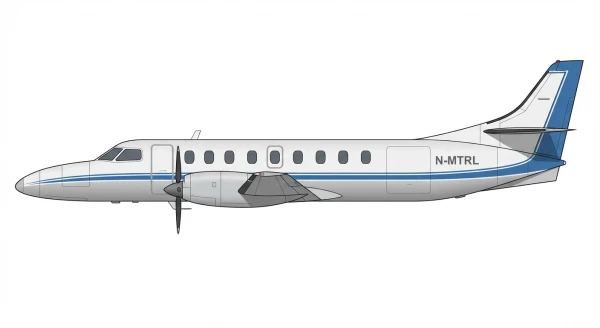
Description
Prototype construction of the Metro began in 1968, with the first flight taking place on August 26, 1969. Fairchild, already involved in marketing the Metro and constructing its wings and engine nacelles, acquired a 90% stake in Swearingen in late 1971 due to Swearingen Aircraft's financial difficulties. The company was subsequently renamed Swearingen Aviation Corporation, enabling production of the Metro.
The Metroliner design, designated SA226-TC Metro, evolved from the Swearingen Merlin business aircraft, representing a stretch of the Merlin III airframe. Optimized to seat 19 passengers in accordance with FAA regulations, the design provided 4 feet and 9 inches of headroom within the passenger cabin. Standard powerplants were two TPE331-3UW turboprops driving three-bladed propellers. Approximately 20 Metros and 30 Merlin IVAs were manufactured before the original Metro models were superseded in 1974 by the SA226-TC Metro II. Key modifications on the Metro II included larger, squared-oval windows and the option for a small, rocket-assisted takeoff engine in the tail cone intended to enhance takeoff performance from high-altitude airfields in the event of engine failure. The Metro III featured external improvements including a 10 ft increase in wingspan, four-bladed propellers, redesigned "quick-access" engine cowlings, and drag-reducing airframe modifications such as landing gear doors that closed after gear extension. Metro 23 models were designed for certification under FAR Part 23 standards and offered an optional external pod under the lower fuselage for increased baggage capacity.
The Fairchild Swearingen Metroliner was primarily designed for civilian passenger and cargo transport. Certain modified versions have been adapted for military or paramilitary roles, primarily involving reconnaissance and surveillance. These specialized aircraft are equipped with sensor systems, including radar and electro-optical/infrared (EO/IR) cameras, integrated for surveillance missions. They do not typically feature traditional offensive weaponry. For instance, a Metro III aircraft was modified for the Colombian Air Force for counternarcotics reconnaissance. The Colombian National Police also operates several Metro 23 aircraft for similar purposes. Metro 23 aircraft operated by the Peruvian Air Force and the Trinidad and Tobago Coast Guard are similarly configured for counternarcotics operations, indicating a focus on surveillance capabilities.
Entry into service began in 1972 with the delivery of two original Metro models to Société Minière de Bakwanga (MIBA) in Kinshasa, Zaire. Commuter Airlines was the first airline to utilize the type in January 1973, followed by Air Wisconsin. In civilian service, the Metroliner's sales in the 19-seat airliner market were significantly competitive. It proved particularly popular in Australia, where almost 20% of the fleet operated since the first example arrived in 1975.
Main Variants:
-
SA226-TC Metro and Metro II: Initial production models designed as 19-seat commuter airliners.
-
SA227-AC Metro III: Improved variant with increased weight capacity, longer wingspan, four-bladed propellers, and redesigned engine cowlings.
-
SA227-BC: Specialized Metro III variant, with 15 built for Mexican airline AeroLitoral and others for the U.S. Armed Forces designated as C-26Bs.
-
Metro 23: Designed for certification under FAR Part 23 standards, featuring system and power improvements.
-
Fairchild C-26 Metroliner: Military versions used by the U.S. military in various roles, including the C-26A, C-26B, and RC-26B.