MH-53J Pave Low III
American long-range special operations helicopter, an upgraded variant of the Sikorsky H-53 series produced through conversion (1988-1991) and operated by the United States Air Force until its retirement in 2008. Key figures: top speed 310 km/h, range 1,100 km, service ceiling 4,900 m, max takeoff weight 20,865 kg, built 41.
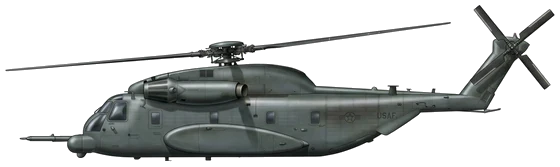
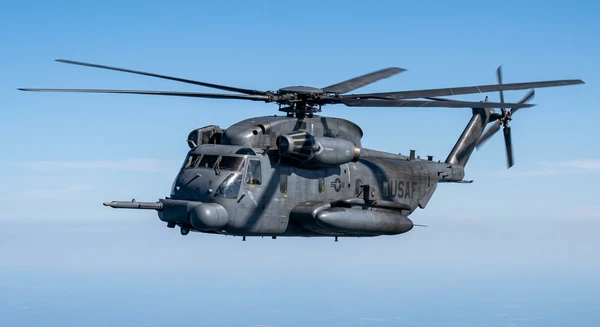
| Crew | 6 (2 pilots, 2 flight engineers, 2 aerial gunners) |
| Length | 27 m (88.6 ft) |
| Wingspan | 22.0 m (72.0 ft) |
| Height | 7.6 m (24.9 ft) |
| Wing area | 378.4 m² (4073.0 sqft) |
| Empty weight | 14,515 kg (32,000 lbs) |
| Max. takeoff weight | 20,865 kg (45,999 lbs) |
| Powerplant | 2 × General Electric T64-GE-100 3,230 kW each |
| Maximum speed | 310 km/h (193 mph) |
| Operational range | 1,100 km (684 mi) |
| Service ceiling | 4,900 m (16,076 ft) |
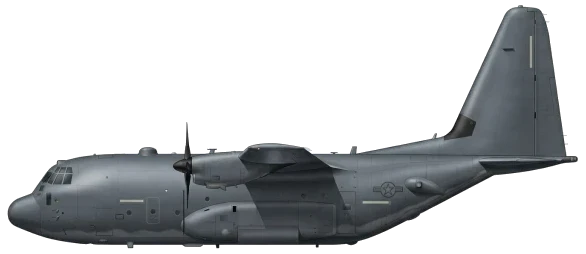
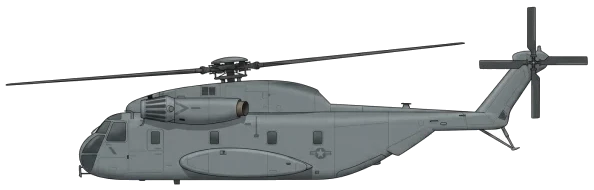
Description
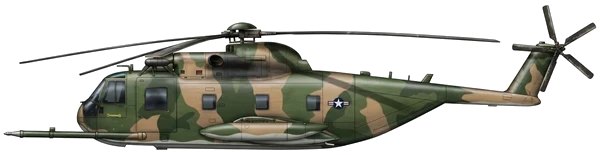
The MH-53J Pave Low III was a long-range special operations and combat search and rescue (CSAR) helicopter operated by the United States Air Force. Derived from the Sikorsky CH-53 Sea Stallion, the series was developed to replace the HH-3E "Jolly Green Giant." The Air Force initially ordered 72 airframes in HH-53B, CH-53C, and HH-53C configurations during the Vietnam War. Following the evaluation of the "Pave Low II" system in 1975, the service converted eight HH-53Cs to the HH-53H Pave Low III standard, delivered in 1979 and 1980. Between 1986 and 1990, the Air Force upgraded 31 HH-53B, HH-53C, and CH-53C airframes, along with all existing MH-53Hs, to the MH-53J Pave Low III Enhanced configuration, totaling 41 aircraft.
Design
The MH-53J was designed for low-level, long-range penetration into denied areas in adverse weather conditions. The airframe featured 1,000 pounds of armor plating and two General Electric T64-GE-415 turboshaft engines, each providing 4,380 shaft horsepower. Navigation and obstacle avoidance were facilitated by the AN/APQ-158 terrain-following and terrain-avoidance radar, an AN/AAQ-18 forward-looking infrared (FLIR) sensor, and a Canadian Marconi Doppler radar navigation system. Other avionics included a Litton or Honeywell inertial guidance system, a Global Positioning System (GPS) receiver, and a computerized moving-map display. The aircraft had a maximum takeoff weight of 50,000 pounds and could transport 38 troops or 20,000 pounds of cargo via an external hook.
Armament
Armament consisted of three pintle-mounted weapons. These typically included two 7.62 mm M134 Miniguns located in forward hatches on each side of the fuselage and one 12.7 mm M2 Browning machine gun or M134 Minigun mounted on the tail ramp.
Operational History
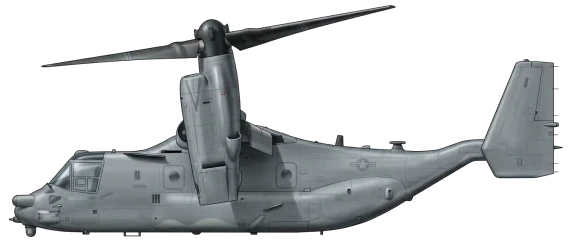
Operational service began in 1967 in Southeast Asia, where the HH-53B performed CSAR and covert operations. The Air Force lost 14 aircraft to combat and three to accidents during the conflict. Notable missions included the 1970 Son Tay prison raid and the 1975 SS Mayagüez rescue operation. In December 1989, five MH-53Js of the 20th Special Operations Squadron deployed for Operation Just Cause in Panama, conducting 193 sorties for reconnaissance, insertion, and medivac missions. The MH-53J/M fleet later served in the wars in Afghanistan and Iraq. The series was retired in September 2008 and replaced by the V-22 Osprey.
Variants
- HH-53B: Search and rescue variant featuring a retractable in-flight refueling probe and external fuel tank bracing struts.
- HH-53C: Improved version that removed tank bracing struts and added armor and a more comprehensive radio suite.
- HH-53H: Production standard Pave Low III variant equipped with FLIR, terrain-following radar, and an inertial guidance system.
- MH-53J: Pave Low III Enhanced variant featuring upgraded engines, digital avionics, and integrated GPS.
- MH-53M: Pave Low IV configuration modified with the Interactive Defensive Avionics System/Multi-Mission Advanced Tactical Terminal for real-time threat updates.
Frequently Asked Questions
What type of aircraft is the MH-53J Pave Low III?
What is the maximum speed of the MH-53J Pave Low III?
What is the range of the MH-53J Pave Low III?
How many MH-53J Pave Low III have been built?
Which countries operate the MH-53J Pave Low III?
What is the service ceiling of the MH-53J Pave Low III?
- MAY 102026 Created Page created: MH-53J Pave Low III