HH-3 Jolly Green Giant
American twin-engine transport and search and rescue helicopter, developed in the early 1960s, utilized for long-range recovery operations and maritime rescue. Key figures: top speed 265 km/h, range 1,443 km, service ceiling 6,400 m, max takeoff weight 10,002 kg, built 181.
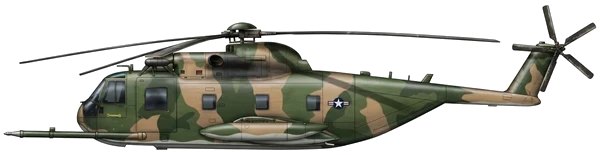
| Crew | 3 |
| Length | 22 m (72.2 ft) |
| Wingspan | 19 m (62.3 ft) |
| Height | 5.5 m (18.1 ft) |
| Wing area | 280.5 m² (3019.3 sqft) |
| Empty weight | 6,051 kg (13,340 lbs) |
| Max. takeoff weight | 10,002 kg (22,051 lbs) |
| Powerplant | 2 × General Electric T58-GE-10 1,000 kW each |
| Maximum speed | 265 km/h (165 mph) |
| Operational range | 1,443 km (897 mi) |
| Service ceiling | 6,400 m (20,997 ft) |
| Climb rate | 11.3 m/s (37.1 ft/s) |
Description
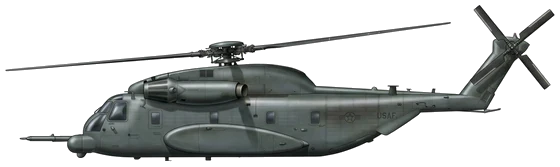
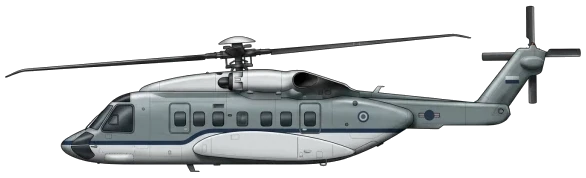
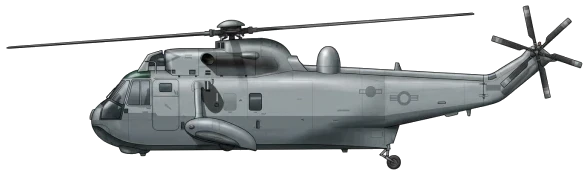
The Sikorsky S-61R is a twin-engine helicopter developed as a derivative of the S-61/SH-3 Sea King for transport and search and rescue (SAR) roles. It features a revised fuselage with a rear loading ramp, a watertight hull, and retractable tricycle landing gear. This fuselage configuration was later utilized for the larger CH-53 variants and the S-92. Sikorsky produced the S-61R prototype as a private venture, with its first flight occurring on June 17, 1963. The United States Air Force (USAF) subsequently ordered the type as the CH-3C.
Design
The HH-3E Jolly Green Giant variant is equipped with specialized systems for combat recovery, including protective armor, self-sealing fuel tanks, and a retractable inflight refueling probe. It utilizes jettisonable external tanks and a high-speed hoist. Power is provided by two General Electric T58-GE-10 turboshaft engines, each producing 1,400 shp. The United States Coast Guard (USCG) version, the HH-3F Pelican, incorporates search radar with a nose antenna radome offset to port and maintains water landing capability. Armament is limited to door guns on specific variants.
Operational History
Between May 31 and June 1, 1967, two USAF HH-3Es performed the first nonstop transatlantic helicopter flight, traveling from New York to Paris in 30 hours and 46 minutes with nine in-flight refuelings. Both aircraft were later lost during combat operations in Southeast Asia. The USAF retired the HH-3E in the 1990s, replacing it with the HH-60G Pavehawk. The USCG operated 40 HH-3F Pelicans from the late 1960s until the late 1990s, when they were replaced by the HH-60J Jayhawk.
Agusta manufactured 22 AS-61R helicopters under license for the Italian Air Force. These aircraft served with the 15° Stormo in SAR and Combat SAR roles, deploying for missions in Somalia, Albania, Bosnia, Kosovo, Iraq, and Afghanistan. Italy phased out the HH-3F in 2014. Other operators have included the Tunisian Air Force and the Argentine Air Force, the latter of which used the S-61R as a presidential transport.
Variants
- CH-3C: Initial military transport version for the USAF powered by two 1,050 shp T58-GE-1 engines.
- CH-3E: Improved transport version for the USAF equipped with 1,500 shp T58-GE-5 engines.
- HH-3E Jolly Green Giant: Long-range, air-refuellable search and rescue helicopter for the USAF featuring protective armor and a high-speed hoist.
- HH-3F Pelican: Long-range search and rescue version for the USCG equipped with search radar and water landing capability.
- AS-61R: License-built version of the S-61R produced by Agusta for the Italian Air Force.
Frequently Asked Questions
What type of aircraft is the HH-3 Jolly Green Giant?
What is the maximum speed of the HH-3 Jolly Green Giant?
What is the range of the HH-3 Jolly Green Giant?
When did the HH-3 Jolly Green Giant first fly?
How many HH-3 Jolly Green Giant have been built?
Which countries operate the HH-3 Jolly Green Giant?
What is the service ceiling of the HH-3 Jolly Green Giant?
- MAY 102026 Created Page created: HH-3 Jolly Green Giant