CH-53 Sea Stallion
American heavy-lift helicopter, noteworthy for its service in the Vietnam and Gulf Wars, principally deployed for transport duties. Key figures: top speed 315 km/h, range 1,000 km, service ceiling 5,639 m, max takeoff weight 33,300 kg, unit price $40M, built 284. In service with 3 air forces as of 2026 — United States (176), Germany (66), Israel (22).
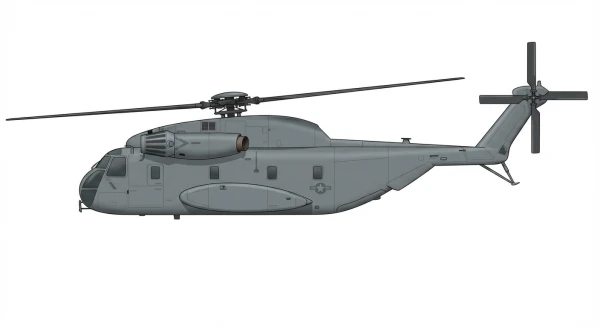
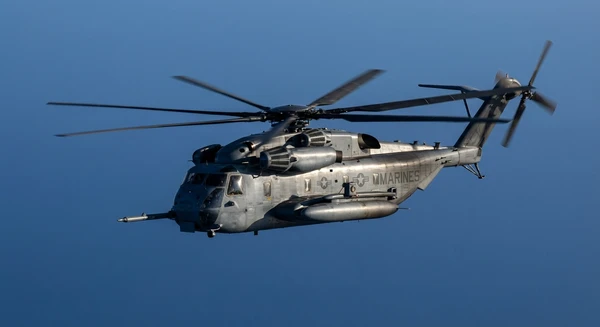
| Crew | 3 (2 pilots, mechanic) |
| Length | 30.2 m (99.1 ft) |
| Wingspan | 24.1 m (79.0 ft) |
| Height | 8.5 m (27.8 ft) |
| Empty weight | 15,071 kg (33,226 lbs) |
| Max. takeoff weight | 33,300 kg (73,414 lbs) |
| Powerplant | 3 × turboshafts General Electric T64-GE-416 3,270 kW each |
| Maximum speed | 315 km/h (196 mph) |
| Operational range | 1,000 km (621 mi) |
| Service ceiling | 5,639 m (18,501 ft) |
| Climb rate | 13.0 m/s (42.7 ft/s) |


Recent Events — CH-53 Sea Stallion
5 events →
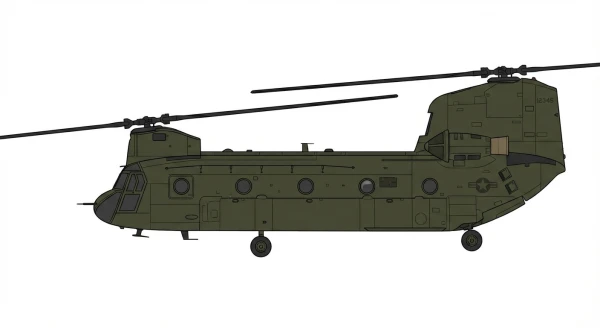

Description
The CH-53 Sea Stallion (Sikorsky S-65) is an American heavy-lift transport helicopter designed and built by Sikorsky Aircraft for the United States Marine Corps. It entered operational service in September 1966 and fulfills assault transport, aircraft recovery, personnel transport, and medical evacuation roles. The aircraft is known for its heavy payload capacity and remaining one of the largest military helicopters in active service.
Development
Development began in March 1962 when the US Navy Bureau of Naval Weapons issued a requirement on behalf of the US Marine Corps to replace the CH-37 Mojave. Sikorsky's S-65 design was selected in July 1962, leading to a contract in September 1962 for two YCH-53A prototypes. The YCH-53A made its initial flight on October 14, 1964, and production deliveries to operational units began on September 12, 1966. Sikorsky built 141 CH-53As, while VFW-Fokker in Germany license-built 108 CH-53G variants for the German military.
Design
The CH-53 features a watertight fuselage based on the S-61R, dynamic systems derived from the S-64 Skycrane, a six-bladed articulated main rotor, and a folding tail boom for shipboard stowage. Power is supplied by two upper-fuselage General Electric T64 turboshaft engines, ranging from early 2,850 shp T64-6 models to 3,925 shp T64-GE-413 units. Mechanical flight controls are supported by three independent hydraulic systems, and structural integrity of the metal rotor blades is monitored by a nitrogen-pressurized Blade Inspection Method system. Crewed by four personnel, the cabin holds up to 38 fully-equipped troops or 24 medical litters in its base configuration.
Armament
Defensive armaments include door-mounted 7.62×51mm M60 machine guns on the CH-53A, or .50 BMG M2/XM218 and GAU-15/A machine guns on later models, with options for a ramp-mounted GAU-21. The internal cargo capacity is 8,000 pounds, while the single-point external sling hook supports 13,000 pounds, with the RH-53D cargo hook rated up to 25,000 pounds.
Operational History
The CH-53 saw its first combat deployment with the US Marine Corps in Vietnam in 1967, participating in downed aircraft recoveries and troop evacuations during Operation Frequent Wind. USAF variants performed search and rescue during Operation Ivory Coast in 1970 and the Mayagüez incident in 1975, while US Navy RH-53Ds flew in Operation Eagle Claw in 1980. Export customers include Israel, Germany, Iran, Austria, and Mexico. Israel used CH-53s to capture a Soviet radar system during Operation Rooster 53 in 1969, and Germany deployed CH-53Gs on international missions in Iraq, Kosovo, Bosnia, and Afghanistan.
Variants
-
CH-53A: Initial production transport variant built for the US Marine Corps, powered by two T64-GE-6 engines.
-
HH-53B: Combat search and rescue variant developed for the US Air Force featuring an aerial refueling probe, drop tanks, rescue hoist, and T64-GE-3 engines.
-
CH-53D: Upgraded US Marine Corps variant featuring T64-GE-412/413 engines, an uprated transmission, and seating for 55 troops.
-
RH-53D: Dedicated airborne mine countermeasures variant for the US Navy and Iran, equipped with mine-sweeping equipment and defensive .50-caliber machine guns.
-
CH-53G: German military baseline variant derived from the CH-53D, with 108 units license-built in Germany by VFW-Fokker.
Frequently Asked Questions
What type of aircraft is the CH-53 Sea Stallion?
What is the maximum speed of the CH-53 Sea Stallion?
What is the range of the CH-53 Sea Stallion?
When did the CH-53 Sea Stallion first fly?
How many CH-53 Sea Stallion have been built?
Which countries operate the CH-53 Sea Stallion?
How much does a CH-53 Sea Stallion cost?
What is the service ceiling of the CH-53 Sea Stallion?
- AUG 62026 Updated Description updated
- AUG 52026 Updated Powerplant updated in a site-wide editorial pass
- APR 72026 Updated Sources and cross-references refreshed
- JAN 122026 Updated Range updated in a site-wide editorial pass