Mirage I / MD-550 Mystère Delta
French experimental jet fighter from the 1950s, never deployed in combat or operational use. Key figures: top speed 1,700 km/h, service ceiling 14,600 m, max takeoff weight 5,150 kg, unit price $12M, built 1.
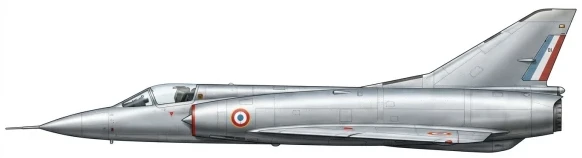
| Crew | 1 |
| Length | 12.8 m (42.0 ft) |
| Wingspan | 7.3 m (24.0 ft) |
| Wing area | 27.1 m² (291.7 sqft) |
| Empty weight | 3,610 kg (7,959 lbs) |
| Max. takeoff weight | 5,150 kg (11,354 lbs) |
| Powerplant | 2 × turbojets Dassault MD-30R 1,960 kgf each |
| Ejection seat | Martin-Baker Mk 4 |
| Maximum speed | 1700 km/h (Mach 1.7) |
| Service ceiling | 14,600 m (47,900 ft) |
Description
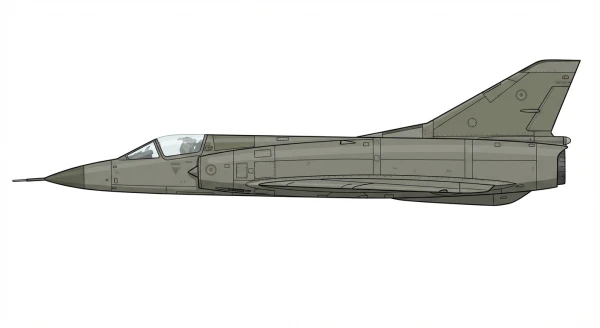
The MD.550 Mystère Delta, later redesignated Mirage I, was a single-seat delta-wing interceptor prototype built by Dassault Aviation in France. Flown as a technology demonstrator rather than an operational type, it was Dassault's response to a 1952 French government light fighter specification and served as the direct ancestor of the Mirage III family. Only one aircraft was completed; it was scrapped after the flight test programme.
Development
The 1952 French specification called for a lightweight all-weather interceptor able to climb to 18,000 m (59,100 ft) in six minutes and reach Mach 1.3 in level flight, a requirement shaped by Korean War experience with the Mikoyan-Gurevich MiG-15. Three manufacturers responded: Dassault with the MD.550 Mystère Delta, Sud-Est with the SE.212 Durandal and Sud-Ouest with the SO.9000 Trident. The prototype made its first flight on 25 June 1955 without afterburners or rocket motor and with an oversized vertical stabilizer, reaching Mach 1.15. It was then rebuilt with a reduced-area swept fin, afterburning engines and a SEPR 66 rocket booster, at which point it was renamed Mirage I; in this configuration it reached Mach 1.3 in level flight on turbojet power alone and Mach 1.6 with the rocket lit. Testing of the Mirage I and its two rivals showed the limits of the light fighter concept in endurance and equipment capacity. Dassault studied an enlarged twin-Gabizo Mirage II, but abandoned it in favour of a design 30 per cent heavier powered by the Snecma Atar, which became the Mirage III, first flown on 17 November 1956.
Design
The airframe used a tailless delta layout with 60° leading-edge sweep and a 5 per cent thickness-to-chord ratio, with a large vertical stabilizer and rudder and retractable tricycle landing gear. The absence of a horizontal stabilizer prevented the use of conventional flaps, producing a long takeoff run and high landing speed, while the low wing loading caused buffeting at low altitude. Against this, the delta was simple to build, structurally robust and offered wing volume for fuel. Power came from two Armstrong Siddeley MD.30 Viper turbojets built under licence by Dassault, rated at 7.35 kN (1,650 lbf) each in the initial Mystère Delta form and 9.61 kN (2,160 lbf) as reheated MD.30R units in the Mirage I, supplemented by a SEPR 66 liquid-fuel rocket motor. The aircraft carried no operational radar or fire-control equipment.
Armament
The size of the airframe limited it to a single air-to-air missile. During flight trials it was concluded that the aircraft was too small to carry a useful armament, one of the findings that led to the abandonment of the design.
Variants
- MD.550 Mystère Delta: Original single-seat prototype with delta vertical tail surface and two non-afterburning M.D.30 turbojets; one built.
- Mirage I: Rebuilt first prototype with swept vertical tail, reheated M.D.30R engines and a SEPR 66 rocket booster.
- Mirage II: Enlarged two-seat-class interceptor project powered by two Turbomeca Gabizo turbojets; one airframe abandoned incomplete.
Frequently Asked Questions
What type of aircraft is the Mirage I / MD-550 Mystère Delta?
What is the maximum speed of the Mirage I / MD-550 Mystère Delta?
When did the Mirage I / MD-550 Mystère Delta first fly?
How many Mirage I / MD-550 Mystère Delta have been built?
How much does a Mirage I / MD-550 Mystère Delta cost?
What is the service ceiling of the Mirage I / MD-550 Mystère Delta?
- AUG 302026 Updated Description updated
- AUG 182026 Updated Alias corrected to the Dassault spelling, which was linking an unrelated drone engine
- AUG 132026 Updated Production and service figures corrected (the MD-550 prototype had inherited the Mirage III values)
- APR 72026 Updated Sources and cross-references refreshed
- JAN 242026 Updated Thrust updated