MD-450 Ouragan
French fighter-bomber from the early Cold War era, known for its service in the Suez Crisis and Indo-Pakistani War. Key figures: top speed 940 km/h, range 920 km, service ceiling 13,000 m, max takeoff weight 7,900 kg, unit price $1M, built 567.
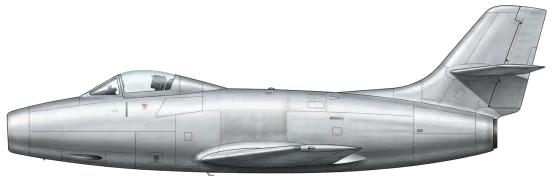
| Crew | 1 |
| Length | 10.7 m (35.2 ft) |
| Wingspan | 13.2 m (43.2 ft) |
| Height | 4.1 m (13.6 ft) |
| Wing area | 23.8 m² (256.2 sqft) |
| Empty weight | 4,142 kg (9,132 lbs) |
| Max. takeoff weight | 7,900 kg (17,416 lbs) |
| Powerplant | 1 × turbojet with centrifugal compressor Rolls-Royce Nene 104B 2,263 kgf each |
| Ejection seat | Martin-Baker Mk 4 |
| Maximum speed | 940 km/h (584 mph) |
| Operational range | 920 km (572 mi) |
| Service ceiling | 13,000 m (42,651 ft) |
| Climb rate | 38.0 m/s (124.7 ft/s) |
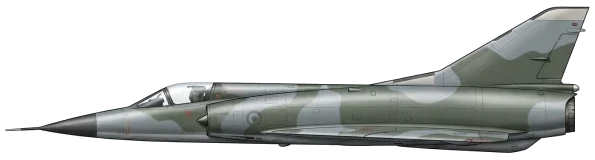
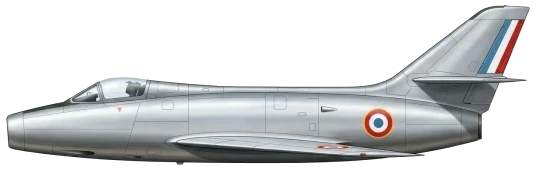
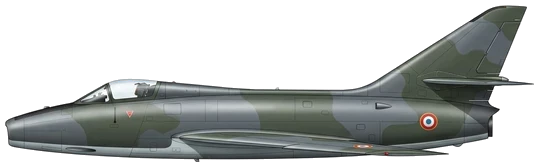
Description
The Dassault M.D.450 Ouragan was a French single-seat fighter-bomber built by Dassault Aviation. It entered French Air Force squadron service in 1952 and was the first French-designed jet combat aircraft to reach production. Beyond France, it was operated by India (as the Toofani), Israel and El Salvador, seeing combat in the Suez Crisis, the Six-Day War, the Indian operation against Diu and the Salvadoran Civil War.
Development
Marcel Bloch, who returned from Buchenwald in March 1945 and renamed himself and his company Dassault in early 1946, began work on an all-French jet fighter as a private venture in 1947. Detailed design under the designation M.D.450 started in December 1947; prototype construction began at Saint-Cloud on 7 April 1948, and contract No. 2223/48 of 29 June 1948 covered three prototypes. The first prototype flew on 28 February 1949 with Kostia Rozanoff at the controls, reaching 980 km/h and an initial climb of 43 m/s. The second prototype flew in May 1949 with a pressurised cockpit, and the 450-litre wingtip tanks appeared in December 1949. The third prototype flew on 2 June 1950 with a Hispano-Suiza Nene 104. Twelve pre-production aircraft were ordered in 1949; a fixed order for 150 production aircraft followed on 31 August 1950, with two further batches of 100 and a third cancelled in January 1952 in favour of the Mystère IIC. Forward fuselages were built by SNCASE at Toulouse, rear fuselages by SNCASO at Saint-Nazaire and wings at Bouguenais, with final assembly at Mérignac. The first production aircraft flew on 5 December 1951; 39 were completed in 1952, 93 in 1953 and 118 by mid-1954.
Design
The Ouragan used a divided nose intake ducting air around the cockpit to a Rolls-Royce Nene turbojet mounted behind the pilot, with a cylindrical fuselage, bubble canopy and tricycle landing gear. The wing was thin and tapered along the leading edge, with a swept tailplane and swept vertical stabiliser. Early aircraft had Martin-Baker Mk.1 ejection seats, most production aircraft SNCASO E.86 seats. The type was stable as a gun and rocket platform but prone to snap rolls and flat spins in tight turns owing to its low fuselage length-to-diameter ratio.
Armament
Fixed armament was four 20 mm Hispano-Suiza HS.404 cannon with 125 rounds per gun, mounted below the intake. Four external hardpoints carried up to 908 kg, typically two 227 kg bombs, sixteen 105 mm Brandt T-10 rockets, or eight rockets with two 458-litre napalm bombs; Matra pods with 18 SNEB 68 mm rockets each could also be fitted.
Operational History
France operated 370 examples including prototypes, replacing the de Havilland Vampire, and used the type with the Patrouille de France for two years. Replacement by the Mystère IVA began in May 1955 and the last frontline Ouragans were withdrawn in 1961. India ordered 71 aircraft on 25 June 1953 with Nene 105 engines, later adding 33 second-hand machines for a total of 104; Toofanis struck Diu aerodrome on 18 December 1961, flew ground-attack sorties in Assam and Nagaland, and reconnaissance during the 1962 Sino-Indian War. One strayed into Pakistan on 24 April 1965 and was forced to land. Israel received at least 75 aircraft by 1955, equipping five squadrons. An Ouragan downed an Egyptian Vampire on 12 April 1956, and on 30 October 1956 two Ouragans shot down four Vampires at the Mitla Pass; on 31 October rocket attacks contributed to the capture of the destroyer Ibrahim el Awal. Two were lost to small arms fire during Suez. Israel sold 18 to El Salvador, delivered 1973–1978 and flown from Ilopango against FMLN forces; one scored the war's only air-to-air kill on 25 January 1981, and several were destroyed in an FMLN raid on Ilopango in 1982.
Variants
- MD 450A Ouragan: First 50 production aircraft with the Nene 102 engine.
- MD 450B Ouragan: Hispano-Suiza Nene 104B engine and revised two-section nose gear doors.
- MD 450R Ouragan: Reconnaissance variant, one built.
- MD 450-30L Ouragan: Pre-production airframe with SNECMA Atar 101B, side intakes and two 30 mm DEFA cannon, first flown 21 January 1952.
- Dassault Barougan: Four aircraft modified for rough-field use with twin low-pressure main wheels and a brake parachute, first flown 24 February 1954 and abandoned in 1958.
Frequently Asked Questions
What type of aircraft is the MD-450 Ouragan?
What is the maximum speed of the MD-450 Ouragan?
What is the range of the MD-450 Ouragan?
When did the MD-450 Ouragan first fly?
How many MD-450 Ouragan have been built?
Which countries operate the MD-450 Ouragan?
How much does a MD-450 Ouragan cost?
What is the service ceiling of the MD-450 Ouragan?
- AUG 302026 Updated Description updated
- AUG 122026 Updated Range corrected to the ferry range
- AUG 62026 Updated Powerplant updated
- JUL 232026 Updated Sources and cross-references refreshed
- APR 72026 Updated Sources and cross-references refreshed