SO 4050 Vautour
French jet-powered multirole aircraft, developed in the 1950s, utilized in combat operations during the Six-Day War by Israel. Key figures: top speed 1,106 km/h, range 5,400 km, service ceiling 15,200 m, max takeoff weight 21,000 kg, unit price $2M, built 149.
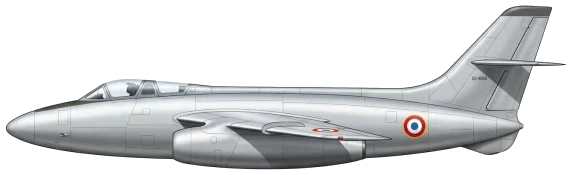
| Crew | 1 |
| Length | 15.6 m (51.1 ft) |
| Wingspan | 15.1 m (49.5 ft) |
| Height | 4.9 m (16.2 ft) |
| Wing area | 45 m² (484.4 sqft) |
| Empty weight | 10,000 kg (22,046 lbs) |
| Max. takeoff weight | 21,000 kg (46,297 lbs) |
| Powerplant | 2 × SNECMA Atar 101E-3 turbojet engines 7,400 kgf each |
| Ejection seat | Dassault E-101 |
| Maximum speed | 1106 km/h (687 mph) |
| Operational range | 5,400 km (3,355 mi) |
| Service ceiling | 15,200 m (49,869 ft) |
| Climb rate | 60.0 m/s (196.9 ft/s) |
Description
In response to a 1951 French Air Force requirement for a multirole jet, the aircraft company SNCASO (later Sud Aviation) adapted its existing S.O. 4000 prototype. The resulting design, the S.O. 4050, performed its maiden flight on October 16, 1952, and demonstrated promising performance, even exceeding Mach 1 in a dive during early testing. Initial prototypes were tested with various British and French engines, but the production aircraft, named Vautour II, were powered by the indigenous SNECMA Atar turbojet. Though originally planned for a large production run, the Vautour was seen as a stop-gap, particularly in the strategic bomber role, and was maligned as obsolete and underpowered for much of its service life. Production ceased after 149 aircraft were manufactured, with the type entering service in 1958 and retiring in 1979 from French frontline units.
Design
The Sud Aviation Vautour is a mid-sized, swept-wing monoplane featuring a 35-degree wing sweep, a "flying" tail, and two SNECMA Atar 101 turbojet engines mounted in pods beneath the wings. It utilizes a bicycle-type landing gear with main units under the fore and aft fuselage, stabilized by smaller outrigger gear in the engine pods. A significant portion of the fuselage is dedicated to a 5.0-meter internal weapons bay and fuel tanks. Key limitations, particularly in the Vautour IIB bomber variant, included the absence of radar and modern navigation systems, relying instead on a World War II-era Norden bombsight housed in a glazed nose section. The Vautour IIN interceptor variant, however, was equipped with radar for all-weather operations.
Armament
The Vautour could be configured with a variety of armaments to suit its multirole capability. A typical armament included four 30 mm DEFA cannons, each supplied with 100 rounds. The internal weapons bay could accommodate a maximum of 2,725 kg (6,000 lb) of munitions, including conventional bombs, a pack of 116 rockets, or a camera pack. Four underwing hardpoints allowed for an additional 4,000 kg of external stores, such as bombs, rockets, or napalm tanks. As a core component of France's early force de frappe, the Vautour IIB bomber was also capable of carrying a single AN-11 or AN-22 nuclear weapon in its internal bay.
Operational History
The Vautour served with two operators: the French Air Force and the Israeli Air Force (IAF). In French service, it equipped bomber, all-weather fighter, and reconnaissance squadrons but never saw combat. Forty Vautour IIBs formed the initial airborne component of France's nuclear deterrent but were quickly supplemented and replaced by the Dassault Mirage IV due to the Vautour's perceived performance limitations. The IAF had a more active combat career with the type, employing it in attack, reconnaissance, and electronic warfare roles during the Six-Day War and the War of Attrition. Though it scored a single air-to-air kill against an Iraqi Hawker Hunter, it was more valued for its range and bombing capabilities. The IAF retired its last Vautours in 1972, replacing them with the Douglas A-4 Skyhawk.
Variants
- IIA: A single-seat, long-range attack variant armed with cannons and capable of carrying bombs both internally and on underwing pylons.
- IIN: A two-seat, all-weather interceptor equipped with a nose-mounted radar and crewed by a pilot and co-pilot in tandem seats.
- IIB: A two-seat bomber version which replaced the cannon pack with a glazed nose for a bombardier/observer.
- IIBR: A designation for Vautour IIB aircraft that were converted for specialized photo reconnaissance missions.
Frequently Asked Questions
What type of aircraft is the SO 4050 Vautour?
What is the maximum speed of the SO 4050 Vautour?
What is the range of the SO 4050 Vautour?
When did the SO 4050 Vautour first fly?
How many SO 4050 Vautour have been built?
Which countries operate the SO 4050 Vautour?
How much does a SO 4050 Vautour cost?
What is the service ceiling of the SO 4050 Vautour?
- AUG 122026 Updated Range corrected to the sole sourced figure
- APR 72026 Updated Sources and cross-references refreshed
- JAN 242026 Updated Thrust updated
- JAN 232026 Updated Range updated
- JUN 272025 Updated Specifications and description reviewed