Tecnam P2006T
Italian light twin-engine aircraft, notably used for training and light transport since the late 2000s. Key figures: top speed 287 km/h, range 1,722 km, service ceiling 4,267 m, max takeoff weight 1,180 kg, built 578. In service with 1 air force as of 2026 — Dominican Republic (1).
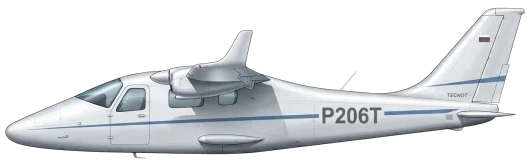
| Crew | 1 |
| Length | 8.7 m (28.5 ft) |
| Wingspan | 11.4 m (37.4 ft) |
| Height | 2.8 m (9.3 ft) |
| Wing area | 14.8 m² (158.8 sqft) |
| Empty weight | 760 kg (1,676 lbs) |
| Max. takeoff weight | 1,180 kg (2,601 lbs) |
| Powerplant | 2 × pistons engine Rotax 912S3 75 kW each |
| Maximum speed | 287 km/h (178 mph) |
| Operational range | 1,722 km (1,070 mi) |
| Endurance | 5 hours |
| Service ceiling | 4,267 m (13,999 ft) |
| Climb rate | 6.4 m/s (21.0 ft/s) |
| Takeoff distance | 448 m (1,470 ft) |



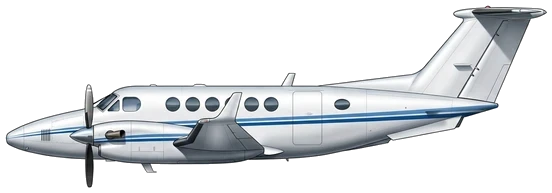
Description
The Tecnam P2006T is an Italian four-seat, twin-engined light aircraft built by Costruzioni Aeronautiche Tecnam at Capua, near Naples. Designed primarily for multi-engine flight training, it received EASA CS-23 type certification in June 2009 and FAA Part 23 certification in 2010. It is the lightest certified twin-engine aircraft on the market and has also been adapted for surveillance and special-mission work.
Development
The aircraft was conceived by Luigi Pascale, Tecnam co-founder and chief designer, as a low-cost multi-engine trainer positioned between legacy piston twins and modern glass-cockpit types. Initially designated P2006 VELT (Very Light Twin), it was built around the Rotax 912S3 engine. The prototype flew from Capua Airport in September 2007, with EASA CS-23 IFR certification following on 5 June 2009 and FAA approval in 2010. The P2006T SMP special-mission platform appeared in 2015, and the P2006T MkII, with Garmin G1000 NXi avionics, followed in 2017. Tecnam unveiled the P2006T NG at AERO Friedrichshafen in April 2024, incorporating more than 300 changes; EASA certified it in February 2025. Over 400 aircraft had been delivered by early 2025.
Design
The P2006T is an all-metal shoulder-wing monoplane with retractable electro-hydraulic tricycle landing gear, a steerable nosewheel and trailing-link main units. The primary structure uses riveted and bolted light aluminium alloy; the two-spar cantilever wing has sheet-metal ribs, GFRP leading edges and electrically actuated flaps. Control surfaces are driven by pushrods rather than cables and pulleys. The NG is powered by two Rotax 912iSc3 fuel-injected engines of 100 hp (75 kW) each, burning either Avgas 100LL or 92-octane mogas at about 3.7 US gal/h per engine, driving two-blade MT Propeller MTV-21 constant-speed, fully feathering units. Automatic mixture control eliminates cockpit mixture levers, and a dual-battery system supports in-flight restarts. Cruise speed is 148 kn (274 km/h), range 930 nm (1,722 km), service ceiling 14,000 ft, and useful load 410 kg. Avionics comprise the Garmin G1000 NXi with GFC 700 autopilot, synthetic vision, terrain awareness and ADS-B In/Out, with a GCU 477 keyboard on the NG. The NG adds four independent doors, enlarged windows, LED lighting in redesigned wingtips and an 80 kg external baggage compartment.
Operational History
Early US deliveries went to Ocean Air of Watsonville, California, followed by customers in New Zealand and Australia. In 2012 Tecnam worked with Indra, SELEX Galileo and FLIR Systems on the P2006T MRI, fitted with search radar, EO/IR sensors and datalink; the first production example went to CSS Tactical in South Africa in 2014. The Dominican Air Force took a surveillance-configured aircraft in 2016, and the Italian Air Force received three as the T-2006A on 5 July 2016 for multi-engine training with 70° Stormo at Latina. NASA selected a modified airframe for the X-57 Maxwell distributed electric propulsion demonstrator in 2016; the programme was cancelled in 2023 before flight testing. The RAF acquired an ISR-configured example in mid-2024 as a sensor testbed under its Rapid Capabilities Office. Other operators include the Guardia Civil, Harv's Air Service, the Romanian Aviation Academy and the Michigan Department of Natural Resources.
Variants
- P2006T MkII: Standard civil version with Garmin G1000 NXi avionics, introduced 2017.
- P2006T NG: Certified February 2025, with Rotax 912iSc3 engines, higher MTOW, four doors and a new baggage compartment.
- P2006T NG Sport: NG with upgraded interior materials, including leather trim and Flight Stream 510.
- P2006T SMP: Special Mission Platform with structural and electrical provisions for EO/IR sensors, used for patrol, mapping and SAR.
- P2006T MRI: Maritime patrol variant with search radar, EO/IR turret and datalink.
Frequently Asked Questions
What type of aircraft is the Tecnam P2006T?
What is the maximum speed of the Tecnam P2006T?
What is the range of the Tecnam P2006T?
When did the Tecnam P2006T first fly?
How many Tecnam P2006T have been built?
Which countries operate the Tecnam P2006T?
What is the service ceiling of the Tecnam P2006T?
- AUG 302026 Updated Description updated
- JUL 272026 Updated Name updated
- APR 72026 Updated Picture credits updated in a site-wide editorial pass
- FEB 72026 Updated Endurance added
- JAN 122026 Updated Range updated in a site-wide editorial pass