RQ-16 T-Hawk
American ducted fan VTOL miniature UAV, developed in the early 21st century, deployed for reconnaissance and explosive ordnance disposal. Key figures: top speed 130 km/h, range 11 km, service ceiling 3,200 m, max takeoff weight 8 kg.
| Max. takeoff weight | 8 kg (18 lbs) |
| Powerplant | 1 × 3W-Modellmotoren 3W-56 56cc Boxer Twin piston engine 3 kW each |
| Maximum speed | 130 km/h (81 mph) |
| Operational range | 11 km (7 mi) |
| Service ceiling | 3,200 m (10,499 ft) |
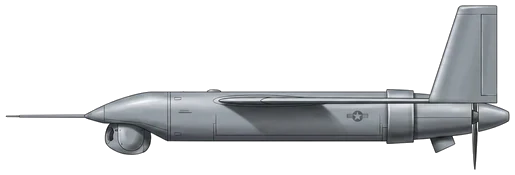
Description
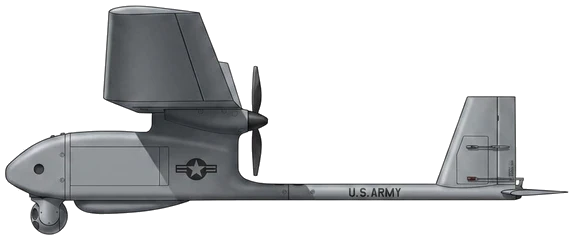
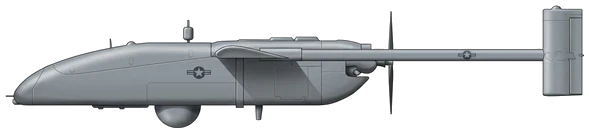
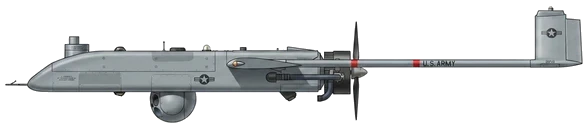
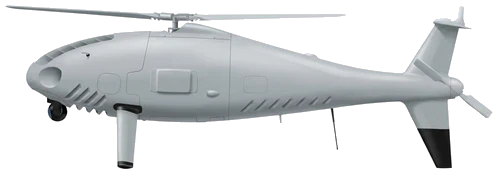
The Honeywell RQ-16 T-Hawk is a ducted fan, vertical takeoff and landing (VTOL) miniature unmanned aerial vehicle (UAV). Developed under DARPA's Micro Air Vehicle (MAV) program, Honeywell Defense and Space Electronic Systems received a $40 million technology demonstration contract in 2003. The project transferred to the U.S. Army's Future Combat System program as the Class I platoon-level drone. In May 2006, Honeywell received a $61 million contract to develop a MAV with extended endurance and a heavy-fuel engine. In 2007, the U.S. Navy awarded a $7.5 million contract for 20 gasoline-engine G-MAVs, followed by a January 2008 order for 372 RQ-16A T-Hawks (186 systems, each containing two air vehicles and one ground station) for Explosive Ordnance Disposal (EOD) teams. The U.S. Army designated the system XM156 but terminated the program in February 2011.
Design
The RQ-16 has a gross weight of 18.5 pounds (8.39 kg) and a fuel capacity of 2.1 pounds (0.95 kg). Powered by a 4 hp 3W-Modellmotoren 3W-56 56cc Boxer Twin piston engine, the vehicle has a 40-minute endurance, a 10,500-foot (3,200 m) service ceiling, and an operating radius of approximately 6 nautical miles (11 km). It achieves forward speeds up to 70 knots (130 km/h), though software restricts operational speed to 50 knots (93 km/h). VTOL capability is limited to wind speeds of 15 knots (28 km/h) or less. The complete backpackable system weighs under 51 pounds (23 kg). Avionics include autonomous flight and navigation systems with dynamic route updating. The sensor payload consists of one forward-looking and one downward-looking daylight or infrared camera.
Operational History
In combat operations, U.S. forces utilized the RQ-16 in Iraq to detect roadside bombs and inspect close-range targets ahead of military convoys. The British Army acquired five systems in 2009, deploying them to Afghanistan in 2010 with the 15 Field Support Squadron, 21 Engineer Regiment; 18 T-Hawks remained in service as of October 2013 within the Talisman counter-IED suite. In April 2010, Honeywell demonstrated the aircraft to Indian security forces at the Counter Terrorism and Jungle Warfare College. In April 2011, the RQ-16 conducted surveillance at the damaged Fukushima Dai-Ichi nuclear power station in Japan to photograph reactor housings, turbine buildings, and spent fuel pools. One air vehicle crashed on the roof of the reactor number 2 building on June 24, 2011.
Variants
-
RQ-16A: The baseline gasoline-engine powered production variant ordered by the U.S. Navy for Explosive Ordnance Disposal teams.
-
XM156 (Class I): The U.S. Army designation for a backpackable version intended for reconnaissance, surveillance, target acquisition, and laser designation, cancelled in 2011.
-
RQ-16B Block II: An updated version of the T-Hawk that received a Honeywell support contract in September 2012.
Frequently Asked Questions
What type of aircraft is the RQ-16 T-Hawk?
What is the maximum speed of the RQ-16 T-Hawk?
What is the range of the RQ-16 T-Hawk?
Which countries operate the RQ-16 T-Hawk?
What is the service ceiling of the RQ-16 T-Hawk?
- JUL 62026 Created Page created: RQ-16 T-Hawk