Wessex
British turbine-powered utility and anti-submarine helicopter, developed in the mid-20th century and operated for over 40 years in various military and civilian roles. Key figures: top speed 212 km/h, range 500 km, service ceiling 3,700 m, max takeoff weight 6,123 kg, built 382.
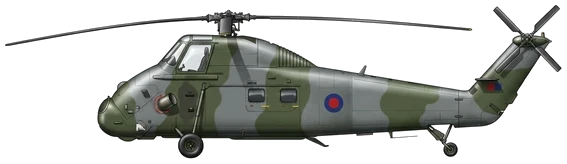
| Crew | 2 |
| Length | 20.1 m (65.8 ft) |
| Wingspan | 17.1 m (56.0 ft) |
| Height | 4.8 m (15.8 ft) |
| Wing area | 228.8 m² (2462.8 sqft) |
| Empty weight | 3,783 kg (8,340 lbs) |
| Max. takeoff weight | 6,123 kg (13,499 lbs) |
| Powerplant | 2 × de Havilland Gnome H.1200 Mk.110/111 turboshaft 1,010 kW each |
| Maximum speed | 212 km/h (132 mph) |
| Operational range | 500 km (311 mi) |
| Service ceiling | 3,700 m (12,139 ft) |
| Climb rate | 8.4 m/s (27.6 ft/s) |
- Unguided Bomb Depth charges
- Unguided Bomb Torpedoes
Description
The Westland Wessex is a turbine-powered helicopter developed by Westland Aircraft as a licensed derivative of the piston-engined Sikorsky S-58. Following the 1956 arrival of a Sikorsky S-58 pattern aircraft in Britain, Westland replaced the original Wright Cyclone piston engine with a Napier Gazelle turboshaft. This turbine configuration first flew on 17 May 1957. The first Westland-built production model, the HAS.1, conducted its maiden flight on 20 June 1958 and entered Royal Navy service in 1961. Production included 140 HAS.1, 73 HC.2, and 101 HU.5 airframes, among other variants and conversions.
Design
The shift to turboshaft propulsion reduced vibration and noise while increasing payload capacity. Early models used the single Napier Gazelle engine, while later versions, such as the HC.2 and HU.5, featured coupled de Havilland Gnome engines providing 1,550 shp. The aircraft was the first in Royal Air Force (RAF) service cleared for instrument flight and night operations, aided by an automatic pilot system. The HC.2 variant has a maximum speed of 132 mph, a 310-mile range, and a gross weight of 13,500 lb.
Armament
In anti-submarine warfare (ASW) configurations, the Wessex carried dipping sonar for detection and was armed with torpedoes or depth charges. As a transport, it accommodated 16 troops, eight stretchers, or a 4,000-pound external payload. During internal security operations in Northern Ireland, the aircraft was fitted with defensive countermeasures against small arms and shoulder-launched missiles.
Operational History
The Royal Navy initially utilized the Wessex as a dedicated ASW platform before reassigning older models to search and rescue (SAR) duties. The RAF employed the type for troop transport, air ambulance, and ground support from 1962. During the Indonesian Confrontation (1962–1966), the Wessex operated from land bases and carriers to ferry troops and supplies in Borneo. In the 1982 Falklands War, approximately 55 Wessex HU.5s were deployed for logistics and special forces insertions. Nine aircraft were lost during that conflict, including two HU.5s in glacier crashes and six destroyed aboard the Atlantic Conveyor.
International operators included the Royal Australian Navy, which used 27 aircraft for ASW and utility roles between 1963 and 1989. Other export customers included Iraq, Ghana, Brunei, and Oman. Civilian operations were conducted by Bristow Helicopters, which used the Wessex 60 to support North Sea oil rigs until 1982. The last British military examples were retired in 2003.
Variants
- Wessex HAS.1: Initial Royal Navy anti-submarine and utility model powered by a single Napier Gazelle engine.
- Wessex HC.2: Royal Air Force tactical transport variant designed to carry up to 16 troops.
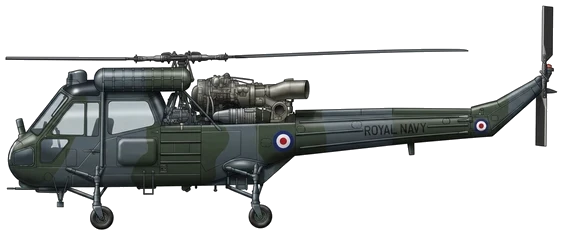
- Wessex HAS.3: Royal Navy anti-submarine version featuring improved avionics and a prominent dorsal radome.
- Wessex HU.5: Royal Navy commando assault transport equipped with coupled de Havilland Gnome engines.
- Wessex 60: Civilian variant of the HC.2 utilized for commercial transport and oil industry support.
Frequently Asked Questions
What type of aircraft is the Wessex?
What is the maximum speed of the Wessex?
What is the range of the Wessex?
When did the Wessex first fly?
How many Wessex have been built?
Which countries operate the Wessex?
What is the service ceiling of the Wessex?
- MAY 102026 Created Page created: Wessex