Westland Scout
British light utility helicopter, developed in the late 1950s and operated from the 1960s to the 1990s, used primarily for observation, liaison, and light attack roles. Key figures: top speed 211 km/h, range 507 km, service ceiling 5,400 m, max takeoff weight 2,404 kg, built 150.
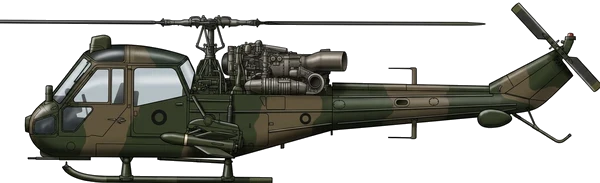
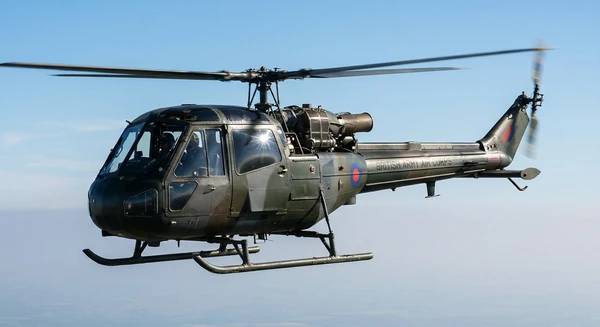
| Crew | 1–2 |
| Length | 9.3 m (30.3 ft) |
| Wingspan | 9.8 m (32.3 ft) |
| Height | 2.7 m (8.9 ft) |
| Wing area | 75.9 m² (816.9 sqft) |
| Empty weight | 1,466 kg (3,232 lbs) |
| Max. takeoff weight | 2,404 kg (5,300 lbs) |
| Powerplant | 1 × Rolls-Royce Nimbus 101 or 102 511 kW each |
| Maximum speed | 211 km/h (131 mph) |
| Operational range | 507 km (315 mi) |
| Service ceiling | 5,400 m (17,717 ft) |
| Climb rate | 8.5 m/s (27.9 ft/s) |
- Anti-Tank SS.11
- Rocket Pod Two-inch rocket pod
- Gun Pod L8A1 GPMG pack
Description
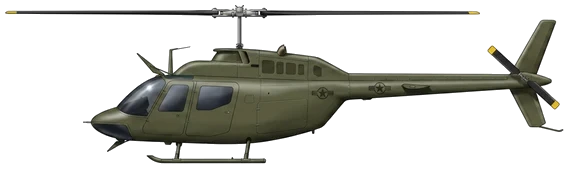
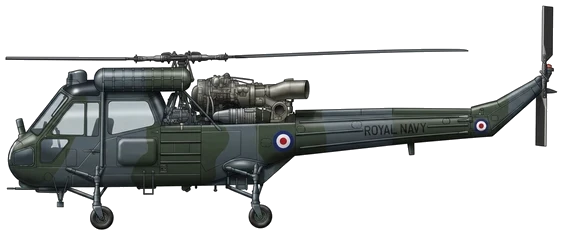
The Westland Scout is a land-based light utility helicopter developed by Westland Helicopters from the Saunders-Roe P.531. The prototype P.531-2 first flew on 9 August 1959, and the first Army Scout AH Mk 1 flew on 4 August 1960. Deliveries began in early 1963. Approximately 150 Scouts were produced through 1968, primarily at the Fairey Aviation Division factory in Hayes. Powered by a single Rolls-Royce Nimbus turboshaft engine derated to 685 shp, the aircraft features an undercarriage designed to tolerate ground resonance and an airframe with a 7,200-hour fatigue life. Avionics and specialized systems utilized include the AF.120 sighting unit with x2.5 and x10 magnification, a Marconi Heli-Tele aerial surveillance system, and a 3.5 million candlepower Nightsun searchlight.
Armament
For combat operations, the Scout could carry up to two forward-firing 7.62mm L7 GPMG packs mounted on the skid booms, or pintle-mounted GPMGs in the cabin. In the anti-tank role, it carried four Nord SS.11 wire-guided missiles. The helicopter could also carry a 1,500 lb slung load, or be configured for casualty evacuation with two internal or external stretchers. Other weapon systems trialled but not adopted included the 7.62mm General Electric Minigun, two-inch rocket pods, and the French AME.621 20mm cannon.
Operational History
The British Army Air Corps was the primary operator, using the Scout from 1963 until 1994. The type saw deployment during the Indonesia–Malaysia confrontation in Borneo, the Aden Emergency, the Jebel Akhdar War in Oman, and in Northern Ireland and the Falklands War. During the 1982 Falklands War, Scouts performed casualty evacuation, re-supply, and special forces insertion. On 14 June 1982, Scouts armed with SS.11 missiles successfully engaged Argentine 105 mm howitzer positions near Stanley Racecourse. One Scout was shot down by Argentine IA 58 Pucarás during the conflict. Export users included the Royal Australian Navy, which operated two helicopters from HMAS Moresby until 1973, the Royal Jordanian Air Force, the Uganda Police Air Wing, and the Bahrain Public Security Force.
Variants
-
Saunders-Roe P.531: Prototype helicopter developed from the Saunders-Roe Skeeter.
-
Saunders-Roe P.531-2 Mk.1: Pre-production version of the helicopter.
-
Scout AH.1: Five- to six-seat light utility helicopter variant produced for the British Army.
Frequently Asked Questions
What type of aircraft is the Westland Scout?
What is the maximum speed of the Westland Scout?
What is the range of the Westland Scout?
When did the Westland Scout first fly?
How many Westland Scout have been built?
Which countries operate the Westland Scout?
What is the service ceiling of the Westland Scout?
- JUL 272026 Updated Name updated
- JUL 232026 Updated Sources and cross-references refreshed
- JUL 12026 Created Page created: Scout