IA 58 Pucará
Argentinian counter-insurgency aircraft, notorious for its use during the Falklands War in the early 1980s. Key figures: top speed 500 km/h, range 3,710 km, service ceiling 10,000 m, max takeoff weight 6,800 kg, unit price $2M, built 110.
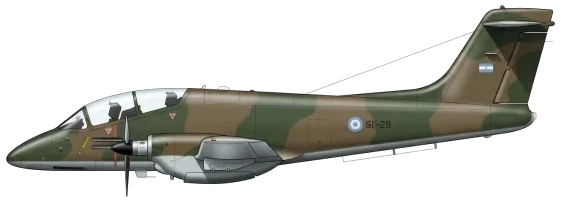
| Crew | 2 |
| Length | 14.3 m (46.8 ft) |
| Wingspan | 14.5 m (47.6 ft) |
| Height | 5.4 m (17.6 ft) |
| Wing area | 30.3 m² (326.1 sqft) |
| Empty weight | 4,020 kg (8,863 lbs) |
| Max. takeoff weight | 6,800 kg (14,991 lbs) |
| Powerplant | 2 × turboprops Turbomeca Astazou XVIG 729 kW each |
| Ejection seat | Martin-Baker Mk 6 |
| Maximum speed | 500 km/h (311 mph) |
| Operational range | 3,710 km (2,305 mi) |
| Service ceiling | 10,000 m (32,808 ft) |
| Climb rate | 18.0 m/s (59.1 ft/s) |
Description
The FMA IA 58 Pucará is an Argentine twin-turboprop ground-attack and counter-insurgency aircraft built by the Fábrica Militar de Aviones. A low-wing, all-metal monoplane with retractable landing gear and a T-tail, it entered Argentine Air Force service in May 1975 and was designed for operations from short, unprepared strips. It saw combat during Operativo Independencia in Tucumán, the 1982 Falklands War, and the Sri Lankan Civil War.
Development
Development began in August 1966 at DINFIA as the AX-2, meeting an Argentine Air Force COIN requirement. The project was promoted by engineer Ricardo Olmedo and directed by Aníbal Dreidemie, designer of the IA-52 Guaraní II and IA-63 Pampa. A full-scale unpowered glider test vehicle flew on 26 December 1967 to validate the layout. Construction of a powered prototype, initially designated IA 58 Delfín, began in September 1968; it flew on 20 August 1969 with two 674 kW Garrett TPE331 engines. A second prototype with 729 kW Turbomeca Astazou XVIG engines flew on 6 September 1970, and the Astazou was selected for production. The first production aircraft flew on 8 November 1974, with deliveries from early 1976. About 60 had been delivered by 1982.
Design
Construction is conventional and all-metal, mainly duralumin. The unswept cantilever wings have 7 degrees of dihedral on the outer panels and slotted trailing-edge flaps. The two crew sit in tandem under an upward-opening clamshell canopy on Martin-Baker Mk 6AP6A zero/zero ejection seats with dual controls. Armour plating protects the crew and engines from ground fire. The Astazou engines drive three-bladed Ratier-Forest 23LF propellers usable as air brakes. The tricycle undercarriage has low-pressure tyres and tall legs for underslung stores clearance; three JATO rockets can be fitted under the fuselage. Fuel is carried in two fuselage tanks of 800 L combined and two self-sealing wing tanks of 460 L. Undercarriage, flaps and brakes are hydraulic, with no pneumatic system.
Armament
Fixed armament comprises two 20 mm Hispano-Suiza HS.804 cannon under the cockpit with 270 rounds each and four 7.62 mm FN Browning machine guns on the fuselage sides with 900 rounds each, aimed by a reflector sight. Three hardpoints carry stores singly or in clusters: one centreline station of 1,000 kg and two wing pylons of 500 kg each, for a maximum external load of 1,620 kg. Typical Falklands loads included unguided bombs, 2.75 in rocket pods and 7.62 mm gun pods.
Operational History
First deliveries went to the 2° Escuadrón de Exploración y Ataque of the III Brigada Aérea at Reconquista. Twelve aircraft deployed to the Falklands in April 1982, flying from Port Stanley, Goose Green and Pebble Island. Three were destroyed at Goose Green by Sea Harrier cluster bombs on 1 May and six in the SAS Pebble Island raid on 15 May. On 21 May one was downed by the first combat-fired Stinger and another by Sea Harrier cannon fire. On 28 May two Pucarás shot down a Royal Marines Scout helicopter, the only confirmed Argentine air-to-air victory of the war. Eleven aircraft were captured after the surrender; six were taken to the United Kingdom. Sri Lanka bought two aircraft (CA-601, CA-602), adding CA-604 and CA-605 in 1993, flying close air support from SLAF Anuradhapura and Palaly, including Operation Riviresa. CA-601 was shot down by a MANPADS in July 1995; the type was retired in 1997. Uruguay operated the type until 2017. Numerous export negotiations with Mauritania, Venezuela, Iraq, Iran and others were cancelled.
Variants
- IA-58A Pucará: Two-seat main production version for counter-insurgency, close air support and attack.
- IA-58B Pucará Bravo: Prototype with deeper forward fuselage, two 30 mm DEFA cannon replacing the Hispanos and revised avionics; first flew 15 May 1979.
- IA-58C Pucará Charlie: Single-seat prototype with forward cockpit removed, added 30 mm DEFA cannon, Matra R550 Magic and Martin Pescador missiles, extra armour and EW suite; flew 30 December 1985.
- IA-58D Pucará Delta: Modernisation of IA-58A airframes with new avionics, HUD, RWR and 950 shp PT6A-62 engines.
- IA-58 Pucará Fénix: Border surveillance and patrol conversion with PT6A-62 engines, four-bladed propellers, podded EO/IR turret and data link, authorised December 2021.
Frequently Asked Questions
What type of aircraft is the IA 58 Pucará?
What is the maximum speed of the IA 58 Pucará?
What is the range of the IA 58 Pucará?
When did the IA 58 Pucará first fly?
How many IA 58 Pucará have been built?
Which countries operate the IA 58 Pucará?
How much does a IA 58 Pucará cost?
What is the service ceiling of the IA 58 Pucará?
- AUG 302026 Updated Description updated
- AUG 122026 Updated Range corrected to the ferry range
- AUG 52026 Updated Climb rate added; thrust updated
- APR 72026 Updated Sources and cross-references refreshed
- JAN 242026 Updated Thrust updated