Arava
Israeli light transport aircraft, active during the late 20th century, widely deployed for cargo, troop, and paratroop transport. Key figures: top speed 326 km/h, range 1,056 km, service ceiling 7,620 m, max takeoff weight 7,711 kg, unit price $1.85M, built 103. In service with 3 air forces as of 2026 — Venezuela (4), El Salvador (3), Ecuador (1).
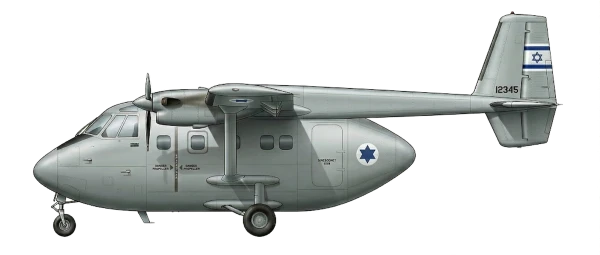
| Length | 12.7 m (41.6 ft) |
| Wingspan | 21.0 m (68.8 ft) |
| Height | 5.2 m (17.1 ft) |
| Wing area | 43.7 m² (470.2 sqft) |
| Empty weight | 4,050 kg (8,929 lbs) |
| Max. takeoff weight | 7,711 kg (17,000 lbs) |
| Powerplant | 2 × turboprops Pratt & Whitney Canada PT6A-36 559 kW each |
| Maximum speed | 326 km/h (203 mph) |
| Operational range | 1,056 km (656 mi) |
| Service ceiling | 7,620 m (25,000 ft) |
| Climb rate | 6.6 m/s (21.7 ft/s) |




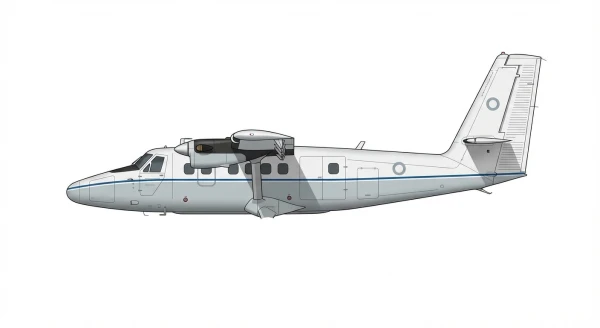
Description
The Israel Aerospace Industries (IAI) Arava is an Israeli light short takeoff and landing (STOL) utility transport aircraft. Developed during the 1960s, it was the first indigenous aircraft design produced by IAI to enter production. The type served in military transport, casualty evacuation, electronic warfare, and signals intelligence roles, entering limited operational service during the 1973 Yom Kippur War before being formally procured by the Israeli Air Force in 1983.
Development
Full-scale development of the Arava was authorized by the Israeli government in June 1968 to establish indigenous manufacturing capability and supply international civil and military transport markets. Influenced by the French Nord Noratlas, the design aimed to operate from 400-meter unprepared runways while carrying up to 20 passengers or bulky cargo. The first prototype made its maiden flight on 27 November 1969, but was destroyed during flight testing on 19 November 1970 following a wing strut failure. Testing resumed with the second prototype on 8 May 1971. Production ceased in 1988 after 103 aircraft had been built, including 70 for military customers.
Design
The Arava features a short, barrel-shaped fuselage with a hinged rear cargo section that swings open for rapid loading. Its twin-boom tail assembly extends rearward from the engine nacelles. Power is supplied by two wing-mounted Pratt & Whitney Canada PT6A turboprop engines driving three-bladed Hartzell propellers. The aircraft utilizes a fixed nosewheel landing gear to reduce overall structural weight.
Armament
Military configurations can be equipped for anti-submarine and gunship missions. Weapons options include two 0.50-inch Browning machine guns in fuselage side packs, a third machine gun installed in the rear fuselage, and two external fuselage pods holding 82 mm rocket launchers, torpedoes, or sonobuoys. In cargo roles, the IAI 201 variant provides a maximum payload capacity of 2,351 kg.
Operational History
The Israeli Air Force initially operated three leased Aravas with Squadron 122 during the 1973 Yom Kippur War for transport and medical evacuation missions. In 1983, the IAF acquired nine Aravas modified in the United States with specialized electronics for signals intelligence roles, operating them until their retirement in 2004. IAI exported approximately 70 military Aravas to Central and South American nations, alongside operators in Thailand, Eswatini, and Cameroon. Mexican Air Force Aravas were deployed operationally during the 1994 Zapatista conflict for aerial reconnaissance and bombing missions.
Variants
-
IAI 101: Base civil transport production version.
-
IAI 102: Civil passenger aircraft configured for up to 20 standard airline passengers or 12 VIP passengers.
-
IAI 201: Standard military transport production variant.
-
IAI 202: Modified military variant fitted with winglets and an auxiliary power unit.
-
IAI 202B: Electronic warfare model equipped with large nose and tail radomes housing mission electronics.
Frequently Asked Questions
What type of aircraft is the Arava?
What is the maximum speed of the Arava?
What is the range of the Arava?
When did the Arava first fly?
How many Arava have been built?
Which countries operate the Arava?
How much does a Arava cost?
What is the service ceiling of the Arava?
- AUG 62026 Updated Description updated
- APR 72026 Updated Picture credits updated in a site-wide editorial pass
- JAN 122026 Updated Range updated in a site-wide editorial pass