A-37 Dragonfly vs IA 58 Pucará
A-37 Dragonfly vs IA 58 Pucará at a glance — top speed 816 vs 500 km/h, range 1,628 vs 3,710 km, max takeoff weight 6,350 vs 6,800 kg, built 577 vs 110 units.
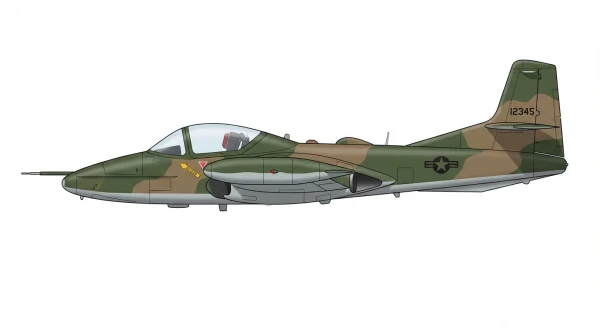
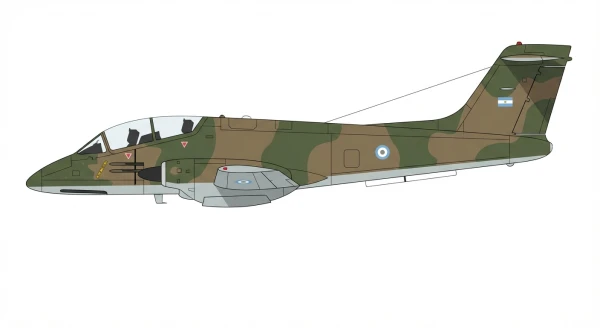
| A-37 Dragonfly | IA 58 Pucará | |
|---|---|---|
| Origin country | 🇺🇸 United States | 🇦🇷 Argentina |
| Category | Combat Aircraft | Combat Aircraft |
| Manufacturer | Cessna | FMA |
| First flight | 1 October 1964 | 8 November 1974 |
| Year introduced | 1967 | 1976 |
| Number produced | 577 units | 110 units |
| Average unit price | $160K | $2 million |
| Wing area | 17.1 m² | 30.3 m² |
| Wingspan | 10.9 m | 14.5 m |
| Height | 2.7 m | 5.4 m |
| Length | 8.6 m | 14.3 m |
| Maximum speed | 816 km/h | 500 km/h |
| Operational range | 1,628 km | 3,710 km |
| Service ceiling | 12,730 m | 10,000 m |
| Max. takeoff weight | 6,350 kg | 6,800 kg |
| Empty weight | 2,817 kg | 4,020 kg |
| Total thrust | 2 x 2,586 kgf | 2 x 729 kW |
Detailed Comparison
The Cessna A-37 Dragonfly and FMA IA 58 Pucará are light attack aircraft from different design philosophies, tailored to specific counter-insurgency (COIN) requirements. The A-37 is a jet-powered evolution of the T-37 trainer, rapidly developed by the United States for the high-intensity air environment of the Vietnam War. In contrast, the Pucará is an Argentine purpose-built, turboprop-powered aircraft designed from the outset for operations from austere, unprepared airstrips in lower-intensity conflicts.
Development and Design
The A-37's lineage from a basic trainer is evident in its compact, side-by-side cockpit configuration. Its development involved a pragmatic conversion, strengthening the wings, nearly doubling engine thrust with two General Electric J85 turbojets, and adding eight underwing hardpoints. Survivability was enhanced with armored seats, flak curtains, and self-sealing fuel tanks, reflecting adaptations based on combat experience. The Pucará was a clean-sheet design, resulting in an aircraft optimized for its role. It features a slender fuselage with a tandem cockpit offering superior visibility for the crew, protected by armor plating. Its Turbomeca Astazou turboprop engines, robust high-lift wing, and tall, durable tricycle landing gear were specifically chosen to facilitate operations from short, rough fields, a key requirement for Argentine operational contexts.
Specifications and Performances
The core performance differences stem directly from their powerplant choices.
- Speed and Altitude: The A-37's turbojets give it a decisive speed advantage (816 km/h vs. the Pucará's 500 km/h) and a higher service ceiling (12,730 m vs. 10,000 m), allowing for faster ingress and egress from target areas.
- Payload: The Dragonfly can carry a substantially heavier external ordnance load of 2,600 kg across eight hardpoints, compared to the Pucará's 1,620 kg on three hardpoints. This made the A-37 a more flexible bomb and rocket platform.
- Inherent Armament: The Pucará possesses a formidable fixed gun armament of two 20mm cannons and four 7.62mm machine guns, ideal for strafing runs without occupying external hardpoints. The A-37 relies on a single nose-mounted 7.62mm Minigun, often supplemented by gun pods.
Deployment and usage
Both aircraft have extensive combat records. The A-37 flew over 160,000 combat sorties in Vietnam, performing close air support, helicopter escort, and armed reconnaissance with a high degree of success, though 22 USAF aircraft were lost in combat. Its speed and payload were well-suited for the conflict. The Pucará was first used in Argentina's domestic counter-insurgency operations. During the Falklands War, its ability to operate from small grass strips was a key asset, but it proved vulnerable to British Sea Harriers and Stinger MANPADS. It did, however, achieve a rare air-to-air victory for a COIN aircraft by downing a British helicopter. Sri Lanka also used the Pucará effectively in a COIN capacity.
Conclusion
The A-37 Dragonfly was a successful, pragmatic adaptation of an existing jet platform, providing speed and a heavy weapons load for the specific demands of the Vietnam War. The IA 58 Pucará stands as a purpose-built turboprop, designed for ruggedness, endurance, and austere field performance, with a powerful internal armament. While the A-37 excelled as a fast-moving bomb truck, the Pucará was a more specialized rough-field gunship. Each represents a valid, yet distinct, solution to the challenges of light attack and counter-insurgency, dictated by the technological capabilities and operational doctrines of their respective nations.