T-37 Tweet
American jet trainer, notable for its Cold War-era inception, extensively used for pilot training and counter-insurgency role. Key figures: top speed 684 km/h, range 1,500 km, service ceiling 11,948 m, max takeoff weight 2,980 kg, built 1,269. In service with 1 air force as of 2026 — Pakistan (69).
| Length | 9 m (29.5 ft) |
| Wingspan | 10.1 m (33.1 ft) |
| Height | 2.8 m (9.2 ft) |
| Wing area | 17 m² (183.0 sqft) |
| Empty weight | 1,840 kg (4,057 lbs) |
| Max. takeoff weight | 2,980 kg (6,570 lbs) |
| Powerplant | 2 × turbojets Continental J69-T-25 465 kgf each |
| Ejection seat | Weber T-37 |
| Maximum speed | 684 km/h (425 mph) |
| Operational range | 1,500 km (932 mi) |
| Service ceiling | 11,948 m (39,199 ft) |
| Climb rate | 17.1 m/s (56.1 ft/s) |

Description
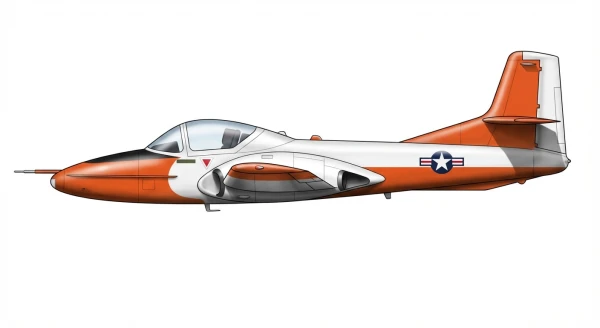
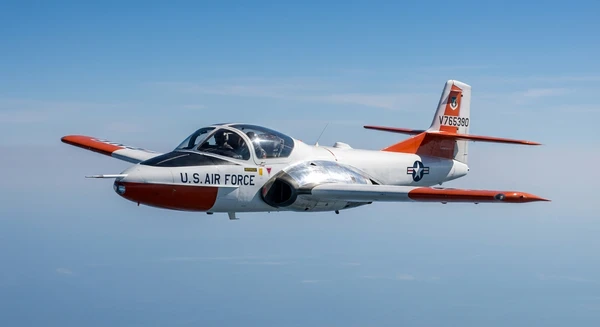
The Cessna T-37 Tweet (Model 318) is an American twin-engine, side-by-side jet trainer aircraft developed for the United States Air Force (USAF). Designed by Cessna, the type entered USAF service in June 1956 as a primary pilot trainer. The T-37 served as the USAF's primary training platform for over 50 years and was known for the high-pitched whistle of its turbojet engines, which earned it the nickname "Tweet".
Development
The USAF launched the Trainer Experimental (TX) program in 1952 seeking a lightweight twin-jet basic trainer. Cessna submitted its Model 318 design and received a contract for three XT-37 prototypes in 1954, with the maiden flight occurring on 12 October 1954. After the first prototype crashed during spin tests, Cessna added nose strakes and an enlarged tail unit to improve handling. The USAF ordered the revised design into production as the T-37A, receiving the first aircraft in June 1956. Cessna produced 444 T-37As before introducing the T-37B in 1959, which featured uprated engines and revised avionics. Total production reached 1,269 aircraft before manufacturing ended in 1975.
Design
The T-37 is an all-metal aircraft featuring a low straight wing and two turbojet engines buried in the wing roots. Its unpressurized cockpit houses two ejection seats in a side-by-side configuration under a rear-hinged clamshell canopy, restricting operational flights to an altitude ceiling of 25,000 feet. The airframe includes wide-track tricycle landing gear, a nosewheel speedbrake, and intake screens that deploy when the landing gear extends to prevent foreign object damage. Power is supplied by two Continental J69 turbojets equipped with thrust attenuators, which permit the engines to remain spooled up during landing approaches to facilitate faster go-arounds.
Armament
The T-37A and T-37B carry no internal or external weapons. The export-oriented T-37C variant features strengthened wings with one underwing hardpoint per side capable of carrying up to 500 lb of stores. Armament options for the T-37C include a General Electric pod with a .50 caliber (12.7 mm) machine gun, 70 mm folding-fin rocket pods, practice bombs, or AIM-9 Sidewinder missiles.
Operational History
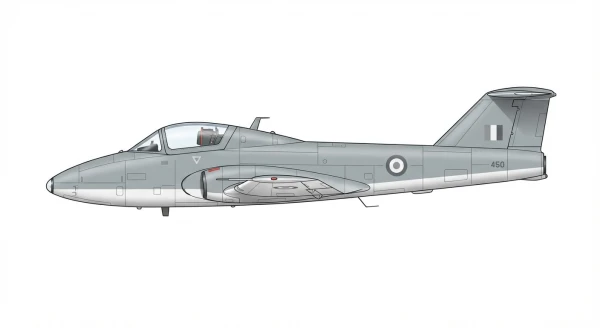
USAF pilot training in the T-37 began in 1957. High engine noise required structural soundproofing at operating bases and mandatory ear protection for ground personnel. During the late 1970s Beagle conflict, Chile modified its T-37s for light attack duties, while Colombia reoriented its T-37C fleet to attack roles in the early 1980s. Export customers included Pakistan, South Korea, Brazil, Turkey, and Thailand. The USAF formally retired its final T-37B on 31 July 2009, replacing the fleet with the turboprop Beechcraft T-6 Texan II.
Variants
- XT-37: Initial prototype aircraft powered by Continental YJ69-T-9 turbojet engines, with three built.
- T-37A: Initial production basic trainer powered by J69-T-9 engines, with 444 built for the USAF.
- T-37B: Upgraded primary production variant featuring uprated J69-T-25 engines and revised avionics.
- T-37C: Armed export trainer fitted with two underwing hardpoints and wingtip fuel tanks.
- XAT-37D: Two-seat counter-insurgency light-attack prototype that served as the basis for the A-37 Dragonfly.
Frequently Asked Questions
What type of aircraft is the T-37 Tweet?
What is the maximum speed of the T-37 Tweet?
What is the range of the T-37 Tweet?
When did the T-37 Tweet first fly?
How many T-37 Tweet have been built?
Which countries operate the T-37 Tweet?
What is the service ceiling of the T-37 Tweet?
- AUG 62026 Updated Description updated
- AUG 52026 Updated Climb rate added
- JUL 232026 Updated Sources and cross-references refreshed
- APR 72026 Updated Picture credits updated in a site-wide editorial pass
- APR 52026 Updated Ejection seat added
- JAN 122026 Updated Range updated in a site-wide editorial pass