A-4 Skyhawk vs A-6 Intruder
A-4 Skyhawk vs A-6 Intruder at a glance — top speed 1,077 vs 1,040 km/h, range 4,063 vs 5,219 km, max takeoff weight 11,136 vs 27,500 kg, built 2,960 vs 693 units.
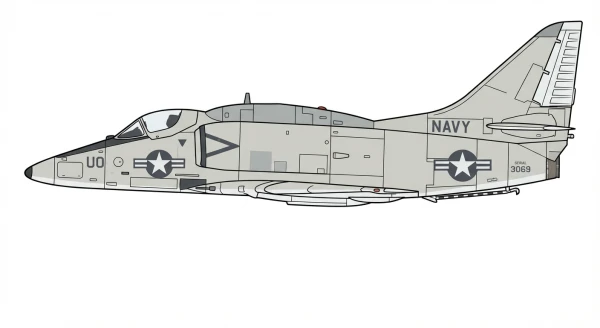
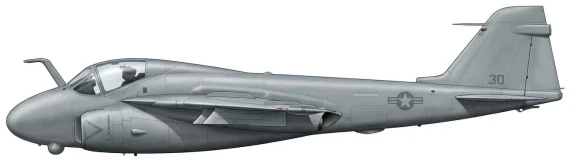
| A-4 Skyhawk | A-6 Intruder | |
|---|---|---|
| Origin country | 🇺🇸 United States | 🇺🇸 United States |
| Category | Combat Aircraft | Combat Aircraft |
| Manufacturer | McDonnell Douglas | Grumman |
| First flight | 22 June 1954 | 19 April 1960 |
| Year introduced | 1956 | 1963 |
| Number produced | 2960 units | 693 units |
| Average unit price | $2 million | $25 million |
| Wing area | 24.2 m² | 49.1 m² |
| Wingspan | 8.4 m | 16.2 m |
| Height | 4.6 m | 4.8 m |
| Length | 12.2 m | 16.6 m |
| Maximum speed | 1077 km/h | 1040 km/h |
| Operational range | 4,063 km | 5,219 km |
| Service ceiling | 12,880 m | 12,400 m |
| Max. takeoff weight | 11,136 kg | 27,500 kg |
| Empty weight | 4,750 kg | 11,630 kg |
| Total thrust | 1 x 4,100 kgf | 2 x 8,436 kgf |
Detailed Comparison
The Douglas A-4 Skyhawk and Grumman A-6 Intruder were both procured by the U.S. Navy to replace the piston-engined A-1 Skyraider, yet they represent opposing aerodynamic and doctrinal extremes. The A-4 prioritized mass reduction and daytime visual attack, while the A-6 prioritized avionics integration and all-weather blind-bombing capabilities.
Development and Design
Ed Heinemann designed the A-4 under a strict weight-reduction mandate, bringing the XA4D-1 prototype in at exactly half the Navy's specified weight limit. The A-4 utilized a short-span (8.38 m) delta wing machined from a single forging, which eliminated the weight of wing-folding mechanisms. It also used gravity-actuated leading-edge slats instead of hydraulic motors. Grumman designed the A-6 around the Digital Integrated Attack/Navigation Equipment (DIANE) suite. The A-6 required a wider fuselage to accommodate side-by-side seating for a pilot and bombardier/navigator, utilizing a CRT-based Vertical Display Indicator for head-down, instrument-based navigation.
Specifications and Performances
The A-6 is a heavier platform, weighing 11,630 kg empty compared to the A-4's 4,750 kg. This mass dictates their respective payload capacities:
- The A-6 carries up to 18,000 lb of ordnance across five hardpoints.
- The A-4 carries up to 8,500 lb of ordnance across five hardpoints.
Both aircraft utilize the Pratt & Whitney J52 turbojet. The A-6 requires two engines to generate 8,436 kgf of thrust, whereas the single-engine A-4 operates on 4,100 kgf. Despite generating less than half the total thrust, the lighter A-4 maintains a higher top speed (1,077 km/h vs. 1,040 km/h) and a faster climb rate (43.0 m/s vs. 38.7 m/s).
Deployment and usage
In Vietnam, the A-6 executed nighttime and adverse weather interdiction, though its low-altitude ingress profile resulted in 84 combat losses, primarily to conventional anti-aircraft artillery. The A-4 operated as a light attack asset, flying high-volume daytime sorties. The A-4's low unit cost ($2.0 million vs the A-6's $25.0 million) drove its export success. During the Yom Kippur War, Israeli A-4s sustained high attrition to radar-guided SA-6 systems but maintained high sortie generation rates. In the Falklands War, Argentine A-4s penetrated British air defenses at wave-top heights to sink HMS Coventry and HMS Ardent. The A-6 saw no foreign sales, remaining exclusively a U.S. asset until its retirement after Desert Storm.
Conclusion
For localized conflicts and export markets, the A-4 Skyhawk is the more pragmatic procurement choice. Its single-engine architecture and minimal electronic complexity allow air forces to field high numbers of close air support platforms with low maintenance overhead. However, for peer-level naval strike, the A-6 Intruder holds the tactical advantage. The ability to deliver 18,000 lbs of munitions on target at night or through heavy overcast justifies its procurement cost and intensive maintenance footprint. Naval aviation requires all-weather capability to project power globally; the A-6 fulfills that requirement, while the A-4 is restricted to permissive, daytime visual environments.