A-1 Skyraider
American single-seat attack aircraft, in service from 1946 to the early 1980s, utilized for carrier-based dive and torpedo bombing during the Korean and Vietnam Wars. Key figures: top speed 518 km/h, range 2,118 km, service ceiling 8,700 m, max takeoff weight 8,213 kg, built 3,180.
| Crew | 1 |
| Length | 11.8 m (38.8 ft) |
| Wingspan | 15.2 m (50.0 ft) |
| Height | 4.8 m (15.7 ft) |
| Wing area | 37.2 m² (400.3 sqft) |
| Empty weight | 5,429 kg (11,969 lbs) |
| Max. takeoff weight | 8,213 kg (18,107 lbs) |
| Powerplant | 1 × Wright R-3350-26WA Duplex-Cyclone 18-cylinder air-cooled radial piston engine 2,000 kW each |
| Maximum speed | 518 km/h (322 mph) |
| Operational range | 2,118 km (1,316 mi) |
| Endurance | 10 hours |
| Service ceiling | 8,700 m (28,543 ft) |
| Climb rate | 14.5 m/s (47.6 ft/s) |
- Unguided Bomb Mk 82
- Unguided Bomb Improvised toilet bombs
- Nuclear AD-4B specialized munitions
- Rocket Pod Aero rocket launchers
- Gun Pod Gun pods
Description
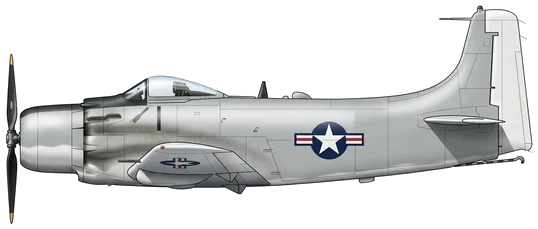
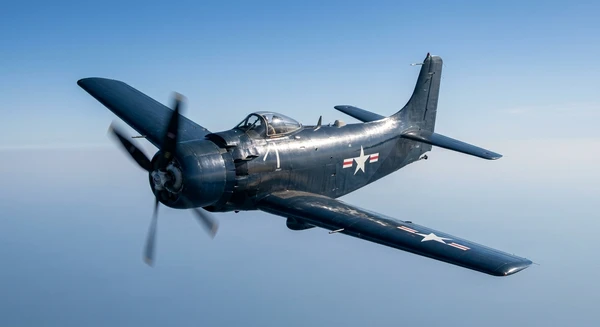
The Douglas A-1 Skyraider, originally designated AD, was designed by Ed Heinemann of the Douglas Aircraft Company to meet U.S. Navy requirements for a carrier-based, single-seat dive and torpedo bomber. It was intended to succeed the Douglas SBD Dauntless, Curtiss SB2C Helldiver, and Grumman TBF Avenger. The XBT2D-1 prototype first flew on March 18, 1945, and U.S. Navy evaluation began in April 1945. Production occurred at the Douglas plant in El Segundo, California, with 3,180 aircraft built by the time production ended in 1957.
Design
The A-1 is a low-wing monoplane powered by a Wright R-3350 Duplex-Cyclone radial engine. Initial power output exceeded 2,000 hp, with the final AD-7 variant producing 2,800 hp. The design features large straight wings with 15 external hardpoints. During development, engineers reduced airframe weight by 1,800 lb by simplifying the fuel system and eliminating the internal bomb bay. For pilot protection, the aircraft includes armor plating around the cockpit area. U.S. Air Force (USAF) variants were later fitted with the Stanley Yankee extraction system to allow for pilot egress.
Armament
Internal armament consists of four 20 mm AN/M3 cannon with 200 rounds per gun. The 15 hardpoints provide a total external payload capacity of 10,500 lbs. Munition types include bombs, torpedoes, mine dispensers, unguided rockets, and gun pods.
Operational History
The Skyraider entered service in December 1946 with squadron VA-19A. During the Korean War, it was the primary strike aircraft for the U.S. Navy and Marine Corps. On May 2, 1951, Skyraiders conducted the only aerial torpedo attack of the conflict, striking the Hwacheon Dam. In the Vietnam War, the A-1 was utilized by the U.S. Navy, USAF, and the Republic of Vietnam Air Force (RVNAF) for close air support and search and rescue escort missions, known by the call sign "Sandy." U.S. Navy pilots recorded two gun kills against North Vietnamese MiG-17 jet fighters in 1965 and 1966.
The Royal Navy operated 50 AD-4W early warning variants as the Skyraider AEW.1 until 1962. The French Air Force utilized 113 Skyraiders during the Algerian War and later in Chad. The RVNAF acquired more than 350 aircraft over the course of the Vietnam War. Other operators included Sweden, where the aircraft served as target tugs, as well as Cambodia and Gabon.
Variants
- AD-1: The initial production model with 242 aircraft built.
- AD-4: A variant featuring strengthened landing gear, four 20 mm cannon, and 14 Aero rocket launchers.
- AD-5 (A-1E): A widened version with side-by-side seating for two crew members and the removal of dive brakes.
- AD-6 (A-1H): A single-seat attack variant with a centerline station stressed for 3,500 lb of ordnance.
- AD-7 (A-1J): The final production model, powered by a Wright R-3350-26WB engine and featuring strengthened wings.
Frequently Asked Questions
What type of aircraft is the A-1 Skyraider?
What is the maximum speed of the A-1 Skyraider?
What is the range of the A-1 Skyraider?
When did the A-1 Skyraider first fly?
How many A-1 Skyraider have been built?
Which countries operate the A-1 Skyraider?
What is the service ceiling of the A-1 Skyraider?
- MAY 102026 Created Page created: A-1 Skyraider