A-4 Skyhawk vs F-5 Freedom Fighter
A-4 Skyhawk vs F-5 Freedom Fighter at a glance — top speed 1,077 vs 1,700 km/h, range 4,063 vs 2,806 km, max takeoff weight 11,136 vs 11,187 kg, built 2,960 vs 1,204 units.
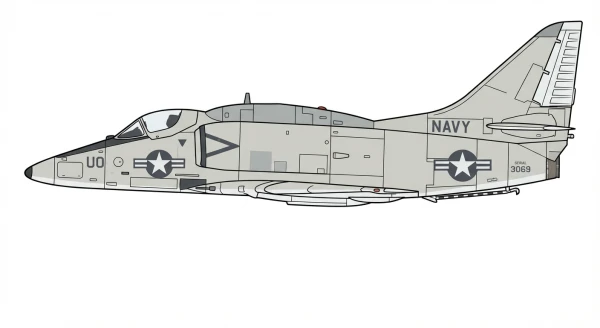
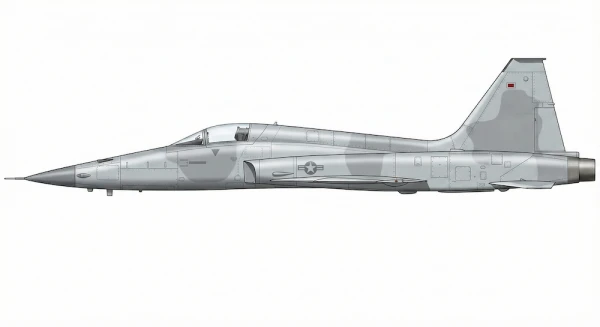
| A-4 Skyhawk | F-5 Freedom Fighter | |
|---|---|---|
| Origin country | 🇺🇸 United States | 🇺🇸 United States |
| Category | Combat Aircraft | Combat Aircraft |
| Manufacturer | McDonnell Douglas | Northrop |
| First flight | 22 June 1954 | 30 July 1959 |
| Year introduced | 1956 | 1965 |
| Number produced | 2960 units | 1204 units |
| Average unit price | $2 million | $2 million |
| Wing area | 24.2 m² | 17.3 m² |
| Wingspan | 8.4 m | 8.1 m |
| Height | 4.6 m | 4.1 m |
| Length | 12.2 m | 14.5 m |
| Maximum speed | 1077 km/h | 1700 km/h |
| Operational range | 4,063 km | 2,806 km |
| Service ceiling | 12,880 m | 15,789 m |
| Max. takeoff weight | 11,136 kg | 11,187 kg |
| Empty weight | 4,750 kg | 4,349 kg |
| Total thrust | 1 x 4,100 kgf | 2 x 3,176 kgf |
Detailed Comparison
Douglas designed the A-4 Skyhawk as a nuclear delivery system shrunk to fit smaller carriers, while Northrop’s F-5 was an export-focused lightweight fighter intended to counter Soviet MiGs on a budget. Though both emerged from the 1950s trend toward reversing weight creep, the Skyhawk prioritized ordnance delivery and range, whereas the F-5 prioritized kinematic performance and air-to-air capability.
Development and Design
Ed Heinemann’s "gram strategy" for the A-4 produced a machine half the Navy’s specified weight. The single-spar delta wing eliminated heavy folding mechanisms, creating a compact airframe capable of absorbing punishment. The design focused on structural simplicity and maximum internal fuel volume. Conversely, Northrop’s Edgar Schmued designed the F-5 around two high-thrust-to-weight General Electric J85 turbojets—engines originally designed for missiles. The F-5 utilized the area rule (coke bottle fuselage) for supersonic flight, focusing on aerodynamic refinement rather than the A-4’s brute-force simplicity. The Skyhawk was built to haul; the F-5 was built to turn.
Specifications and Performances
Performance metrics reveal the doctrinal split. The F-5E reaches 1,700 km/h and climbs at 175 m/s, dwarfing the A-4’s subsonic 1,077 km/h top speed and 43 m/s climb rate. The F-5 is an interceptor; the A-4 is a target in an air-to-air engagement. However, the Skyhawk dominates in logistics: it carries an 8,500 lb payload—surpassing the F-5's 7,000 lb limit—despite having a significantly smaller footprint. The A-4 also offers superior range (1,867 km vs 891 km), critical for carrier operations or deep strike, while the F-5’s short legs necessitate forward basing and external tanks for meaningful sortie times.
Deployment and usage
The A-4 served as the US Navy's primary light attack platform in Vietnam, flying thousands of sorties into high-threat environments. Its combat history is defined by heavy ground attack usage, often sustaining significant battle damage that would ground more complex airframes. In the Falklands, Argentine A-4s proved lethal against modern naval air defenses, sinking HMS Coventry and Ardent.
The F-5 found its niche in export markets and air superiority for smaller nations. In the Ogaden War, Ethiopian F-5s decimated Somali MiG-21s, validating its design as a low-cost counter-air asset. The USAF utilized the F-5 primarily as an aggressor aircraft to simulate Soviet tactics, acknowledging its kinematic resemblance to the MiG-21 Fishbed. While the A-4 dropped bombs, the F-5 taught pilots how to survive dogfights.
Conclusion
For strike capability and logistical efficiency, the A-4 Skyhawk is the superior platform. Its ability to deliver heavier payloads at longer ranges from austere decks remains unmatched in its weight class. The F-5 succeeds specifically as a low-cost air superiority fighter and lead-in trainer. While the F-5 offers affordable supersonic interception, the Skyhawk’s engineering efficiency—lifting nearly its own weight in ordnance—makes it the more operationally valuable asset for force projection.