F-5 Freedom Fighter
American light fighter of Cold War era, notable for worldwide deployment, used extensively in Vietnam and various regional conflicts. Key figures: top speed 1,700 km/h, range 2,806 km, service ceiling 15,789 m, max takeoff weight 11,187 kg, unit price $2M, built 1,204. In service with 16 air forces as of 2026 — United States (43), Spain (19), Iran (16) and 13 others.
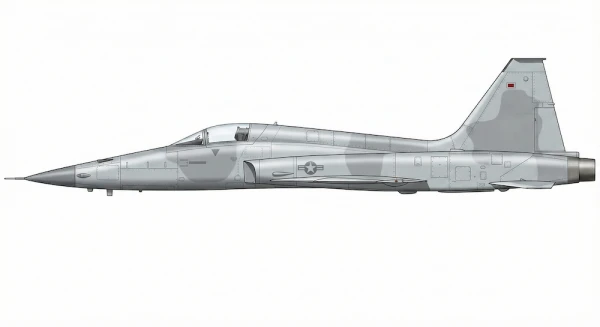
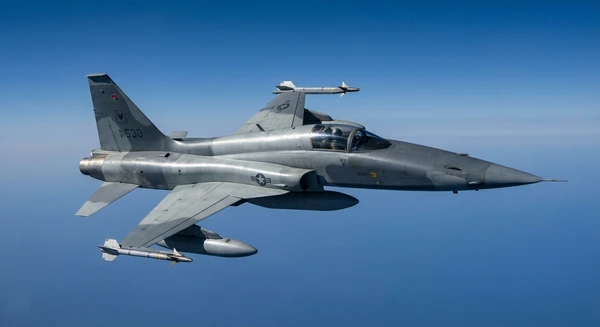
| Crew | 1 |
| Length | 14.5 m (47.4 ft) |
| Wingspan | 8.1 m (26.7 ft) |
| Height | 4.1 m (13.4 ft) |
| Wing area | 17.3 m² (186.0 sqft) |
| Empty weight | 4,349 kg (9,588 lbs) |
| Max. takeoff weight | 11,187 kg (24,663 lbs) |
| Powerplant | 2 × turbojets General Electric J85-GE-21B 3,176 kgf each |
| Ejection seat | Northrop M-38 |
| Maximum speed | 1700 km/h (Mach 1.7) |
| Operational range | 2,806 km (1,744 mi) |
| Service ceiling | 15,789 m (51,801 ft) |
| Climb rate | 175.0 m/s (574.1 ft/s) |
-
 United States
43
United States
43
-
 Spain
19
Spain
19
-
 Iran
16
Iran
16
-
 Botswana
15
Botswana
15
-
 Turkey
13
Turkey
13
-
 Venezuela
6
Venezuela
6
-
 Kenya
5
Kenya
5
-
 Brazil
4
Brazil
4
-
 Switzerland
4
Switzerland
4
-
 Morocco
4
Morocco
4
-
 Chile
3
Chile
3
-
 Tunisia
3
Tunisia
3
-
 Honduras
2
Honduras
2
-
 Thailand
2
Thailand
2
-
 Yemen
2
Yemen
2
-
 Mexico
1
Mexico
1
- Air-to-Surface AGM-65 Maverick
- Air-to-Air Medium-Range AIM-120 AMRAAM
- Air-to-Air Short-Range Raytheon AIM-9 Sidewinder
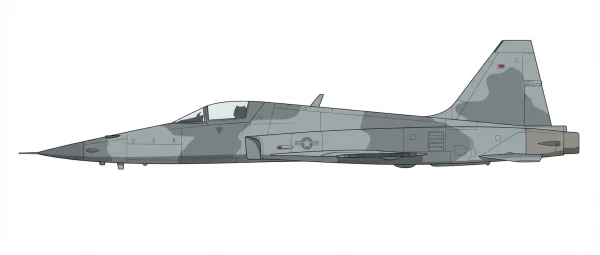
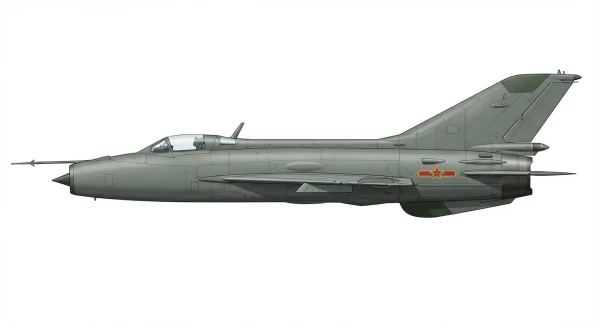
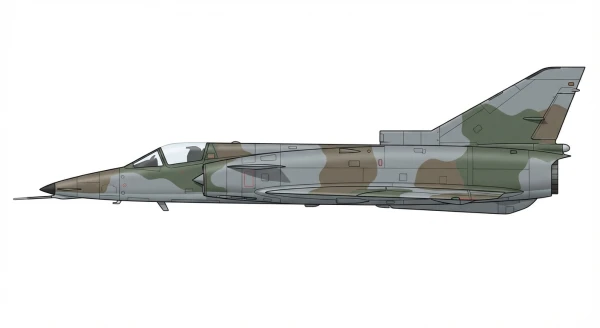
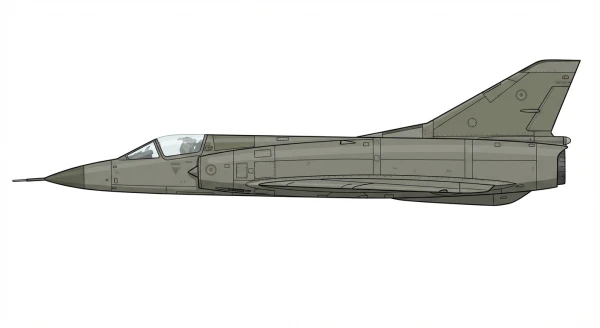
Description
The Northrop F-5 emerged from a privately funded project in the late 1950s by the Northrop Corporation, led by vice president of engineering and aircraft designer Edgar Schmued. The impetus for its design stemmed from a December 1953 NATO specification (NBMR-1) that called for a lightweight tactical fighter capable of carrying both conventional and nuclear weapons and operating from austere airfields. After touring Europe and Asia to examine the NBMR-1 and the needs of SEATO members, Schmued set out to reverse the trend of increasing size and weight in fighter development, prioritizing high performance, maneuverability, reliability, and cost-effectiveness. Key to the design was the integration of two compact and high-thrust General Electric J85 turbojet engines, originally developed for the ADM-20 Quail decoy. Several designs were considered; eventually the January 1956 PD-2812 version began to resemble the final product, with the engines within the fuselage. The first prototype, later designated as the YT-38 Talon, flew on June 12, 1959, and the first N-156F flew on July 30, 1959. Despite initial wavering from the USAF, the N-156F was selected as the winner of the F-X competition on April 23, 1962, becoming the "F-5A", with production starting in October of that year.
Design
The Northrop F-5 family is characterized by its small, highly aerodynamic design, optimized for performance and ease of maintenance. The original F-5A and F-5B variants were designed with two compact and high-thrust General Electric J85 engines. The second-generation F-5E Tiger II featured upgraded, more powerful GE J85-21 engines, larger fuel capacity, greater wing area, and improved leading-edge extensions for enhanced turn rates. Avionics were also improved, including the addition of air-to-air radar; the F-5A and B models lacked radar. Specific avionics could be customized, with options such as an inertial navigation system, TACAN, and ECM equipment. A two-position nose landing gear was incorporated from the Canadian CF-5 to reduce takeoff distance.
Armament
The F-5's armament consists of two 20 mm M39A2 revolver cannons in the nose, each with 280 rounds. It features seven hardpoints: two wing-tip AAM launch rails, four under-wing, and one under-fuselage pylon station. These provide a total capacity of 7,000 pounds (3,200 kg) for various combinations of ordnance. Rocket options include LAU-61/LAU-68 rocket pods (each with 19/7 Hydra 70 mm rockets), LAU-5003 rocket pods (each with 19 CRV7 70 mm rockets), LAU-10 rocket pods (each with 4 Zuni 127 mm rockets), or Matra rocket pods (each with 18 SNEB 68 mm rockets). For missiles, the F-5 can carry two AIM-9 Sidewinder air-to-air missiles on the wingtips in its initial configuration, or up to four AIM-9 Sidewinders or AIM-120 AMRAAMs on upgraded versions. It also supports air-to-surface capabilities, such as four AGM-65 Maverick missiles on upgraded models after 1995. Moreover, the F-5 can be armed with a variety of air-to-ground ordnance, including Mark 80 series unguided bombs, CBU-24/49/52/58 cluster bomb munitions, napalm bomb canisters, M129 Leaflet bombs, and Paveway family laser-guided bombs. The aircraft can carry up to three external Sargent Fletcher drop tanks (150/275 US gallons each) for extended range. Some Thai F-5s are equipped with a GPU-5/A 30 mm cannon pod on the centerline station.
Operational History
The F-5 has seen widespread operational use across various theaters, often serving as a cost-effective and reliable platform for both air-to-air and ground attack missions. Notably, the type was deployed in the Vietnam War, where it underwent combat evaluation and saw service with both the USAF and the Republic of Vietnam Air Force (RVNAF). The USAF initially trialed the F-5A, designated as F-5C, in a program called Skoshi Tiger, finding it capable in the ground-attack role, albeit with a shorter range than contemporaries. The RVNAF eventually received F-5s as well, with the type becoming a mainstay in their inventory. In the US, the F-5 was famously adopted as an "aggressor" aircraft, valued for its maneuverability and similarities to the Soviet MiG-21, providing realistic dissimilar air combat training. In the Ogaden War, Ethiopian F-5s played a pivotal role against Somali forces, achieving air superiority and conducting effective interdiction and strike missions. Across the globe, the F-5 has equipped numerous air forces from countries including Canada, Greece, Iran, Kenya, Malaysia, Mexico, Morocco, the Netherlands, Norway, Philippines, Singapore, South Korea, Spain, Switzerland, Taiwan, and Venezuela; its affordability, ease of maintenance, and adaptable design have contributed to its longevity and continued relevance in diverse operational environments. However, it did have marginal acceleration, rearward visibility, and fuel fraction compared to some contemporaries.
Variants
Main Variants:
-
F-5A: The initial single-seat fighter version, lacking radar in its original configuration but later upgraded with AN/APQ-153 radar.
-
F-5B: A two-seat trainer variant that retained combat capabilities but omitted the nose-mounted cannons.
-
RF-5A Tigereye: A dedicated reconnaissance version equipped with a four-camera nose, replacing the standard fighter nose.
-
F-5E Tiger II: A significantly upgraded single-seat fighter with more powerful engines, increased fuel capacity, larger wing area, and improved avionics, including the AN/APQ-153 radar.
-
F-5F Tiger II: A two-seat, combat-capable trainer variant of the F-5E, featuring a longer nose that housed a single M39 cannon and the Emerson AN/APQ-157 radar.
Frequently Asked Questions
What type of aircraft is the F-5 Freedom Fighter?
What is the maximum speed of the F-5 Freedom Fighter?
What is the range of the F-5 Freedom Fighter?
When did the F-5 Freedom Fighter first fly?
How many F-5 Freedom Fighter have been built?
Which countries operate the F-5 Freedom Fighter?
How much does a F-5 Freedom Fighter cost?
What is the service ceiling of the F-5 Freedom Fighter?
- SEP 52026 Updated Maximum range corrected to the F-5A ferry range (the previous figure was the F-5E Tiger II value)
- AUG 122026 Updated Range corrected to the ferry range with external tanks
- JUL 232026 Updated Sources and cross-references refreshed
- APR 72026 Updated Sources and cross-references refreshed
- JAN 242026 Updated Thrust updated
- JAN 122026 Updated Range updated in a site-wide editorial pass