MiG-21 Fishbed
Soviet supersonic jet fighter, renowned for extensive service during the Cold War, prevalent in various international conflicts. Key figures: top speed 2,175 km/h, range 793 km, service ceiling 17,500 m, max takeoff weight 10,400 kg, unit price $2M, built 11,496. In service with 7 air forces as of 2026 — North Korea (26), Angola (23), Yemen (19) and 4 others.
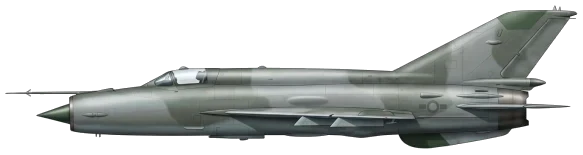

| Crew | 1 |
| Length | 14.7 m (48.2 ft) |
| Wingspan | 7.2 m (23.5 ft) |
| Height | 4.1 m (13.5 ft) |
| Wing area | 23 m² (247.6 sqft) |
| Empty weight | 4,871 kg (10,739 lbs) |
| Max. takeoff weight | 10,400 kg (22,928 lbs) |
| Powerplant | 1 × turbojet Tumansky R-25-300 7,095 kgf each |
| Ejection seat | Severin KS-1 |
| Maximum speed | 2175 km/h (Mach 2.0) |
| Operational range | 793 km (493 mi) |
| Service ceiling | 17,500 m (57,415 ft) |
-
 North Korea
26
-
 Angola
23
-
 Yemen
19
-
 Libya
11
-
 Mali
9
-
 Mozambique
8
-
 Sudan
4
- Air-to-Air Short-Range Vympel R-3 (AA-2 Atoll)
- Air-to-Air Short-Range Vympel R-60 / K-60 (AA-8 Aphid)
- Low-Drag JSC NPO Basalt FAB-500
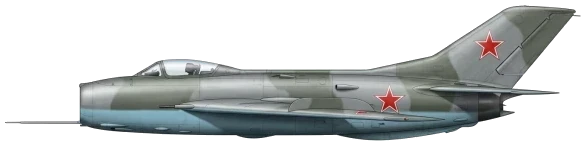
Description
The Mikoyan-Gurevich MiG-21 (NATO reporting name Fishbed) is a single-engine, single-seat supersonic fighter and interceptor developed in the Soviet Union in the 1950s. Roughly 11,500 were built up to 1986, counting Soviet, Czechoslovak and Indian production, making it the most-produced supersonic combat aircraft in history; some 60 air forces flew it on four continents. It fought over North Vietnam, the Middle East, Africa, the Indian subcontinent, the Balkans, Libya and Syria. The last European and Indian fleets stood down between 2021 and 2025, and as of 2026 around a hundred remain listed in service with seven air forces, mostly in Africa and with North Korea.
Development
The MiG-21 followed the transonic MiG-15 and MiG-17 and the supersonic MiG-19 as the Mikoyan bureau's answer to a Mach 2 lightweight fighter. The Ye-1 study of 1954 was reworked into the Ye-2 when its intended engine proved underpowered; both had swept wings. The Ye-4 introduced the tailed delta that every production version kept, flying on 16 June 1955.
Soviet plants at Gorky, Moscow and Tbilisi built 10,645 aircraft, Czechoslovakia 194 MiG-21F-13s under licence and Hindustan Aeronautics 657 MiG-21FL, M and bis. The last Soviet example, a MiG-21UM, left the line in December 1986. Mass production made the aircraft cheap: a MiG-21MF cost less than a BMP-1 and a fraction of an F-4 Phantom II. China's Chengdu J-7, developed from the MiG-21F-13, is a separate lineage built until 2013.
Design
The MiG-21 is a tailed delta: a 57-degree leading-edge sweep on a thin TsAGI S-12 section, a stabilator, a small ventral fin and a semi-monocoque fuselage no more than 4 ft 1 in (1.24 m) wide. A translating shock cone in the circular nose intake regulates airflow. The layout left little room for a radar antenna, which ultimately capped the airframe's development. Three ventral airbrakes, a brake parachute and provision for two JATO rockets suit it to short, rough strips.
The first generation flew on the Tumansky R-11F-300 afterburning turbojet; the definitive MiG-21bis has the R-25-300, rated at 15,640 lbf (69.6 kN) in afterburner, with an emergency setting usable for two minutes below 6,600 ft (2,000 m) that lifts thrust to 21,900 lbf (97.4 kN), gives a thrust-to-weight ratio slightly above 1:1 and a climb rate near 50,000 ft/min (254 m/s), at a heavy cost in engine life. Maximum speed is in the Mach 2 class at altitude and the service ceiling 57,400 ft (17,500 m). The weaknesses are structural: fuel tanks ahead of the centre of gravity make the aircraft progressively unstable as fuel burns, clean endurance is about 45 minutes, and the delta wing bleeds speed in sustained turns. Simple systems and low costs kept it attractive to air forces with small pilot pools long after it was outclassed.
Upgrades
Russian, Israeli and Romanian firms offered life-extension packages from the 1990s. Romania's LanceR programme (1995-2002) modernised 111 airframes with Israeli avionics: 71 LanceR A for ground attack, 14 two-seat LanceR B and 26 LanceR C air-defence aircraft able to fire R-60M, R-73, Magic 2 and Python III missiles. India's MiG-21 Bison, derived from the Russian MiG-21-93 package, rebuilt bis airframes with a new radar, cockpit and missile fit and served until 2025. Israel offered the MiG-21-2000. North Korea's MiG-21bis, 30 of them bought from Kazakhstan in the 1990s, have received multifunction displays, new communications and indigenous guided glide bombs.
Armament
The MiG-21F-13 carried a single 30 mm cannon; the radar-equipped PF dropped the gun, the PFM restored it as a podded GSh-23, and the M, MF and bis mount a twin-barrel 23 mm GSh-23L internally with 200 rounds. Later versions carried four underwing pylons, plus a centreline drop-tank station. Air-to-air loads progressed from the K-13 (R-3S, AA-2 Atoll) to the R-55 and R-60 (AA-8 Aphid); upgraded aircraft add the R-73, R-77, Python III and Magic 2. Ground-attack stores include UB-16-57 rocket pods, S-24 rockets and up to two 500 kg and two 250 kg bombs.
Operational History
Vietnam, 1966-1973
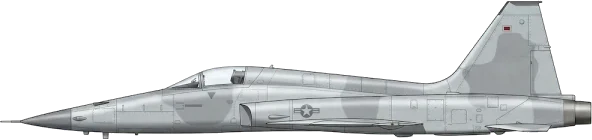
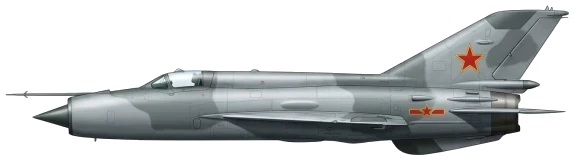
North Vietnam received its first MiG-21s in April 1966 for the 921st Fighter Regiment, adding the 927th in 1972. Flown under tight ground control in fast single-pass attacks on F-105 strike packages, they forced bombers to jettison their loads and inflicted losses out of proportion to their numbers: in 46 recorded engagements between F-4s and MiG-21s the two sides lost 27 Phantoms and 20 MiGs. Soviet records credit Vietnamese MiG-21s with 165 victories for 65 lost; 13 Vietnamese pilots became aces on the type. The experience led the US Navy to found TOPGUN in 1969. In December 1972 the MiG-21 force was tasked against B-52s; Vietnam claims two bombers, which US records do not confirm.
Middle East, 1964-1988
In the 1967 Six-Day War Egypt lost about 100 of 110 MiG-21s, almost all on the ground, and Syria 35 of 60. In the 1973 Yom Kippur War Israel claimed 65 confirmed kills against Egyptian MiG-21s and 26 against Syrian ones; Egypt and Syria claimed 27 and 30. Over Lebanon in June 1982 Syria acknowledged the loss of 37 MiG-21s against the Israeli Air Force. In the Iran-Iraq War Iraqi MiG-21s claimed 43 Iranian aircraft; Iranian F-14s and F-4s downed at least 52.
South Asia, 1963-2025
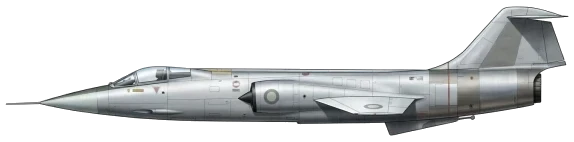
India selected the MiG-21 in 1961 with full technology transfer and inducted it in 1963, its first supersonic fighter; some 870 served in all, peaking at 400 across 19 squadrons. In the 1971 war it claimed four F-104s, two F-6s, an F-86 and a C-130, one Starfighter falling to cannon fire in the subcontinent's first supersonic dogfight. MiG-21s flew high-altitude patrols and strikes in the 1999 Kargil war, losing one to ground fire, and on 10 August 1999 shot down a Pakistani Atlantic patrol aircraft with an R-60. On 27 February 2019 a Pakistani F-16 shot down an IAF MiG-21 Bison over the Line of Control; the pilot was captured and returned, and India's claim to have downed an F-16 in the same fight was disputed. More than 170 Indian pilots and 40 civilians died in MiG-21 accidents after 1970, and over half the 840 aircraft built in India between 1966 and 1984 were lost, earning the nickname "flying coffin". The FL left service in 2013; the Bison fleet, held on standby but not used in the May 2025 conflict with Pakistan, was retired on 26 September 2025 at Chandigarh, where No. 3 and No. 23 Squadrons flew the last sorties before converting to the Tejas Mk1A.
Africa and Asia
Cuban and Angolan MiG-21MF and bis flew up to three sorties a day as fighter-bombers in Angola, losing 13 aircraft between 1984 and 1988, several to South African Mirage F1s. North Korean MiG-21s shot down a US EC-121 in 1969. Libyan MiG-21s flew bombing missions for the Libyan National Army from 2014; two crashed that year and a MiG-21MF was shot down by a surface-to-air missile south of Tripoli on 14 April 2019. Syria's MiG-21s struck insurgents from 2012, losing several to ground fire, and still had about 50 on charge in 2024; after the fall of the Assad government in December 2024 and the Israeli strikes that followed, the air force was dismantled and no MiG-21 is confirmed flying in 2026.
Europe and the final retirements
Yugoslav MiG-21s flew ground-attack sorties in 1991-92, at least seven falling to Croatian and Bosnian air defences. Serbia's last active MiG-21 crashed on 25 September 2020, killing both pilots, and the type was retired in May 2021. Bulgaria flew its last on 31 December 2015. Romania's LanceR fleet, grounded from April to May 2022 after a crash on 2 March, was retired on 15 May 2023 at Bacau as F-16s took over. Croatia stood down its final four fighters and two trainers in November 2024, ending MiG-21 service in Europe.
Operators
As of 2026, the type remains listed in service with North Korea (26), Angola (23), Yemen (19), Libya (11), Mali (9), Mozambique (8) and Sudan (4); the operational state of several of these fleets is uncertain, and Cuba's small fleet is no longer counted as active. Every European operator, India and Vietnam (2015) have retired the type.
Variants
- MiG-21F / F-13 (Fishbed-C): First production day fighter, R-11F-300 engine, one 30 mm cannon, two K-13 missiles on the F-13.
- MiG-21PF / PFM (Fishbed-D/F): All-weather interceptor with RP-21 Sapfir radar and a larger intake cone; the PFM added a side-hinged canopy and a podded GSh-23.
- MiG-21R (Fishbed-H): Tactical reconnaissance version with a centreline sensor pod.
- MiG-21M / MF (Fishbed-J): Multirole version with four pylons and an internal GSh-23L; the MT and SMT traded performance for fuel.
- MiG-21bis (Fishbed-L/N): Final Soviet production version with the R-25-300 engine, strengthened airframe and G limits raised to +8.5.
- MiG-21U / US / UM (Mongol): Two-seat conversion trainers; the UM was the last version in production.
Frequently Asked Questions
What type of aircraft is the MiG-21 Fishbed?
What is the maximum speed of the MiG-21 Fishbed?
What is the range of the MiG-21 Fishbed?
When did the MiG-21 Fishbed first fly?
How many MiG-21 Fishbed have been built?
Which countries operate the MiG-21 Fishbed?
How much does a MiG-21 Fishbed cost?
What is the service ceiling of the MiG-21 Fishbed?
- OCT 52026 Updated Specifications aligned on the MiG-21bis
- OCT 52026 Updated Description overhauled: variants and upgrades, retirements through India in 2025, remaining operators and combat record
- AUG 12026 Updated Manufacturer updated
- JUL 232026 Updated Sources and cross-references refreshed
- JUN 262026 Updated Missiles updated
- APR 72026 Updated Sources and cross-references refreshed
- JAN 122026 Updated Range updated in a site-wide editorial pass