A400M Atlas vs Il-76 Candid
A400M Atlas vs Il-76 Candid at a glance — top speed 780 vs 850 km/h, range 3,300 vs 5,000 km, max takeoff weight 141,000 vs 195,000 kg, built 174 vs 960 units.
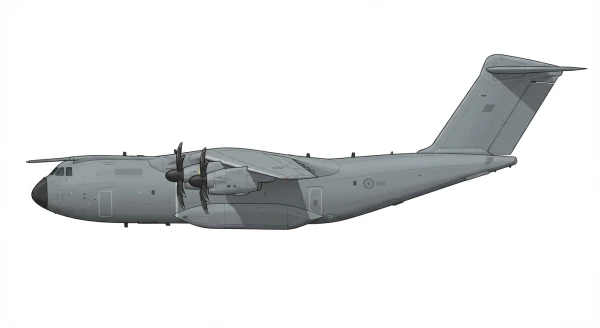
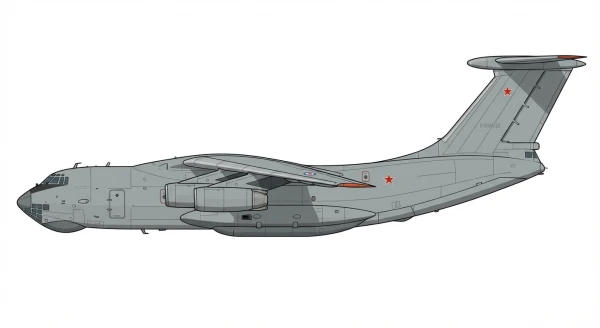
| A400M Atlas | Il-76 Candid | |
|---|---|---|
| Origin country | 🇪🇺 Europe | 🇷🇺 Ex-USSR |
| Category | Military Transport Aircraft | Military Transport Aircraft |
| Manufacturer | Airbus | Ilyushin |
| First flight | 11 December 2009 | 25 March 1971 |
| Year introduced | 2013 | 1974 |
| Number produced | 174 units | 960 units |
| Average unit price | $152 million | -- |
| Wing area | 221.5 m² | 300.0 m² |
| Wingspan | 42.4 m | 50.5 m |
| Height | 14.7 m | 14.8 m |
| Length | 45.1 m | 46.6 m |
| Maximum speed | 780 km/h | 850 km/h |
| Operational range | 3,300 km | 5,000 km |
| Service ceiling | 12,500 m | 13,000 m |
| Max. takeoff weight | 141,000 kg | 195,000 kg |
| Empty weight | 66,500 kg | 92,500 kg |
| Total thrust | 4 x 8,203 kW | 4 x 14,500 kgf |
Detailed Comparison
The Airbus A400M Atlas and the Ilyushin Il-76 Candid occupy overlapping segments of the heavy-lift market but diverge sharply in doctrine and industrial execution. The A400M functions as a high-tech tactical-strategic hybrid designed to replace the C-130 and C-160 with greater reach, while the Il-76 remains a dedicated strategic hauler built to operate independently of ground infrastructure across the vast Soviet (and now Russian) sphere of influence.
Development and Design
The A400M program, managed by OCCAR, represents a complex European political compromise. Its defining characteristic is the Europrop TP400-D6 powerplant—the most powerful Western turboprop in service. The decision to use counter-rotating propellers and a "down-between-engines" lift philosophy allows for steep tactical descents and short-field performance (STOL). However, this innovation came at the cost of severe gearbox reliability issues and years of delays. Extensive use of carbon fiber reinforced plastic (30% of structure) reduces weight but complicates battle damage repair compared to metal airframes.
Conversely, the Il-76 prioritizes mechanical robustness over avionic sophistication. Designed for the Soviet VDV (Airborne Forces), it features a high-lift wing and a rugged multi-wheel landing gear system capable of handling unpaved Siberian strips. The retention of a glass nose for a navigator and a flight engineer station in older variants highlights its lack of automation compared to the two-pilot, fly-by-wire cockpit of the A400M. While the modernized Il-76MD-90A introduces the PS-90A-76 engines and digital cockpit, the fundamental 1970s airframe design limits cargo cross-section efficiency.
Specifications and Performances
The Il-76 holds a distinct advantage in raw lift capacity. With a maximum takeoff weight of 195,000 kg and a payload capacity reaching 60 tonnes (Il-76MD-90A), it significantly outperforms the A400M’s 37-tonne limit. The Il-76 also offers superior range with maximum payload and higher cruise speeds (850 km/h vs 780 km/h).
However, the A400M wins on volume utility. Its cargo box width of 4.00 meters accommodates modern armored vehicles and helicopters (like the NH90 or CH-47 Chinook) that cannot fit into the narrower Il-76 fuselage without disassembly. The A400M requires only 1,150 meters for takeoff, enabling access to tactical airstrips denied to the heavier Ilyushin, which requires substantially more runway despite its rough-field gear.
Deployment and usage
Operational history reveals the doctrinal divide. The Il-76 serves as the logistical backbone for Russian operations in Syria and Ukraine, executing high-volume strategic airlift and mass paratroop drops (VDV doctrine). Its deployment in the Soviet-Afghan war established its reputation for survivability, though it remains vulnerable to MANPADS due to its large thermal signature.
The A400M proved its worth during Operation Barkhane in the Sahel, where the French Air and Space Force utilized its ability to land on sand strips to deliver supplies directly to forward operating bases, bypassing the need for transshipment via smaller tactical aircraft. However, availability rates have plagued the fleet; early operations were often hampered by propeller gearbox inspections and retrofit campaigns.
Conclusion
The Il-76 Candid remains the superior platform for pure strategic logistics, offering higher payload capacity and lower acquisition costs for nations requiring bulk transport of munitions or fuel. It is the workhorse for high-intensity conflict zones where volume matters more than precision.
The A400M Atlas, despite its troubled development, is the more capable tactical asset. It offers the unique ability to deliver outsized combat vehicles directly into the theater of operations, bridging the gap between strategic flight and tactical insertion. For modern air forces requiring rapid deployment of complex weapon systems to austere locations, the A400M justifies its higher cost; for sheer tonnage over distance, the Il-76 retains the edge.