AC-130 vs KC-130 Hercules
AC-130 vs KC-130 Hercules at a glance — top speed 669 vs 670 km/h, range 4,800 vs 5,250 km, max takeoff weight 70,307 vs 79,379 kg, built 21 vs 124 units.
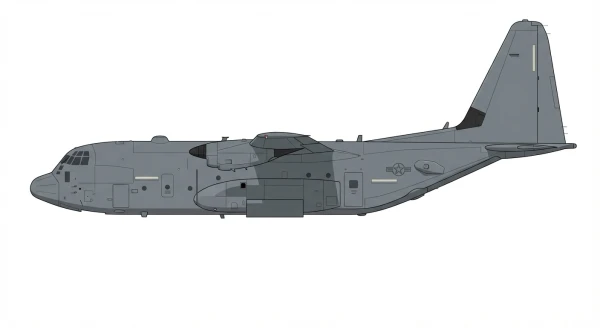
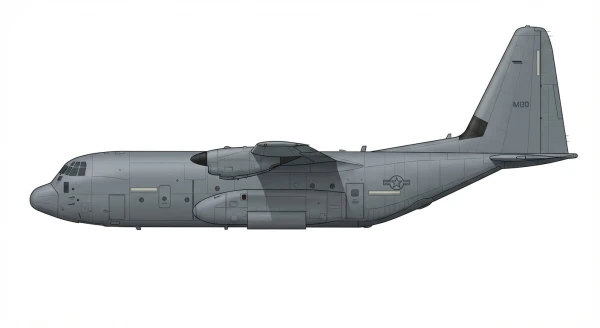
| AC-130 | KC-130 Hercules | |
|---|---|---|
| Origin country | 🇺🇸 United States | 🇺🇸 United States |
| Category | Military Special Mission Aircraft | Military Special Mission Aircraft |
| Manufacturer | Lockheed Martin | Lockheed Martin |
| First flight | 1 January 1967 | 1 January 1960 |
| Year introduced | 1968 | 1962 |
| Number produced | 21 units | 124 units |
| Average unit price | $150 million | $22 million |
| Wing area | 162.2 m² | 162.0 m² |
| Wingspan | 40.4 m | 40.4 m |
| Height | 11.7 m | 11.6 m |
| Length | 29.8 m | 29.8 m |
| Maximum speed | 669 km/h | 670 km/h |
| Operational range | 4,800 km | 5,250 km |
| Service ceiling | 9,144 m | 8,534 m |
| Max. takeoff weight | 70,307 kg | 79,379 kg |
| Empty weight | 33,063 kg | 34,274 kg |
| Total thrust | 4 x 3,661 kW | 4 x 4,474 kW |
Detailed Comparison
The Lockheed C-130 airframe spawned two heavily modified variants reflecting diverging military doctrines: the USAF’s AC-130 ground-attack gunship and the USMC’s KC-130 tanker. The AC-130 requires $150 million per unit to function as a dedicated, sensor-heavy close air support platform. The KC-130 costs $22 million per unit, operating primarily as a multi-role aerial refueler with secondary cargo and modular strike capabilities.
Development and Design
The AC-130 originated in 1967 under Project Gunship II to replace the underpowered Douglas AC-47. Air Force Special Operations Command doctrine drove its design toward loiter-heavy, nighttime precision fires. Modifications stripped cargo capacity to house fire-control computers, side-firing artillery ranging from 20mm Vulcans to 105mm M102 howitzers, and synthetic aperture radar. The KC-130, first flown in 1960, was built around Marine Air-Ground Task Force logistics. The USMC required an organic tactical tanker capable of refueling aircraft from unimproved strips. The KC-130J variant integrates a 27,215 kg fuel capacity with wing-mounted drogue pods. In a shift toward multi-mission capability, the USMC introduced the Harvest HAWK kit, allowing the KC-130 to deploy AGM-114 Hellfire and AGM-176 Griffin missiles using an AN/AAQ-30 Target Sight System without permanently sacrificing its tanker role.
Specifications and Performances
Performance metrics reflect differing engine configurations and payload penalties. The KC-130J utilizes Rolls-Royce AE 2100D3 turboprops generating 4,474 kW each, establishing a maximum takeoff weight (MTOW) of 79,379 kg. This yields a 5,250 km range and a 953-meter takeoff distance, aligned with expeditionary requirements. The AC-130, weighed down by armor, artillery, and sensor suites, operates at a lower 70,307 kg MTOW. Older variants relied on Allison T56-A-15 engines, restricting range to 4,800 km. Both airframes maintain maximum speeds near 670 km/h, bounded by the C-130 fuselage drag rather than thrust.
Deployment and usage
The USAF deploys the AC-130 exclusively in semi-permissive airspace. Combat feedback dictates night-only operations due to the airframe's vulnerability to MANPADS and radar-guided AAA—a constraint hardened during the 1991 Gulf War when an AC-130H was shot down at dawn at the Battle of Khafji. The KC-130 operates continuously as the logistical backbone of Marine aviation. During Operation Iraqi Freedom, VMGR-252 utilized KC-130Js to refuel jets directly adjacent to combat zones. With the Harvest HAWK, Marine tankers have executed battlefield illumination and close air support in Afghanistan, bridging the gap between logistics and kinetic fires.
Conclusion
The platforms maintain distinct operational advantages based on theater conditions:
- The AC-130 dominates low-threat, nighttime environments requiring sustained, high-volume direct fire. Its fixed artillery provides area saturation and kinetic persistence that roll-on precision-guided munitions cannot replicate.
- The KC-130 dictates expeditionary logistics. It functions as a multi-role force multiplier for Marine aviation, fueling strike packages while retaining precision strike capabilities via Harvest HAWK at 15% of the AC-130's acquisition cost.
For dedicated close air support, the AC-130 holds the absolute edge. For broad operational utility and budgetary efficiency across global deployments, the KC-130 provides a higher structural return on investment.