C-130 Hercules Variants
How to read a C-130 designation: model letters A to J, the J-30 stretch, Block 8.1, the KC, HC, MC, AC, EC, WC and LC prefixes, and who flies which version.
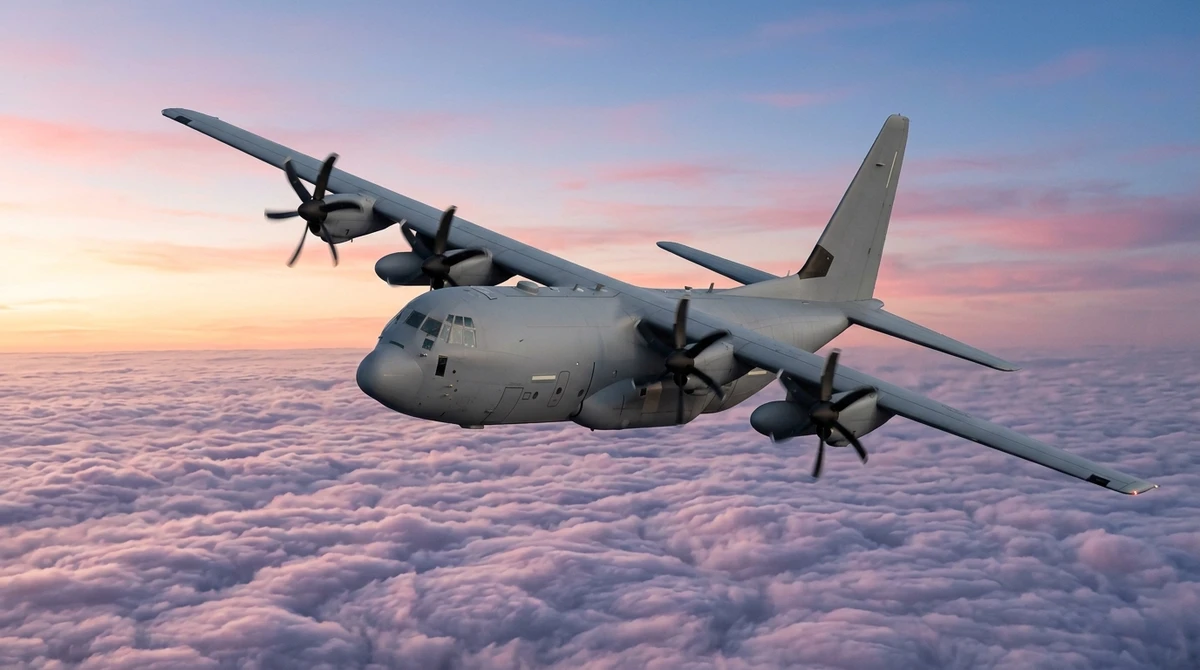
The C-130 Hercules has been in production since 1954, and the letters around the number tell most of its story. A, B, E and H were successive production models of the original airframe, each a change of engine or fuel system; J is a different aircraft that looks the same, with new engines, six-blade propellers and a two-pilot cockpit. The prefix in front of the C says what the airframe was converted to do: K for a tanker, H for rescue, M for special operations, A for a gunship, E for electronic warfare, W for weather, L for skis. As of 3 October 2026 Lockheed Martin counts more than 570 C-130Js delivered to 27 countries, and the US Air Force is retiring its last C-130Hs at 14 to 16 a year.
Three labels therefore matter. The model letter (C-130H, C-130J) identifies the production generation. The mission prefix (KC-130J, AC-130J) identifies the conversion, read exactly as the US designation system prescribes. The block, used only on the J, identifies the avionics and communications standard an aircraft was built or retrofitted to, Block 8.1 being the current one. "C-130J-30" or "CC-130J" adds a fourth element, the 15-foot fuselage stretch, which is a Lockheed designation rather than a US military one.
- Model letter: A (1956), B (1959), E (1962) and H (export deliveries from 1964, US Air Force from 1974) share the Allison T56 and a four-blade propeller; the H was built until 1996. K is the British H, F/G/R/T are Navy and Marine Corps builds, and L-100 is the civil airframe.
- C-130J: first flight 5 April 1996, Rolls-Royce AE 2100D3 engines, Dowty R391 six-blade propellers, two pilots and a loadmaster instead of five crew; it entered the US Air Force inventory in February 1999 and is the only model still in production.
- J-30: the stretched fuselage, 112 ft 9 in against 97 ft 9 in. Canada calls it the CC-130J; the US Air Force briefly used that label too, which is why both names appear in inventories.
- Prefixes: every special-mission J (KC, HC, MC, AC, WC, EC) is a C-130J airframe modified on or after the production line; the HC-130J, MC-130J and AC-130J all descend from the Marine Corps' KC-130J.
- Scale: Lockheed puts total Hercules deliveries above 2,700 across 63 nations; GMN inventory data lists 69 air forces flying the C-130 and 21 flying the KC-130.
The model letters, A to H
The YC-130 prototype first flew at Burbank on 23 August 1954, and the production C-130A, with four Allison T56-A-11 or -9 turboprops and three-blade propellers, began deliveries in December 1956; the US Air Force ordered 219. The C-130B of May 1959 introduced the T56-A-7, four-blade propellers and fuel tanks in the center wing (134 ordered). The C-130E, in service from August 1962 and the first long-range model, kept the engine but added two 1,290-gallon external tanks and a higher takeoff weight; 389 were ordered.
The C-130H is the E with the more powerful T56-A-15, a redesigned outer wing and updated avionics. Exports came first: Wikipedia records initial deliveries in 1964 to New Zealand (whose own account dates the first three aircraft to 1965), Lockheed's history dates the H's service entry to March 1965, and the US Air Force took the first of its 308 in June 1974. Production ran until 1996, and Lockheed counts 1,202 deliveries across the H's variants. The US Air Force sorts its fleet into production standards: the C-130H3, built from 1992 to 1996, added ring-laser gyros, GPS, a partial glass cockpit, the APN-241 color radar and night-vision-compatible lighting; the earlier aircraft are grouped as H1 and H2. The C-130H-30 is the stretched H, with a 100-inch plug behind the cockpit and an 80-inch plug aft.
Two national families sit beside the H. The C-130K is the British H, the Hercules C.1 in Royal Air Force service, with the stretched C.3 and the Met Office's W.2 research aircraft; the RAF flew Hercules of one model or another from 1967 until its C-130Js left at the end of June 2023. The US Navy and Marine Corps have their own letters: the C-130F of 1958 (GV-1 under the old Navy system), the strengthened C-130G, and the C-130R and C-130T with T56-A-16 engines, each becoming a KC-130 when fitted with refueling pods. The civil L-100 flew on 20 April 1964 and was built until 1992, 114 aircraft including the stretched L-100-20 and L-100-30; the LM-100J, a civil-certified C-130J-30, first flew on 25 May 2017.
| Service entry | Engines | What changed | |
|---|---|---|---|
| C-130A | Dec 1956 | T56-A-11 / -9, three-blade propellers | Initial production model; 219 ordered by the USAF |
| C-130B | May 1959 | T56-A-7, four-blade propellers | Center-wing fuel tanks, AC electrical system134 ordered; six became KC-130B tankers |
| C-130E | Aug 1962 | T56-A-7 | Two 1,290-gal external tanks, higher takeoff weight389 ordered; L-100 is the civil equivalent |
| C-130F / G / R / T | 1958 onward | T56-A-16 on R and T | Navy and Marine Corps builds; KC-130F/R/T when fitted with refueling pods |
| C-130H | Exports 1964–65; USAF June 1974 | T56-A-15 | Redesigned outer wing, updated avionics; H3 (1992–96) adds GPS, partial glass cockpit, APN-241 radarBuilt until 1996; 1,202 delivered across variants per Lockheed |
| C-130K | 1967 | T56-A-15 | British H: Hercules C.1, stretched C.3, W.2 research aircraft |
| C-130J | USAF Feb 1999 | Rolls-Royce AE 2100D3, six-blade Dowty R391 | Digital flight deck, two-pilot crew, head-up displays, new cargo handlingOnly model in production; Block 8.1 current |
| C-130J-30 / CC-130J | 1999 (RAF Hercules C.4) | As C-130J | 15-ft fuselage stretch: 128 passengers or 8 pallets against 92 or 6 |
| L-100 / LM-100J | 1965 / first flight 2017 | T56 / AE 2100D3 | Civil freighters; 114 L-100 built to 1992; LM-100J is a civil C-130J-30 |
The C-130J Super Hercules: a new type under an old number
The C-130J was launched by a Royal Air Force order for 25 aircraft on 16 December 1994, and first flew on 5 April 1996. Against the H it carries four Rolls-Royce AE 2100D3 turboprops (4,700 shp each) driving Dowty R391 six-blade composite propellers, a digital two-pilot flight station with head-up displays, dual inertial navigation with GPS, a low-power color radar and an enhanced cargo-handling system; the minimum crew is two pilots and a loadmaster. The J has 40 percent more range, a 21 percent higher maximum speed and a 41 percent shorter takeoff than the E and H; stall and tail-icing problems delayed certification to September 1998, and the first US Air Force aircraft followed in February 1999.
The C-130J-30 is Lockheed's name for the stretched version, 15 ft (4.6 m) longer, which lifts capacity from 92 to 128 passengers and from six to eight pallets. The Royal Air Force called it the Hercules C.4 (the short J was the C.5); Canada's 17 aircraft, delivered between June 2010 and May 2012, are the CC-130J; and the US Air Force used CC-130J for its own stretched aircraft for a time after 2002 before reverting to C-130J, so that two different variants have shared one designation. Most export customers buy the -30.
Block upgrades
C-130J production has moved through numbered blocks, which define the avionics and communications fit rather than the airframe. Earlier standards are sparsely documented in public sources; the MC-130J is a derivative of the Block 6.5 KC-130J. The current standard, Block 8.1, was planned in 2012 for more than 200 aircraft in seven nations between 2014 and 2018, and took longer. The US Air Force flew the first Block 8.1 aircraft at Little Rock on 3 February 2017, describing the upgrade as enhanced GPS, communications and friend-or-foe identification that "allows the C-130J to comply with worldwide air traffic management regulations". Lockheed Martin's own list, published when Norway received the first upgraded C-130J-30 in February 2024, starts with a flight management system compliant with CNS/ATM mandates, civil GPS, an updated IFF and a CNS/ATM datalink (the full list is in the upgrade table below) and applies to the US Air Force, Marine Corps and Coast Guard and to Australia, France, Germany and New Zealand among others. The first production aircraft built to the standard was delivered in 2024.
The special missions, read by prefix
Under the US system the mission prefix modifies the basic C (cargo) designation, so a KC-130J is a C-130J converted to refuel. The whole J special-mission family shares one root: Lockheed's 2008 contract for six modified KC-130Js led to the HC-130J and MC-130J, and the AC-130J is a modified MC-130J.
KC-130J tanker
The KC-130 is the Marine Corps' tanker and transport, with a removable cabin tank and two hose-and-drogue wing pods. The KC-130F entered service in 1962, followed by the KC-130R and KC-130T; the last KC-130T was retired by the reserve squadron VMGR-452 in April 2021, completing the transition to the KC-130J, in Marine service since 2001. The Marine Corps' 2025 aviation plan counts 75 KC-130Js in four squadrons against a program of record of 95; the Harvest HAWK kit adds a targeting sensor and Hellfire missiles for armed overwatch. France, Germany, Italy, Kuwait and Saudi Arabia also fly the KC-130J.
HC-130J Combat King II and the Coast Guard HC-130J
Two different aircraft carry the HC-130J name. The US Air Force's HC-130J Combat King II, the combat search-and-rescue tanker that refuels rescue helicopters and tiltrotors, first flew on 29 July 2010, reached initial operational capability on 25 April 2013 and totals 39 aircraft, production complete. The Coast Guard's HC-130J is a long-range surveillance and search-and-rescue aircraft without the refueling gear, a distinct production variant in Lockheed's list.
MC-130J Commando II
The MC-130J infiltrates, exfiltrates and resupplies special operations forces and refuels helicopters and tiltrotors. It added to the KC-130J a strengthened wing, a boom refueling receptacle, bigger generators, an electro-optical/infrared sensor, a combat systems officer station and armor; first flight was 20 April 2011, initial operational capability 7 December 2012, and the name changed from Combat Shadow II to Commando II in March 2012. The 64th and last was delivered to the 415th Special Operations Squadron at Kirtland on 14 January 2025; the MC-130E, MC-130P and MC-130H were retired in turn, the last Combat Talon II on 2 April 2023.
AC-130J Ghostrider and its predecessors
The gunship line runs from the AC-130A of 1968 through the AC-130E, the AC-130H Spectre (retired 2015), the AC-130U Spooky II (retired June 2020) and the AC-130W Stinger II, a converted MC-130W retired in July 2022. The AC-130J Ghostrider, named in May 2012, reached initial operational capability in 2017 and stood up its first squadron, the 73rd Special Operations Squadron at Hurlburt Field, on 23 February 2018; the last was delivered in November 2022. Its Precision Strike Package carries trainable 30 mm and 105 mm cannons and standoff munitions (GBU-39, GBU-69, Hellfire, Griffin) for a crew of nine, at a unit cost of $165 million. The fact sheet lists 37 aircraft by FY2024; Air & Space Forces Magazine's 2026 almanac counts 30 in inventory from 31 produced, all at a common Block 30 standard since FY2025.
EC-130H Compass Call and the EA-37B
The EC-130H Compass Call was a C-130H converted to jam enemy command and control, 14 aircraft with a crew of 13, first flown in 1981, delivered from March 1982 and operational in 1983 from Davis-Monthan. The last one flew on 2 September 2026, with a retirement ceremony on 18 September; its replacement, the EA-37B Compass Call, is a Gulfstream G550 carrying about 70 percent of the EC-130H's mission equipment, with five fielded, ten on order and 22 planned through 2031. The other EC-130, the EC-130J Commando Solo psychological-operations broadcaster of the Pennsylvania Air National Guard, was retired in September 2024.
WC-130J, LC-130 and the others
The WC-130J is the Air Force Reserve's Hurricane Hunter: ten aircraft of the 53rd Weather Reconnaissance Squadron at Keesler, operational since October 2006, with a stepped-frequency microwave radiometer and GPS dropsondes. The LC-130H is the ski-equipped polar airlifter, ten aircraft of the New York Air National Guard's 109th Airlift Wing; a next-generation LC-130J is in development, and Congress funded the first at $165 million in FY2026. The E-130J Phoenix II, a C-130J-30 fitted out by Northrop Grumman, will replace the Navy's E-6B in the TACAMO nuclear-communications role. For export customers Lockheed unveiled the C-130J-SOF at the Paris Air Show on 20 June 2017, its tenth production variant: a special-operations configuration with options for a 30 mm gun, Hellfire missiles and refueling, priced from about $85 million, with no customer announced since.
| Mission | Operator | Key dates | Fleet | |
|---|---|---|---|---|
| C-130J / C-130J-30 | Tactical airlift | USAF and 26 other countries | First flight 5 Apr 1996; USAF Feb 1999 | 570+ delivered, all variants (Lockheed, Sep 2026) |
| KC-130J | Tanker, transport, Harvest HAWK overwatch | USMC; France, Germany, Italy, Kuwait, Saudi Arabia | USMC from 2001; last KC-130T retired Apr 2021 | 75 USMC, program of record 95 |
| HC-130J Combat King II | Combat search and rescue, helicopter refueling | USAF | First flight 29 Jul 2010; IOC 25 Apr 2013 | 39, production complete |
| HC-130J (Coast Guard) | Long-range surveillance, search and rescue | US Coast Guard | First flight 2002 | Replacing the HC-130H |
| MC-130J Commando II | Special operations infiltration, resupply, refueling | USAF (AFSOC, Pennsylvania ANG) | First flight 20 Apr 2011; IOC 7 Dec 2012; last delivered 14 Jan 2025 | 64 built |
| AC-130J Ghostrider | Close air support, interdiction, armed reconnaissance | USAF (AFSOC) | IOC 2017; first squadron 23 Feb 2018; last delivered Nov 2022 | 37 by FY24 (USAF); 30 (Air & Space Forces, 2026) |
| WC-130J | Weather reconnaissance | USAF Reserve, 53rd WRS | IOC Oct 2006 | 10 |
| EC-130J Commando Solo | Psychological operations broadcasting | Pennsylvania ANG | Retired Sep 2024 | 7 built |
| E-130J Phoenix II | TACAMO nuclear command communications | US Navy | Northrop Grumman prime; replaces the E-6B | In development |
| C-130J-SOF | Export special-operations configuration | Offered internationally | Unveiled 20 Jun 2017 | No customer announced |
| LM-100J | Civil freighter | Commercial | First flight 25 May 2017 | Civil C-130J-30 |
Production and orders, 2025 to 2026
Lockheed's running count went from more than 525 deliveries in October 2023 to more than 540 in February 2024, more than 560 in January 2026 and more than 570 in September 2026, when its fact sheet listed 27 countries, 20 mission sets and more than 3 million fleet flight hours. US production runs on multiyear contracts: a $3 billion award announced in 2020 for 50 aircraft to be delivered in 2021 to 2025 for the Air Force, Marine Corps and Coast Guard, and a modification announced on 29 December 2025 that raised the ceiling of the Air Force's C-130J contract from $15 billion to $25 billion, covering foreign military sales to Australia, Egypt, France, Germany, New Zealand, Norway and the Philippines through 16 July 2035.
Deliveries stalled in 2025. Lockheed integrated a new communications suite into the production line because of obsolete components, an incompatibility surfaced in testing, and the Air Force paused acceptance "to ensure every C-130J meets the rigorous safety, performance, and airworthiness standards required before the US Government can accept them"; only two C-130Js were delivered in 2025 against 21 in 2024, and Lockheed projected 16 to 24 in 2026.
Recent foreign deliveries: Germany took its sixth and last aircraft, KC-130J 55+06, at Évreux on 19 April 2024, completing three C-130J-30s and three KC-130Js for the binational squadron it shares with France's two C-130J-30s and two KC-130Js. Indonesia received its five C-130J-30s between March 2023 and May 2024 for Air Squadron 31 at Halim. New Zealand's five C-130J-30s, bought for NZ$1.521 billion, arrived between 4 September and December 2024, and the C-130H fleet that had served since 1965 retired on 31 January 2025. The Philippines ordered three C-130J-30s by direct commercial sale, announced on 19 October 2023, for delivery from 2026. Australia signed for 20 C-130J-30s at A$9.8 billion on 24 July 2023, to replace and expand its 12 at Richmond with deliveries from late 2027. Mexico became the first Latin American operator with a C-130J-30 announced on 21 January 2026 and ordered a second on 23 September 2026. Egypt's C-130J-30s were still to deliver in September 2026.
Who flies which version
The H and J now split the world's fleets: the J for the United States and its closer partners, the H for most of the 69 air forces in GMN inventory data, several of which are modernizing rather than replacing it.
| Models | Fleet | Status | |
|---|---|---|---|
| United States | C-130H, C-130J/J-30, KC-130J, HC/MC/AC/WC/EC/LC variants | USAF 154 C-130J and 104 C-130H across components (as of 2025); USMC 75 KC-130J; AFSOC 64 MC-130J | H fleet retiring 14 to 16 a year; Block 8.1; AMP Inc 2 on 71 H models |
| Australia | C-130J-30 | 12; 20 on order | Deliveries from late 2027; Block 8.1 fleet |
| Canada | CC-130J (C-130J-30); CC-130H, CC-130H(T) tanker | 17 CC-130J | Delivered 2010–2012 |
| India | C-130J-30 | 12 ordered by 2013 | One lost 2014, replaced 2019 |
| Germany | C-130J-30, KC-130J | 3 + 3 | Complete Apr 2024; Évreux binational squadron |
| France | C-130H, C-130J-30, KC-130J | 2 + 2 J models | Évreux binational squadron |
| Italy | C-130J, C-130J-30, KC-130J | — | Block 8.1 customer (2012) |
| New Zealand | C-130J-30 | 5 | C-130H retired 31 Jan 2025 |
| Indonesia | C-130H, C-130J-30, KC-130B | 5 J-30 | All delivered by May 2024 |
| Philippines | C-130H; C-130J-30 on order | 3 J-30 on order | Deliveries from 2026 (2023 schedule) |
| Mexico | C-130K, C-130J-30 | 2 J-30 announced | First Latin American C-130J operator (Jan 2026) |
| United Kingdom | C-130K (C.1/C.3), then C-130J (C.4/C.5) | Launch customer, 25 ordered 1994 | Retired June 2023; ex-RAF J models resold |
| All operators | C-130, KC-130 | GMN inventory data: 69 air forces fly the C-130, 21 the KC-130 | AC-130, EC-130H and Commando Solo are US-only |
What comes next
For the US Air Force the question is how fast the H goes. Air & Space Forces Magazine's 2026 almanac counts 106 C-130Hs, all in the Air National Guard and Air Force Reserve, against a congressionally mandated floor of 271 tactical airlifters through 2028, with retirements replaced one for one by C-130J purchases; the Congressional Research Service put the 2025 fleet at 102 C-130Js on active duty, 40 C-130Js and 91 C-130Hs in the Guard and 12 and 13 in the Reserve, and noted that the transition is not one for one because some H squadrons are being inactivated. The FY2026 request sought to retire 14 C-130Hs and the FY2027 request 16 more. Four Guard wings (the 103rd in Connecticut, the 120th in Montana, the 133rd in Minnesota and the 182nd in Illinois) begin converting to the J in 2026 and 2027, and the 153rd in Wyoming, selected on 18 April 2025, gets its first J models in early 2028, after which "no more than four Air Guard airlift wings will be flying C-130Hs by 2029". Congress added $976 million for six more Guard C-130Js in FY2026.
The surviving H models are being rebuilt in three programs. The Avionics Modernization Program Increment 2 adds terrain awareness, a new flight management system and glass displays to 71 aircraft through 2029, and at least 90 aircraft have the eight-blade NP2000 propeller. The T56 Series 3.5 engine enhancement, planned in 2014 for about 220 C-130Hs, is credited by Rolls-Royce with up to 10 percent fuel savings and a 25 percent reliability gain; Connecticut's 103rd Airlift Wing, which completed engines and propellers across its fleet in 2025, reported about 10 percent more thrust and 10 to 17 percent shorter takeoffs, before itself converting to the J.
| Aircraft | Dates | Content | |
|---|---|---|---|
| Block 8.1 | C-130J fleets: USAF, USMC, USCG, Australia, France, Germany, New Zealand, Norway and others; planned in 2012 for 200+ aircraft in seven nations | First USAF test aircraft Feb 2017; first Norwegian retrofit Feb 2024; first production-built aircraft 2024 | CNS/ATM flight management with vertical navigation and coupled autothrottle, civil GPS, ground power modes, updated IFF, CNS/ATM datalink, enhanced intercom, approach and landing systems, expanded diagnostics, PA system, covert lighting, IAMSAR search pattern (Lockheed) |
| AMP Increment 1 | USAF C-130H | 2010s | CNS/ATM compliance for international airspace |
| AMP Increment 2 | 71 ANG and AFRC C-130H | First completed 2022; through 2029 | Terrain awareness and warning, new flight management, glass cockpit displays |
| NP2000 propeller | At least 90 C-130H and LC-130H through 2025 | From the 2010s | Eight composite blades, electronic propeller control; up to 20 percent more thrust |
| T56 Series 3.5 | About 220 USAF C-130H planned (2014) | USAF kits from Dec 2015; 103rd AW complete 2025 | Up to 10 percent fuel saving, 25 percent reliability gain, lower turbine temperatures (Rolls-Royce) |
| ANG H-to-J conversions | 103rd, 120th, 133rd, 182nd, then 153rd Airlift Wings | 2026–2028 | Eight C-130Js per wing typical; no more than four Guard wings on the H by 2029 |
| EA-37B | Replaces 14 EC-130H | EC-130H retired Sep 2026; 22 EA-37B through 2031 | G550 carrying about 70 percent of the Compass Call equipment; crew 9 instead of 13 |
| LC-130J | Replaces 10 LC-130H | First aircraft funded FY2026 | Ski-equipped C-130J for polar resupply |
For the J, the open items are the delivery rate after the 2025 pause, Block 8.1 retrofits across the older fleets, and the new variants: the LC-130J, the E-130J for the Navy, and the amphibious floats and winglets AFSOC is still studying for the MC-130J. The label to watch is the block, not the letter: a 1999 C-130J brought to Block 8.1 is, for air traffic purposes, the same aircraft as one delivered in 2026, in the way an older F-16 keeps its production block through every upgrade.