B-36 Peacemaker vs B-52 Stratofortress
| American strategic bomber from the Cold War era with notable service in the Strategic Air Command from 1949 to 1959. | |
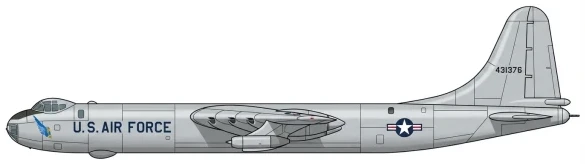
|
|
| Origin country | 🇺🇸 United States |
| Category | Bombers |
| Manufacturer | Convair |
| First flight | 8 August 1946 |
| Year introduced | 1949 |
| Number produced | 384 units |
| Average unit price | $10 million |
| American strategic bomber, significant for Cold War role, actively used in conflict zones from Vietnam to the Gulf War. | |
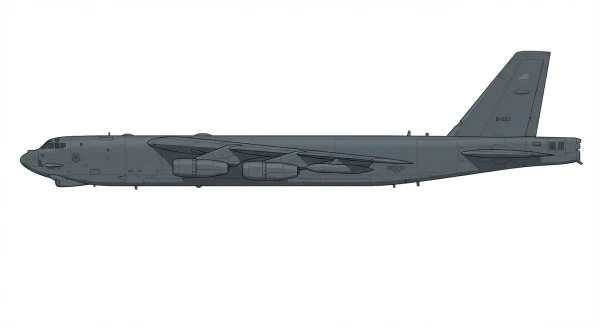
|
|
| Origin country | 🇺🇸 United States |
| Category | Bombers |
| Manufacturer | Boeing |
| First flight | 15 April 1952 |
| Year introduced | 1955 |
| Number produced | 744 units |
| Average unit price | $70 million |
| Wing area | 443.5 m² ◉ |
| Wingspan | 70.0 m ◉ |
| Height | 14.3 m ◉ |
| Length | 49.4 m ◉ |
| Maximum speed | 673 km/h ◉ |
| Operational range | 6,413 km ◉ |
| Service ceiling | 13,289 m ◉ |
| Max. takeoff weight | 185,973 kg ◉ |
| Empty weight | 75,530 kg ◉ |
| Total thrust | 4 x 590 kgf ◉ |
| Wing area | 370.0 m² ◉ |
| Wingspan | 56.4 m ◉ |
| Height | 12.4 m ◉ |
| Length | 48.5 m ◉ |
| Maximum speed | 1000 km/h ◉ |
| Operational range | 14,200 km ◉ |
| Service ceiling | 15,000 m ◉ |
| Max. takeoff weight | 220,000 kg ◉ |
| Empty weight | 83,250 kg ◉ |
| Total thrust | 8 x 968 kgf ◉ |
Performance Radar Chart
Detailed Comparison
Loading analysis...
Generating comparison analysis...
Unable to generate comparison at this time.
Frequently Asked Questions
Which is faster, the B-36 Peacemaker or B-52 Stratofortress?
The B-52 Stratofortress is faster with a maximum speed of 1,000 km/h compared to the B-36 Peacemaker's 673 km/h, a difference of 327 km/h.
Which has longer range, the B-36 Peacemaker or B-52 Stratofortress?
The B-52 Stratofortress has a longer range at 14,200 km compared to the B-36 Peacemaker's 6,413 km.
Which can fly higher, the B-36 Peacemaker or B-52 Stratofortress?
The B-52 Stratofortress has a higher service ceiling at 15,000 meters (49,212 ft) compared to the B-36 Peacemaker's 13,289 meters (43,599 ft).
Which is heavier, the B-36 Peacemaker or B-52 Stratofortress?
The B-52 Stratofortress has a higher maximum takeoff weight at 220,000 kg compared to the B-36 Peacemaker's 185,973 kg.
Which is larger, the B-36 Peacemaker or B-52 Stratofortress?
The B-36 Peacemaker is longer at 49.4 meters compared to the B-52 Stratofortress's 48.5 meters.
Which is more expensive, the B-36 Peacemaker or B-52 Stratofortress?
The B-52 Stratofortress is more expensive at approximately $70 million per unit compared to the B-36 Peacemaker at $10 million.
Which entered service first, the B-36 Peacemaker or B-52 Stratofortress?
The B-36 Peacemaker entered service first in 1949, 6 years before the B-52 Stratofortress which entered service in 1955.
Which has been built in greater numbers, the B-36 Peacemaker or B-52 Stratofortress?
The B-52 Stratofortress has been produced in greater numbers with 744 units compared to 384 units of the B-36 Peacemaker.