B-1B Lancer vs B-52 Stratofortress
B-1B Lancer vs B-52 Stratofortress at a glance — top speed 1,448 vs 1,000 km/h, range 9,400 vs 14,200 km, max takeoff weight 216,400 vs 220,000 kg, built 104 vs 744 units.
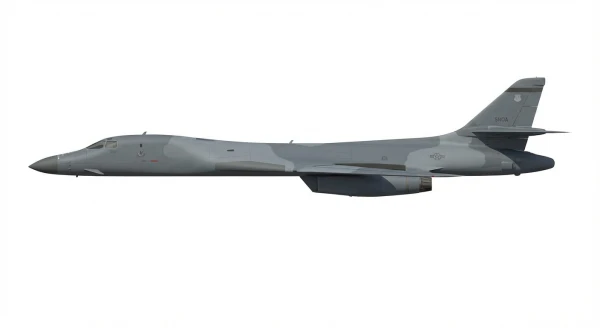
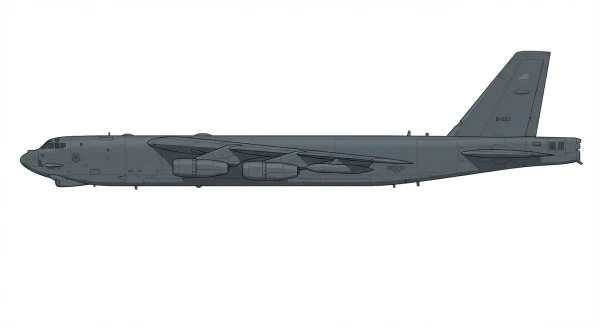
| B-1B Lancer | B-52 Stratofortress | |
|---|---|---|
| Origin country | 🇺🇸 United States | 🇺🇸 United States |
| Category | Bombers | Bombers |
| Manufacturer | Rockwell | Boeing |
| First flight | 23 March 1983 | 15 April 1952 |
| Year introduced | 1986 | 1955 |
| Number produced | 104 units | 744 units |
| Average unit price | $283 million | $9.3 million |
| Wing area | 181.2 m² | 370.0 m² |
| Wingspan | 41.8 m | 56.4 m |
| Height | 10.4 m | 12.4 m |
| Length | 44.5 m | 48.5 m |
| Maximum speed | 1448 km/h | 1000 km/h |
| Operational range | 9,400 km | 14,200 km |
| Service ceiling | 18,000 m | 15,000 m |
| Max. takeoff weight | 216,400 kg | 220,000 kg |
| Empty weight | 87,100 kg | 83,250 kg |
| Total thrust | 4 x 13,961 kgf | 8 x 7,747 kgf |
Detailed Comparison
The B-1B Lancer and B-52 Stratofortress are both long-range strategic bombers, but they originate from different eras and were designed to solve different operational problems. The B-52 is a subsonic, high-altitude bomber from the early Cold War, optimized for range and payload endurance. The B-1B is a supersonic, low-altitude penetrator developed in the latter stages of the Cold War to counter sophisticated Soviet air defenses, trading some of the B-52’s range for speed and a reduced radar signature.
Development and Design
The B-52's design philosophy, originating in the late 1940s, prioritized high-altitude flight and intercontinental range to fulfill its primary mission as a nuclear deterrent. Its simple, robust airframe, featuring eight jet engines on a large 35-degree swept wing, proved remarkably adaptable, allowing for continuous upgrades over a service life spanning more than 70 years.
In contrast, the B-1B program was a response to the increasing lethality of surface-to-air missiles. Its design incorporates variable-sweep wings, which are swept forward for efficient takeoff and long-range cruise and swept back to 67.5 degrees for high-speed, low-altitude penetration. Features like serpentine air intakes and the use of radar-absorbent materials were integrated to reduce its radar cross-section, a key element of its intended mission profile to fly under enemy radar coverage.
Specifications and Performances
While both are heavy bombers, their performance characteristics reflect their distinct roles. The B-1B’s key advantage is speed; its four afterburning General Electric F101 engines enable it to reach Mach 1.25, allowing for rapid response and a greater chance of survival in contested airspace. The B-52H, with its eight Pratt & Whitney TF33 turbofans, is purely subsonic, with a top speed around 1,000 km/h (Mach 0.82).
The B-52 possesses superior range, capable of flying 13,900 km unrefueled compared to the B-1B's 12,000 km. In terms of payload, the B-1B boasts the largest internal capacity, able to carry 75,000 pounds (34,000 kg) of ordnance in its three bomb bays. The B-52 carries a slightly smaller total payload of around 70,000 pounds but is the premier standoff weapons platform, carrying large cruise missiles on external pylons.
Deployment and usage
The B-52’s operational history began with nuclear deterrence, but it quickly adapted to conventional roles, most notably conducting wide-area "carpet bombing" during the Vietnam War. In modern conflicts, it has evolved into an effective standoff "arsenal ship," launching cruise missiles and precision-guided bombs from outside the range of enemy defenses, as seen in the Gulf War and operations in Afghanistan.
The B-1B was converted to a conventional-only role after the Cold War. It first saw combat in 1998 during Operation Desert Fox. Its unique combination of speed, loiter time, and massive payload made it exceptionally effective for time-sensitive strikes and close air support in Afghanistan and Iraq, where it could deliver a large volume of precision munitions rapidly.
Conclusion
The B-52 Stratofortress remains a cornerstone of U.S. strategic power due to its cost-effectiveness, reliability, and unparalleled adaptability as a standoff weapons carrier; it is projected to serve into the 2050s. The B-1B Lancer is a more specialized, high-performance asset designed for penetrating enemy airspace, a role that has become increasingly challenging. Its higher operational costs and the advent of advanced stealth aircraft like the B-21 Raider have led to its planned retirement by 2036. Together, they represent two different, yet historically complementary, approaches to strategic air power.