206 JetRanger vs Bell 430
206 JetRanger vs Bell 430 at a glance — top speed 226 vs 278 km/h, range 624 vs 600 km, max takeoff weight 2,495 vs 4,218 kg, built 7,300 vs 136 units.
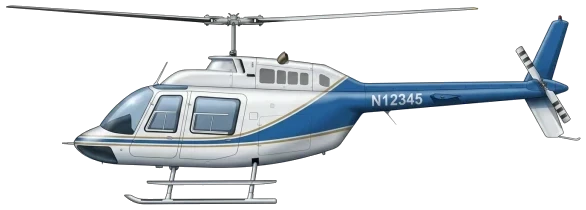
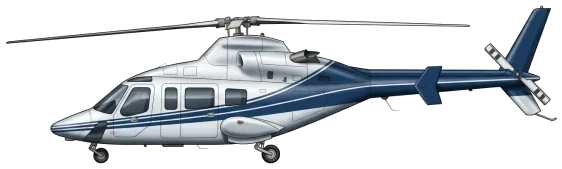
| 206 JetRanger | Bell 430 | |
|---|---|---|
| Origin country | 🇺🇸 United States | 🇺🇸 United States |
| Category | Military Helicopters | Military Helicopters |
| Manufacturer | Bell | Bell |
| First flight | 10 January 1966 | 25 October 1994 |
| Year introduced | 1967 | 1995 |
| Number produced | 7300 units | 136 units |
| Average unit price | $1.3 million | $10 million |
| Wingspan | 10.2 m | 12.8 m |
| Height | 3.9 m | 3.8 m |
| Length | 12.9 m | 15.3 m |
| Maximum speed | 226 km/h | 278 km/h |
| Operational range | 624 km | 600 km |
| Service ceiling | 4,572 m | 6,096 m |
| Max. takeoff weight | 2,495 kg | 4,218 kg |
| Empty weight | 1,737 kg | 2,406 kg |
| Total thrust | 1 x 485 kW | 2 x 585 kW |
Detailed Comparison
The Bell 206 JetRanger and Bell 430 are both products of the same manufacturer but originate from different operational requirements and technological eras. The 206 is a light, single-engine helicopter derived from a 1960s military observation requirement, resulting in a simple, prolific, and highly adaptable platform. The 430 is a more complex, twin-engine medium helicopter developed in the 1990s as a derivative of the Bell 222/230 family, prioritizing performance, cabin volume, and multi-engine safety over the 206's low-cost versatility.
Development and Design
The Bell 206's design was a direct consequence of its failure to win the U.S. Army's Light Observation Helicopter (LOH) contract, prompting Bell to create a commercially successful civilian variant. Its core design features are a two-bladed main rotor and a simple, robust airframe powered by a single Allison 250 series turboshaft. This simplicity contributed to its massive production run of over 7,300 units. In contrast, the Bell 430 was a deliberate evolution, designed to enhance the capabilities of the preceding Bell 230. Its key innovations were a four-blade, bearingless composite main rotor for improved performance and reduced vibration, a stretched fuselage for greater capacity, and a twin-engine configuration. This technological advancement came at a significantly higher price and resulted in a limited production run of 136 aircraft.
Specifications and Performances
The performance differences are dictated by their core designs. The Bell 430’s twin Allison 250-C40B engines provide a significant power and safety advantage over the 206’s single engine. This allows the 430 to carry a much heavier load, with a Max Takeoff Weight of 4218 kg compared to the 206's 2495 kg. The 430 also possesses a higher maximum speed (278 km/h vs. 240 km/h) and service ceiling (6096 m vs. 4572 m). The twin-engine layout provides critical OEI (One Engine Inoperative) flight capability, a standard requirement for many modern military and civilian operations, which the JetRanger lacks.
Deployment and usage
The Bell 206 has seen extensive and varied military service. It became the basis for the ubiquitous OH-58 Kiowa light observation and scout helicopter and has served as the primary helicopter trainer for the U.S. Navy (TH-57 Sea Ranger) for decades. Its adaptability is demonstrated by its use by the Swedish military as both an anti-tank platform armed with ATGMs and an anti-submarine helicopter carrying depth charges. The provided data indicates its compatibility with weapons like the AGM-114 Hellfire. The Bell 430's military service has been more limited, primarily serving in utility, transport, and VIP roles with smaller air arms like those of Bulgaria and the Dominican Republic. Its design is better suited for transport and EMS tasks than direct combat or armed reconnaissance.
Conclusion
The Bell 206 JetRanger stands as a landmark helicopter design, whose low cost, reliability, and adaptability led to its global proliferation in both military and civilian roles. It established a baseline for light utility and training helicopters that persisted for over half a century. The Bell 430 represents a technologically superior machine, offering the speed, power, and safety of a modern twin-engine design with an advanced rotor system. However, its higher acquisition cost ($10 million vs. $1.3 million for the 206) and operational complexity limited its market penetration, preventing it from achieving the widespread impact of its single-engine predecessor. The two aircraft illustrate a classic trade-off between mass-produced utility and high-performance specialization.


