206 JetRanger vs SA316 Alouette III
206 JetRanger vs SA316 Alouette III at a glance — top speed 226 vs 210 km/h, range 624 vs 540 km, max takeoff weight 2,495 vs 2,200 kg, built 7,300 vs 2,000 units.
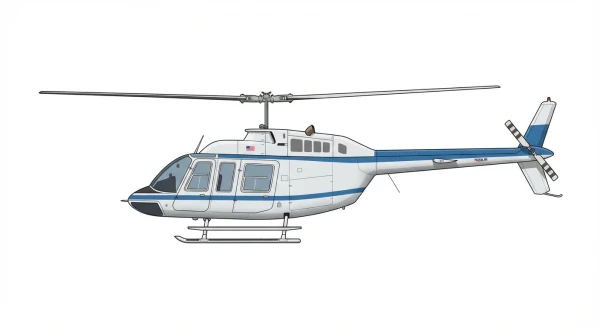
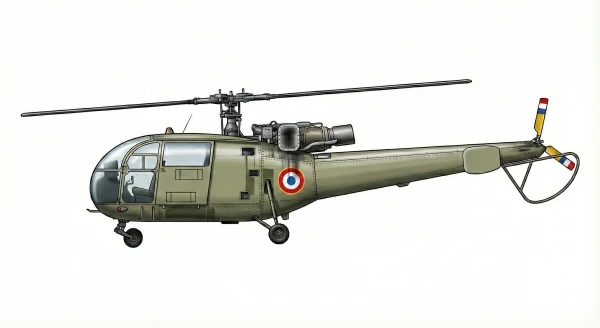
| 206 JetRanger | SA316 Alouette III | |
|---|---|---|
| Origin country | 🇺🇸 United States | 🇫🇷 France |
| Category | Military Helicopters | Military Helicopters |
| Manufacturer | Bell | Sud Aviation |
| First flight | 10 January 1966 | 28 February 1959 |
| Year introduced | 1967 | 1961 |
| Number produced | 7300 units | 2000 units |
| Average unit price | $1.3 million | $1.5 million |
| Wingspan | 10.2 m | 11.0 m |
| Height | 3.9 m | 3.0 m |
| Length | 12.9 m | 10.0 m |
| Maximum speed | 226 km/h | 210 km/h |
| Operational range | 624 km | 540 km |
| Service ceiling | 4,572 m | 3,200 m |
| Max. takeoff weight | 2,495 kg | 2,200 kg |
| Empty weight | 1,737 kg | 1,143 kg |
| Total thrust | 1 x 485 kW | 1 x 713 kW |
Detailed Comparison
The Bell 206 JetRanger and the Sud Aviation SA316 Alouette III dominated the light utility helicopter market of the Cold War era, emerging from the United States and France respectively to define modern rotorcraft operations. While the Bell 206 evolved from a failed US Army observation bid into a versatile commercial and military platform, the Alouette III was purpose-built to leverage early turboshaft technology for utility and high-altitude performance. Both achieved massive production numbers—7,300 for the Bell and 2,000 for the Sud Aviation airframe—becoming staples in light transport, training, and observation roles globally.
Development and Design
Bell's trajectory began with the D-250 prototype for the US Army's Light Observation Helicopter program. After losing the initial bid, Bell redesigned the airframe for the civilian market, resulting in the Model 206A. This design featured a distinctive two-bladed main rotor and a streamlined fuselage, later readopted by the Army as the OH-58. Conversely, Sud Aviation developed the SA316 as an enlarged, more aerodynamic derivative of the Alouette II. Designed by René Mouille, it utilized the powerful Turbomeca Artouste turboshaft to carry heavier loads. The Alouette III offered a spacious cabin for seven occupants or two stretchers, emphasizing utility and internal capacity over the JetRanger's initially more compact observation focus.
Specifications and Performances
The Bell 206 demonstrates superior kinematic performance in cruise, achieving a maximum speed of 240 km/h compared to the Alouette III's 210 km/h. The JetRanger also offers a substantial operational range of 624 km, facilitating extended liaison duties. However, the Alouette III configuration prioritizes raw power application. Equipped with a 713 kW powerplant against a Maximum Takeoff Weight (MTOW) of 2,200 kg, it possesses a significant power reserve. The Bell 206, listed here with a 2,495 kg MTOW and 485 kW output, relies on a more streamlined airframe to achieve its higher top speeds and service ceiling of 4,572 m. The Alouette's lighter empty weight (1,143 kg vs 1,737 kg for the Bell) allows for a higher payload fraction relative to its size.
Deployment and usage
Operational history highlights a divergence in tactical doctrine. The Bell 206 became the standard for Western pilot training (US Navy TH-57) and observation (OH-58 Kiowa). While Swedish variants equipped with ATGMs and depth charges proved the airframe could handle combat loads, it primarily served as a scout. The Alouette III, however, saw aggressive use as a dedicated gunship and assault transport. During the Rhodesian Bush War and Portuguese Overseas Wars, Alouettes were central to vertical envelopment tactics, often modified with side-mounted 20 mm cannons or machine guns (K-Car/G-Car variants). While the Bell 206 dominated North American commercial sectors and police aviation, the Alouette III became the tactical workhorse for military operations in Africa and India.
Conclusion
Ultimately, the Bell 206 JetRanger and SA316 Alouette III optimized different aspects of the light helicopter role. The Bell design succeeded through aerodynamic efficiency and adaptability, creating a legacy as the definitive observation and training platform. The Alouette III leveraged structural ruggedness and engine power, allowing it to perform as a surprisingly effective assault transport and gunship in harsh environments. While the JetRanger captured the commercial and training market, the Alouette III earned its reputation in austere combat zones.